



Korg
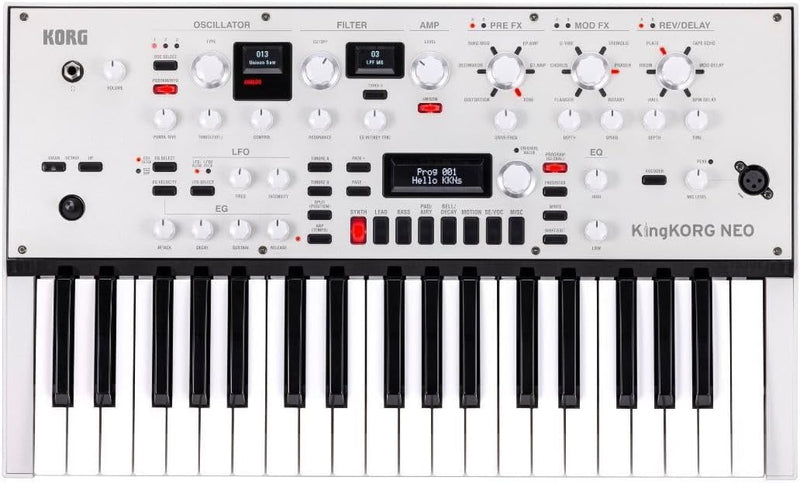
Korg KINGKORGNEO 37-Key Virtual Analog Synthesizer
Korg KingKORG NEO delivers 138-oscillator virtual analog depth with modeled classic filters — built for studio sound design and live performance.
$630.00*
View on Amazon
✓ In Stock on Amazon.com
*Price sourced from Amazon.com. Last updated:Aug 29, 2026.Price and availability are subject to change — details.
Affiliate Disclosure: As an Amazon Associate, Studio Supplies earns from qualifying purchases made through links on this page, at no additional cost to you. This helps support our editorial team.
Notice a mistake? Let Us Know
Overview
Key Features
Features 37 full-size keys designed for expressive performance with velocity-sensitive keys
Includes the XMT Sound Engine, Korg's proprietary eXpanded Modeling Technology that faithfully reproduces the oscillators and filters of classic analog synths
Three oscillators offer 138 types for a wide range of sounds
18 filters provide diverse tonal shaping options to fit any artists desired sound
Twenty-four voice polyphony ensures rich and complex sound layers
Programs and user slots include 300 programs (200 presets + 100 user slots) with 143 new sounds organized into eight categories
Program effects include PRE FX, MOD FX, REV/DELAY, and a two-band EQ
Split/layer functionality allows for up to two timbres for versatile sound creation
Arpeggiation up to eight steps with six types for dynamic patterns
Vocoder with 16 bands and formant shift/hold function for unique vocal effects
Specifications
Keyboard
37 keys, velocity and release-velocity sensitive
Sound Engine
XMT (eXpanded Modeling Technology)
Maximum Polyphony
24 voices
Timbres
2 (Layer / Split)
Oscillators
3 oscillators, 138 types
Filters
1 filter, 18 types
Modulation
2x EG, 2x LFO, 6 Virtual Patches
Effects
PRE FX, MOD FX, REV/DELAY + 2-band EQ
Vocoder
16-band, formant shift/hold
Arpeggiator
Up to 8 steps, 6 types
Programs
300 (200 preset / 100 user), 8 categories
Display
16x2 character OLED (Main); 128x64 pixel OLED (Oscillator/Filter)
Dimensions
565 x 338 x 92 mm (22.24" x 13.31" x 3.62")
Weight
3.1 kg / 6.83 lbs
Frequently Asked Questions
What sound engine powers the KingKORG NEO, and how does it differ from a true analog synth?
The XMT (eXpanded Modeling Technology) engine uses digital modeling to reproduce the oscillator and filter behavior of classic analog circuits. You get the warmth and nonlinear character of analog-style sound — including filter saturation and oscillator drift behavior — without the tuning instability. For studio work, this means more repeatable results session to session while retaining the sonic character you're after.
How does the 24-voice polyphony hold up in dense layer and split configurations?
With up to two timbres active simultaneously in layer or split mode, the 24-voice ceiling distributes across both parts. For lush pad stacks or organ-style sounds with long release tails, you'll want to monitor polyphony use — complex layered patches with heavy reverb and delay tails can eat voices faster than you'd expect. For most live or studio performance contexts, 24 voices is sufficient.
Can the KingKORG NEO integrate with a DAW for MIDI control and automation?
Yes — the KingKORG NEO transmits and receives MIDI, making it straightforward to integrate with any DAW as a MIDI controller or tone generator. Parameter automation via MIDI CC is supported, allowing you to record filter sweeps, LFO rate changes, and other real-time edits directly into your DAW's automation lanes.
What does the 16-band vocoder require to operate effectively?
The vocoder requires a modulator signal — typically a microphone — fed into the designated input. The 16-band configuration provides strong formant articulation and intelligibility. The formant shift and hold functions extend its usefulness beyond traditional robot voice effects into more nuanced timbral transformation for studio production.
How does the arpeggiator interact with the split/layer functionality?
The arpeggiator operates within the KingKORG NEO's architecture and can be applied to your active program, including layered configurations. With up to 8 steps and 6 pattern types, it's capable of generating rhythmic, evolving sequences that complement split performance setups — useful for live performance where one hand plays a lead while the lower split generates a patterned bassline.
Related Products


