

Korg
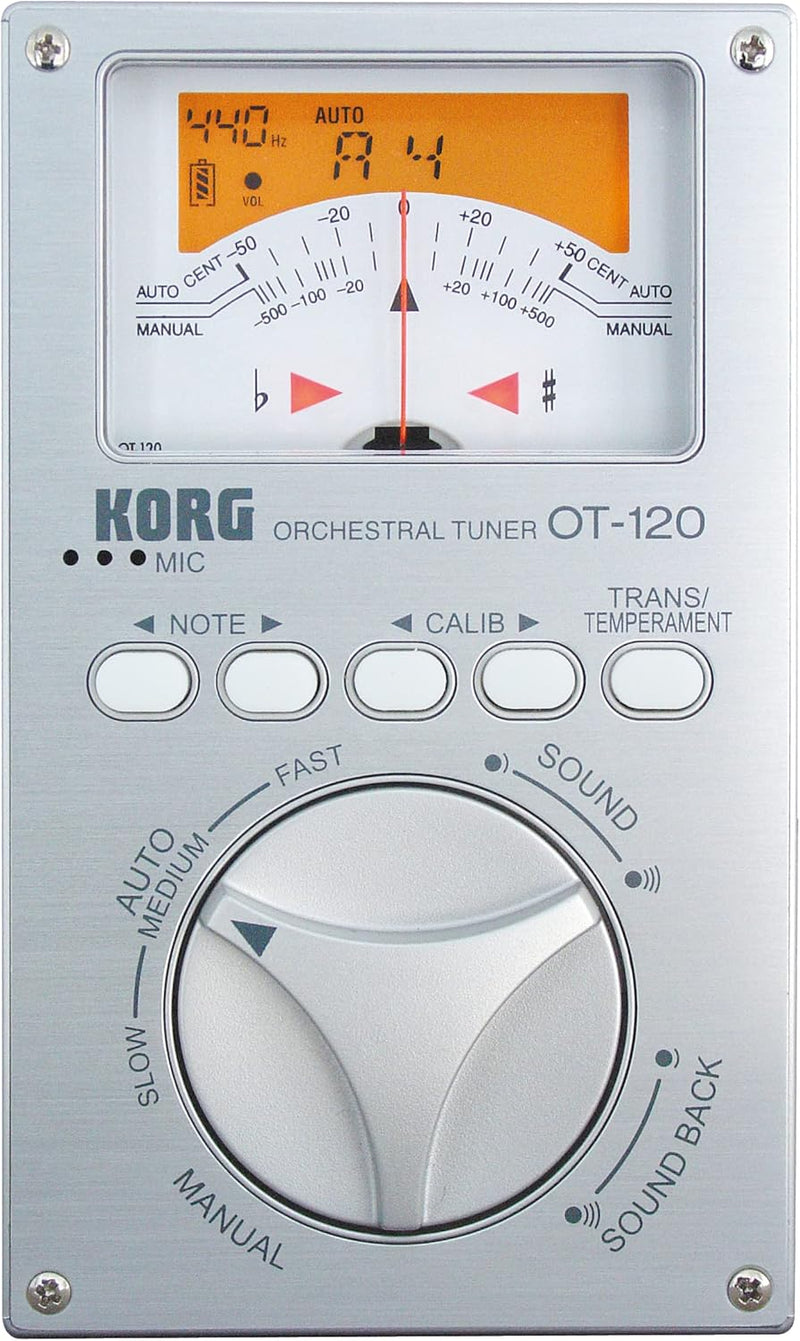
Korg OT120 Orchestral Tuner Meter-Type Chromatic
The Korg OT-120 delivers precision chromatic tuning with an 8-octave range, dual display, and historical temperament support for serious orchestral musicians.
$79.98*
View on Amazon
✓ In Stock on Amazon.com
*Price sourced from Amazon.com. Last updated:Oct 25, 2026.Price and availability are subject to change — details.
Affiliate Disclosure: As an Amazon Associate, Studio Supplies earns from qualifying purchases made through links on this page, at no additional cost to you. This helps support our editorial team.
Notice a mistake? Let Us Know
Overview
Key Features
Chromatic tuner with a wide 8 octave detection range that supports band and orchestra instruments.
Dual display provides both a needle-type meter and an LCD for excellent visibility.
Sound Back mode plays a reference pitch for the note that's closest to the input pitch. The meter indicates the discrepancy between the input and the correct pitch. (This feature requires the additional purchase of the CM-100L microphone.)
Multiple Temperaments support historical tunings
Transpose mode is convenient for wind instruments. The factory package dimensions for the KOR OT120 is 3.75” (W) x 5.75” (D) x 2.5” (H)
Specifications
Type
Chromatic Tuner
Detection Range
8 Octaves
Display
Needle-type meter and LCD
Temperaments
Multiple historical tunings supported
Sound Back
Reference pitch playback (requires CM-100L microphone)
Transpose
Transpose mode for wind instruments
Dimensions
3.75" (W) x 5.75" (D) x 2.5" (H)
Frequently Asked Questions
How many octaves can the Korg OT-120 detect?
The OT-120 has a wide 8-octave detection range, covering the full pitch range of band and orchestra instruments from the lowest brass to the highest woodwinds and strings.
What is Sound Back mode on the OT-120?
Sound Back mode plays an audible reference pitch for the note closest to your input, while the meter shows how far off you are from correct pitch. This feature requires a separately purchased CM-100L contact microphone.
Does the OT-120 support alternative tuning temperaments?
Yes, it includes multiple historical temperaments beyond standard equal temperament, which is useful for period-accurate performance and early music ensembles.
Can the OT-120 handle transposing instruments like clarinets and trumpets?
Yes, the built-in Transpose mode lets you set the tuner to match your instrument's transposition, so you can read concert pitch directly.
What type of display does the OT-120 use?
It features a dual display system combining a traditional needle-type meter with an LCD screen, giving you both analog visual feedback and precise digital readouts simultaneously.
Related Products


