



Acer
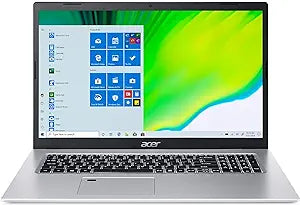
Acer A517-52-59SV Aspire 5 17.3" FHD Laptop
★★★★★
FHD1920 x 1080i5-1135G78GB DDR4512GB NVMe
Intel's 11th Gen Tiger Lake silicon and Wi-Fi 6 in a 17.3" chassis — the Aspire 5 A517 delivers workstation-class connectivity at a mainstream price point.
$1,098.00*
View on Amazon
✓ In Stock on Amazon.com
*Price sourced from Amazon.com. Last updated:Jul 14, 2026.Price and availability are subject to change.
Affiliate Disclosure: Studio Supplies may earn a commission from qualifying purchases made through links on this page, at no additional cost to you. This helps support our editorial team.
Notice a mistake? Let Us Know
Overview
Key Features
Great performance meets long battery life with the Intel Core i5-1135G7 Processor - up to 4.20 GHz, 4 cores, 8 threads, 8 MB Intel Smart Cache
17.3" Full HD (1920 x 1080) IPS Widescreen LED-backlit Display | Intel Iris Xe Graphics
8GB DDR4 Memory (Expandable to 20GB) and 512GB NVMe SSD
1 - USB 3.2 (Type-C) Gen 1 port (up to 5 Gbps) | 2 - USB 3.2 Gen 1 Port (one with Power-off Charging) | 1 - USB 2.0 Port | 1 - HDMI Port with HDCP support
Intel Wireless Wi-Fi 6 | Acer Fingerprint Reader | Backlit Keyboard | Up to 8 Hours Battery Life
Specifications
Processor
Intel Core i5-1135G7, 2.4 GHz base / 4.2 GHz boost, 4 cores / 8 threads, 8MB Smart Cache
Display
17.3" IPS, 1920×1080 Full HD, LED-backlit, widescreen
Graphics
Intel Iris Xe Graphics (integrated)
Memory
8GB DDR4, expandable to 20GB
Storage
512GB NVMe SSD
Operating System
Windows 10 Home
Wireless
Intel Wi-Fi 6 AX201, 802.11ax dual-band
Bluetooth
5.1
Ethernet
10/100/1000 Gigabit (RJ-45)
Ports
1x USB-C 3.2 Gen 1 (5 Gbps), 2x USB-A 3.2 Gen 1 (one with power-off charging), 1x USB 2.0, 1x HDMI
Webcam
HD (1280×720)
Keyboard
Backlit
Security
Acer Fingerprint Reader (Windows Hello)
Battery
Lithium-Ion, up to 8 hours
Weight
4.72 lbs
Model
A517-52-59SV
Pros & Cons
👍 Pros
- 11th Gen Tiger Lake i5-1135G7 delivers strong single-thread performance with a 4.2 GHz boost clock, keeping pace with mid-range productivity workloads without thermal throttling under typical loads.
- 512GB NVMe SSD uses the PCIe bus rather than SATA, providing read speeds 4–5x faster than a traditional SSD — application launches and large file operations are noticeably quicker.
- 17.3" 1920×1080 IPS panel offers wider viewing angles and better color accuracy than TN alternatives, making it usable for color-sensitive tasks like photo review.
- Wi-Fi 6 (802.11ax) with Bluetooth 5.1 represents current-generation wireless — future-proofed for 802.11ax routers and low-latency peripherals.
- RAM is expandable to 20GB via an open SO-DIMM slot, giving a clear, low-cost upgrade path as workloads grow.
👎 Cons
- The 8GB base RAM configuration runs in single-channel with one soldered slot, which measurably reduces Iris Xe graphics bandwidth until a second stick is added.
- Intel Iris Xe is integrated graphics — there is no discrete GPU, so 3D rendering, complex video effects, and modern gaming above low settings exceed its capabilities.
- Up to 8 hours of rated battery life is a ceiling under light use; sustained workloads or screen brightness above 50% will reduce this to 4–6 hours in practice.
- The included USB-C port is USB 3.2 Gen 1 (5 Gbps) with no Thunderbolt 4 — high-bandwidth docks, external GPU enclosures, and 40 Gbps transfers are not supported.
- At 4.72 lbs, the 17.3" chassis is not lightweight; it's a desk-to-desk portable rather than a backpack daily driver.
Frequently Asked Questions
What does the Intel Core i5-1135G7 actually mean for day-to-day performance?
The i5-1135G7 is a 4-core/8-thread Tiger Lake chip with a 4.2 GHz boost clock and 8MB of Smart Cache. In practice, that translates to snappy multitasking across a dozen browser tabs, Office workflows, and light photo editing — workloads that push core-count less than they push single-thread speed, where this chip excels versus prior-gen equivalents.
Can I upgrade the RAM, and is it worth doing?
Yes. The 8GB DDR4 base configuration is expandable to 20GB. The asymmetric ceiling (not a standard 16GB or 32GB) is due to one soldered slot plus one open SO-DIMM slot. Adding an 8GB or 16GB stick is a meaningful upgrade if you run virtual machines, heavy browser sessions, or multiple large files simultaneously.
Does the Intel Iris Xe graphics handle video editing or light gaming?
Iris Xe is Intel's integrated GPU on Tiger Lake and it outperforms prior Intel iGPUs significantly — capable of 1080p video playback, hardware-accelerated export in DaVinci Resolve, and light gaming at reduced settings. It shares system RAM rather than having dedicated VRAM, so the upgrade to 20GB RAM also benefits graphics headroom.
Is the 512GB NVMe SSD fast enough for content work?
The NVMe interface means sequential reads in the 2,000–3,000 MB/s range typical of PCIe Gen 3 drives — a dramatic step up from SATA SSDs. For most users this eliminates storage as a bottleneck for application launches, file transfers, and project loads. No second drive bay is listed, so external storage or cloud is the expansion path.
What does Wi-Fi 6 (802.11ax) change versus Wi-Fi 5?
Wi-Fi 6 supports up to 2.4 Gbps theoretical throughput and uses OFDMA to reduce congestion on crowded networks. On a Wi-Fi 6 router you'll see tangibly lower latency and more consistent speeds in dense environments like offices or apartments with many connected devices. The benefit is most pronounced when multiple devices share the same access point.
Related Products

