



AMD
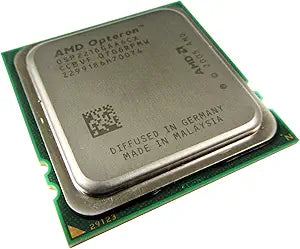
AMD Opteron 2216 2.4GHz Dual Core Socket F CPU
The Opteron 2216 delivers 2.4GHz dual-core throughput on Socket F for legacy multi-socket server deployments that demand long-term platform stability.
Check availability
Affiliate Disclosure: As an Amazon Associate, Studio Supplies earns from qualifying purchases made through links on this page, at no additional cost to you. This helps support our editorial team.
Notice a mistake? Let Us Know
Overview
Specifications
Processor Model
Opteron 2216
Clock Speed
2.4GHz
Cores
Dual Core
Socket Type
Socket F
Frequently Asked Questions
What socket does the Opteron 2216 use, and which server platforms support it?
The 2216 uses Socket F (1207-pin LGA), AMD's server socket introduced with the Barcelona/Santa Rosa generation. Compatible platforms include dual-socket server boards designed for AMD Opteron 2000-series processors — primarily from SuperMicro, HP ProLiant DL series, and Dell PowerEdge 1955/2950 configurations of that era.
How does the 1000MHz HyperTransport bus speed affect multi-socket scalability?
The 1000MHz HyperTransport bus governs inter-processor communication in dual-socket configurations. At 1000MHz with a 16-bit wide link, you get up to 8GB/s of bidirectional bandwidth between sockets. For memory-bound workloads or tightly coupled parallel tasks, this bus represents the primary scalability ceiling in a two-processor configuration.
What is the L2 cache configuration on the 2216?
The Opteron 2216 provides 2MB of L2 cache total, split as 1MB per core. There is no shared L3 cache on this generation — each core's L1 and L2 caches are private, which means inter-core data sharing requires cache-line round-trips through the memory subsystem rather than a shared last-level cache.
Is this CPU still viable for active server workloads?
For new deployments — no. The 2216 is a legacy processor with no ECC DDR3 support (it uses DDR2 registered ECC), no virtualization extensions comparable to modern VT-x/AMD-V implementations, and its IPC is generations behind current Epyc or Xeon platforms. It remains relevant for maintaining or extending the life of existing infrastructure built on Socket F platforms.
Does the 2216 support hardware virtualization?
Yes — it includes AMD-V (AMD Virtualization) support, which enables hardware-assisted VM execution. However, the dual-core configuration and lack of IOMMU at this generation limit practical VM density relative to modern server CPUs.
Related Products


