
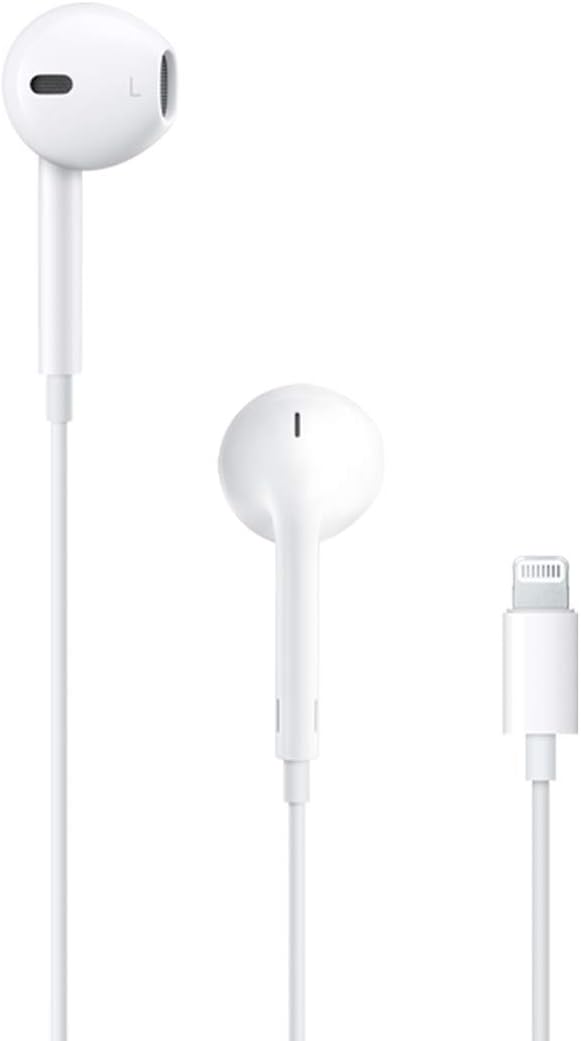


Apple EarPods with Lightning Connector (MMTN2AM/A) — Editorial Review & Use Cases
The Apple EarPods (MMTN2AM/A) are Apple's wired in-ear headphones with the Lightning Connector — the in-box headphone for iPhone models 7 through 14 that came without a headphone jack. Per Apple's official EarPods (Lightning) product page, the EarPods deliver Apple's tuned audio response (slight bass boost, treble emphasis for spoken word clarity), include inline volume + call control + Siri activation, microphone, and the standard universal Apple-shape fit profile. As of 2026, with iPhone 15+ on USB-C, the Lightning EarPods are end-of-life on Apple's roadmap but remain a recommended in-box replacement for iPhone 7-14 users + iPad 4-9 / iPad mini 1-5 / iPad Air 2-3 (Lightning-port iPads).
What the EarPods (Lightning) Specifically Win
- Wired — no battery, no Bluetooth pairing — drops in immediately. No setup, no codec negotiation, no "headphone disconnected" popups during calls
- Inline controls + Siri integration — volume up/down + play/pause/skip + call answer/end + Siri activation from a single button. Doesn't drain phone battery (vs Bluetooth)
- Spatial audio compatible with iPhone — iPhone's spatial audio rendering works with Lightning EarPods (vs Bluetooth which has codec compatibility issues with spatial)
- No latency — wired direct connection — critical for gaming, audio production monitoring, video editing
- Universal Apple-shape fit — the open-air design works for users with various ear shapes without specific tip sizes
- Apple-tuned audio — frequency response designed for music, podcasts, and call clarity (vs Bluetooth's variable Apple/Sony/Bose tuning)
- Lightweight + minimal pocket bulk — coiled around finger fits in pocket / case
- Replacement / spare backup — if AirPods are lost / dead / in case at home, the Lightning EarPods are a working backup
Where the EarPods (Lightning) Specifically Fit
- iPhone 7-14 users needing in-box replacement headphones (originally shipped with each iPhone in this range)
- iPad 4-9 / mini 1-5 / Air 2-3 users for wired audio output
- Backup / spare headphones for AirPods users (case at home, AirPods lost / dead)
- Travel / TSA / Airport — wired, doesn't run out of battery, doesn't go through TSA screening
- Office workplace for calls where wired reliability matters more than wireless freedom
- Gaming on iPhone / iPad — zero latency vs Bluetooth's 30-50ms
- Music / podcast / audio mixing on iOS for monitoring without Bluetooth latency
- Budget-conscious users — Lightning EarPods at $19 retail vs AirPods at $129+
- Phone calls in environments where Bluetooth pairing fails (hospitals, secure facilities, dead Bluetooth on phone)
- Workplace shift work / shared phone for users who don't want to dedicate wireless headphones
Honest Limits Buyers Should Know
- Lightning-only — iPhone 15+ NOT compatible. iPhone 15 and later use USB-C; Lightning EarPods don't physically connect. iPhone 15+ users need USB-C EarPods (MTJY3AM/A) or third-party USB-C wired headphones
- Lightning is end-of-life on Apple's roadmap. Current iPads + iPhones moving to USB-C; Lightning EarPods will become a legacy SKU in the next 2-3 years. Long-term users should plan for USB-C migration
- Wired tether limits mobility. Cable management when walking / exercising / running is awkward; cable can get caught on door handles / chair arms / clothing
- Audio quality is mid-tier. Frequency response is consumer-grade Apple tuning, not audiophile pro. Sennheiser IE 200 / Etymotic ER-2 wired in-ears are noticeably better at similar price point for critical listening
- Microphone quality is OK for calls, not pro-grade. Adequate for daily phone calls; not for podcast recording or video conference where mic quality matters professionally
- No active noise cancellation, no spatial audio Dolby Atmos beyond stereo. Modern audio expectations (ANC, spatial, 3D audio) require AirPods Pro or third-party premium wired headphones
- Open-air design — sound leaks out, ambient noise leaks in. In quiet environments others hear what you're playing. In noisy environments, ambient noise reaches the ears
- Doesn't pass through device's Lightning port — when EarPods are plugged in, the Lightning port is occupied. Charging the iPhone simultaneously requires a USB-C Digital AV Multiport-style adapter
- Single-cable design — no detachable cable. If the cable breaks (notorious wear point at the L-bend near the Lightning plug), the entire EarPods must be replaced (vs detachable-cable headphones)
Where Buyers Should Look Elsewhere
- iPhone 15+ (USB-C) → Apple EarPods USB-C (MTJY3AM/A)
- Premium wired in-ears → Sennheiser IE 200, Etymotic ER-2, Shure SE215 (with custom or detachable cables)
- Wireless freedom → AirPods (basic 2nd Gen), AirPods Pro (with ANC + spatial)
- ANC noise cancellation → AirPods Pro, Sony WF-1000XM5, Bose QuietComfort Earbuds II
- Studio / podcast monitoring quality → Sennheiser HD 280 Pro (wired), Audio-Technica ATH-M40x (wired)
- iPad-only workflow with detachable cable → Bose QC25 (wired) + 3.5mm adapter, third-party 3.5mm → Lightning adapter
- Multi-device flexibility → AirPods Pro (auto-switches between iPhone / iPad / Mac), or Bluetooth-multi-device headphones (Bose 700, Sony 1000XM5)
Sources & Citations
- Apple, "Apple EarPods (Lightning Connector) product page," apple.com (accessed 2026-05-18)
- Apple Support, "Use Apple EarPods with iPhone, iPad, or iPod touch," support.apple.com (accessed 2026-05-18)
- The Verge, "Wired vs wireless iPhone headphone coverage," theverge.com (accessed 2026-05-18)
Last verified: 2026-05-18


