ASRock

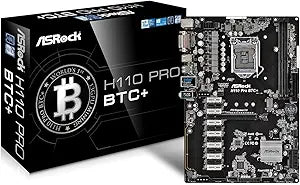
ASRock Asrock H110 Pro BTC+ 13GPU Mining Motherboard

4.3 (758 reviews)

Fit 13 GPUs on a single board and run a full-scale mining rig without the sprawl of multiple machines.

$139.99*$149.99Save 6%
In Stock on Amazon.com
View on Amazon

*Price sourced from Amazon.com. Last updated:Jun 04, 2026.Price and availability are subject to change.

Affiliate Disclosure: Studio Supplies may earn a commission from qualifying purchases made through links on this page, at no additional cost to you. This helps support our editorial team.

Notice a mistake? Let Us Know

Overview

The ASRock H110 Pro BTC+ is purpose-engineered for one job: hosting as many GPUs as physically possible on a single Intel platform. The board pairs an Intel H110 chipset with one PCIe 3.0 x16 slot and twelve PCIe 2.0 x1 slots — giving you 13 total GPU positions in an ATX form factor. The x1 slots operate at PCIe 2.0 bandwidth (approximately 500 MB/s per slot), which is more than sufficient for the GPU-to-CPU communication that cryptocurrency mining requires, since hashing workloads are compute-bound on the GPU die, not bus-bound. DDR4 support at 2133/2400 MHz across two DIMM slots handles system memory needs, and the 128MB-equivalent BIOS space accommodates the platform's mining-focused firmware. Four SATA3 ports and one M.2 SATA3 slot round out storage connectivity.

This board is built for dedicated Ethereum, Ravencoin, Ergo, or comparable proof-of-work mining rigs where the economics reward maximizing GPU density per motherboard. Pairing it with a budget LGA1151 CPU — a Celeron G3930 draws under 51W — keeps idle system overhead low while the GPUs do the real work. The ASRock Super Alloy designation indicates higher-grade capacitors and chokes rated for continuous load, which matters enormously when a rig runs at 80–90% TDP around the clock. Builders should plan for quality PCIe riser cables and a robust multi-PSU or high-wattage single-PSU setup, as GPU count scales the electrical demands far beyond what the motherboard itself consumes.

Key Features

ASRock Super Alloy

Supports 7th and 6th Generation Intel CoreTM i7/i5/i3/Pentium/Celeron Processors

Supports DDR4 2400/2133

1 PCIe 3.0 x16, 12 PCIe 2.0 x1

4 SATA3, 1 M.2 (SATA3)

Specifications

Processor Support
7th and 6th Generation Intel Core i7/i5/i3/Pentium/Celeron Processors
Memory Support
DDR4 2400/2133
PCIe Slots
1 PCIe 3.0 x16, 12 PCIe 2.0 x1
SATA Ports
4 SATA3
M.2 Slots
1 (SATA3)
Construction
ASRock Super Alloy

Pros & Cons

👍 Pros

  • Supports 13 discrete GPUs on a single board, eliminating the cost and complexity of running multiple systems.
  • ASRock Super Alloy components (high-quality capacitors and chokes) are rated for the continuous 24/7 load that mining demands.
  • Dual ATX power connector support distributes current draw across two PSUs for high-GPU-count configurations.
  • Onboard M.2 SATA3 slot allows booting from a small, low-power SSD without consuming a SATA port.
  • Broad CPU compatibility across LGA1151 Skylake and Kaby Lake SKUs lets builders minimize CPU spend.

👎 Cons

  • The 12 expansion slots are PCIe 2.0 x1 — adequate for mining but insufficient if you ever repurpose this board for compute or gaming workloads requiring full bandwidth.
  • No PCIe 3.0 on the x1 slots means GPU-to-CPU bandwidth is capped at ~500 MB/s per slot, which matters if mining software becomes more bus-sensitive in future algorithms.
  • H110 chipset limits overclocking capability — CPU multiplier and base clock adjustments are restricted compared to Z-series boards.
  • Only two DIMM slots with a 32GB DDR4 ceiling — not a constraint for mining, but limits any dual-purpose use case.
  • BIOS updates and riser cable compatibility can require hands-on troubleshooting; ASRock's mining-specific BIOS optimizations aren't always documented clearly.

Frequently Asked Questions

13 GPUs total — one via the PCIe 3.0 x16 slot and twelve via PCIe 2.0 x1 slots. The x1 slots run at PCIe 2.0 bandwidth, which is sufficient for GPU-to-system communication in mining workloads since hashing doesn't saturate even x1 lanes.
Any 6th or 7th Gen Intel Core processor (Skylake/Kaby Lake) in an LGA1151 socket — i3, i5, i7, Pentium, or Celeron all work. Since mining load sits on the GPUs, a budget Celeron G3930 is a common pairing to minimize system cost and power draw.
Yes — powering 13 GPUs demands multiple PSUs or a single high-wattage unit above 1600W depending on your GPU selection. The board supports dual ATX power connectors to help distribute load, but PSU planning is entirely on the builder.
DDR4 at 2133 or 2400 MHz. The H110 chipset supports up to 32GB across two DIMM slots, though mining rigs typically run 4–8GB since GPU memory handles the workload.
Yes — there are display outputs for integrated graphics, so you can use the CPU's iGPU for system management and dedicate all discrete GPUs entirely to mining.