



ASRock
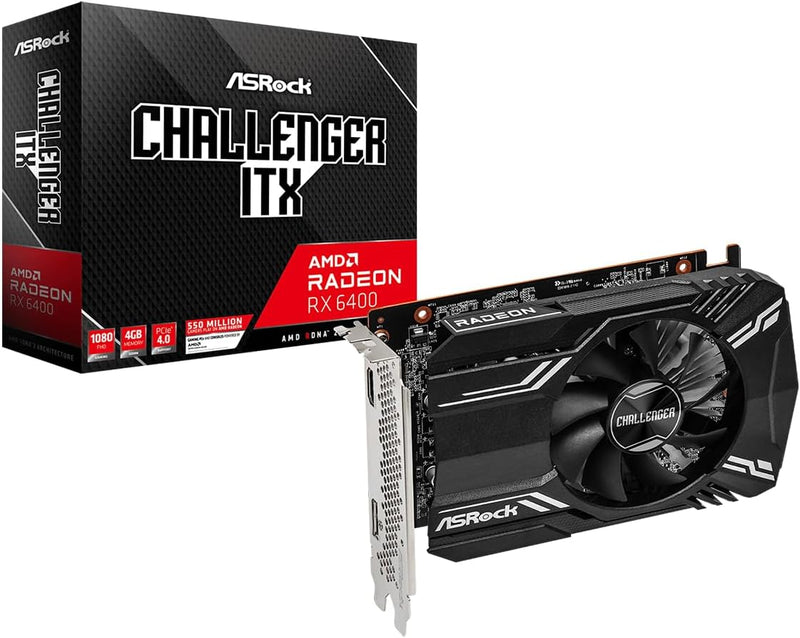
ASRock RX6400 CLI 4G Radeon Graphics Card
RDNA 2's 6nm efficiency meets ITX form factor — the RX 6400 brings DirectX 12 Ultimate gaming to compact builds that larger cards can't touch.
$129.99*
View on Amazon
✓ In Stock on Amazon.com
*Price sourced from Amazon.com. Last updated:Sep 13, 2026.Price and availability are subject to change — details.
Affiliate Disclosure: As an Amazon Associate, Studio Supplies earns from qualifying purchases made through links on this page, at no additional cost to you. This helps support our editorial team.
Notice a mistake? Let Us Know
Overview
Key Features
Ultra-Compact ITX Design, Perfect for small form factor builds and space-constrained systems with limited physical space
Modern RDNA 2 Architecture, Features AMD's efficient RDNA 2 architecture with hardware raytracing support
Solid Clock Performance, Boost clock up to 2321 MHz with 4GB GDDR6 memory for smooth 1080p gaming
Single Fan Cooling, Compact single-fan design with 0dB silent operation during low-intensity tasks
Advanced Features Support, Includes AMD FidelityFX Super Resolution for enhanced gaming performance
High-Resolution Capable, Supports 8K resolution output for stunning visual clarity on compatible displays
Modern Display Connectivity, DisplayPort 1.4 with DSC and HDMI 2.1 with VRR support high refresh rate displays
Power Efficient Design, Does not require external power connectors, drawing all power from PCIe slot
Compatibility Note, Requires PCIe 4.0 for full performance; performance may be limited on PCIe 3.0 systems
Dedicated Support, Contact us directly through Amazon for any product questions or assistance
Specifications
GPU
AMD Radeon RX 6400
Architecture
AMD RDNA 2
Process Node
6nm
Memory
4GB GDDR6
Memory Speed
16 Gbps
Memory Bus
64-bit
Interface
PCI Express 4.0
DirectX
DirectX 12 Ultimate
Max Resolution
7680 × 4320 (8K)
Similar Products
Other products from the same family that visitors often consider:
 ✓ Available
ASRock RX6900XT OCF 16G Radeon Graphics Card
$985.00
View on Amazon → ✓ Available
ASRock RX6500XT PGD 4GO Radeon Graphics Card
$214.97
View on Amazon → Currently Unavailable
ASRock RX7800XT SL 16GO Radeon Graphics Card
Check on Amazon → Currently Unavailable
ASRock PHANTOMXRADEON7 Radeon VII 16GB Graphics Card
Check on Amazon → ✓ Available
ASRock RX6700XT CLD 12G Radeon Gaming Graphics Card
$649.00
View on Amazon →Frequently Asked Questions
Does the RX 6400 require an external PCIe power connector?
No. The RX 6400 is designed to draw all power from the PCIe slot itself, which is why it can fit in slim and low-profile cases without requiring a power cable run from the PSU. This also means the card's performance ceiling is constrained by the PCIe slot's 75W power delivery limit.
Is this card backward compatible with PCIe 3.0 motherboards?
Yes. PCIe 4.0 is backward compatible with PCIe 3.0 slots. The card will operate in older motherboards, though the available bandwidth drops to PCIe 3.0 levels. For a card in this performance tier, the bandwidth difference between PCIe 3.0 and 4.0 is not a meaningful bottleneck at 1080p.
What memory bandwidth does 4GB GDDR6 at 16 Gbps provide on the RX 6400?
The RX 6400 uses a 64-bit memory bus, which at 16 Gbps yields 128 GB/s of memory bandwidth. This is the card's primary performance constraint — the narrow bus width limits how quickly texture data can be fed to the GPU, particularly at higher resolutions or with memory-intensive workloads.
What maximum display resolution does the RX 6400 support?
The card supports a maximum output resolution of 7680 × 4320 (8K). Practically speaking, gaming at 4K or 8K is beyond this card's performance envelope — the 8K output support is relevant for desktop display connectivity, not gaming workloads.
How does the RX 6400 compare to integrated graphics for everyday computing and light gaming?
The RX 6400 delivers substantially higher throughput than AMD or Intel integrated graphics. For 1080p gaming at low-to-medium settings, entry-level esports titles, and GPU-accelerated tasks like video decoding and light creative work, the performance gap is significant and immediately noticeable.
Related Products


