



ASRock
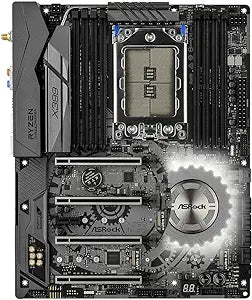
ASRock X399 TAICHI sTR4 AMD ATX Motherboard
USB 3.1USB 3.0Bluetooth 4.2PCIe Gen3
Four PCIe 3.0 x16 slots and 64 PCIe lanes from AMD Threadripper — the X399 TAICHI is the platform for builds that can't afford to be bottlenecked.
$459.00*
Check availability
*Price sourced from Amazon.com. Last updated:Sep 15, 2026.Price and availability are subject to change — details.
Affiliate Disclosure: As an Amazon Associate, Studio Supplies earns from qualifying purchases made through links on this page, at no additional cost to you. This helps support our editorial team.
Notice a mistake? Let Us Know
Overview
Key Features
Supports AMD TR4 Socket Ryzen Threadripper Series CPUs
IR Digital PWM, 11 Power Phase & Dr. MOS and operating system is microsoft windows 10 64-bit,windows 10 RS2 is supported
7.1 CH HD Audio (Realtek ALC1220 Audio Codec), Supports DTS Connect.Supports high speed wireless connections up to 433Mbps
8 SATA3, 3 Ultra M.2 (PCIe Gen3 x4 & SATA3)
2 USB 3.1 10Gb/s (1 Type-A + 1 Type-C), 12 USB 3.0 (4 Front, 8 Rear).Supports Bluetooth 4.2 / 3.0 + High speed class II
Specifications
CPU Socket
AMD TR4 (Ryzen Threadripper, 1st and 2nd Gen)
Power Design
11-phase IR Digital PWM, Dr. MOS
Memory Support
DDR4 up to 3600+(OC), 8x DIMM slots, Quad-Channel
PCIe Slots
4x PCIe 3.0 x16, 1x PCIe 2.0 x1
M.2 Slots
3x Ultra M.2 (PCIe Gen3 x4 & SATA3)
SATA Ports
8x SATA3
USB
2x USB 3.1 Gen2 (1x Type-A, 1x Type-C), 12x USB 3.0
LAN
Dual Intel Gigabit LAN
Wireless
Intel 802.11ac (up to 433 Mbps), Bluetooth 4.2
Audio
7.1 CH HD (Realtek ALC1220), DTS Connect
Multi-GPU
NVIDIA 4-Way SLI, AMD 4-Way CrossFireX
Form Factor
ATX
Frequently Asked Questions
Which AMD Threadripper CPUs are compatible with the X399 TAICHI, and does it support all TR4 processors?
The X399 TAICHI supports AMD TR4 socket Ryzen Threadripper Series CPUs — first-generation Threadripper (1900X through 1950X) and second-generation (2920X through 2990WX). It does not support third-generation Threadripper (TRX40 socket) or later, as those use different socket and platform architectures. Verify your CPU's TR4 compatibility before purchasing.
How does the 11-phase Dr. MOS power delivery affect overclocking stability on the X399 TAICHI?
The 11-phase IR Digital PWM with Dr. MOS integrated power stages means each phase delivers cleaner, more efficient power with lower switching losses than traditional discrete MOSFETs. For Threadripper overclocking — which involves pushing high core counts with significant TDP headroom — this translates to more consistent Vcore delivery and better sustained boost behavior under all-core loads.
Can all four PCIe 3.0 x16 slots run simultaneously at full x16 bandwidth?
No — Threadripper's 64 PCIe lanes are shared across all expansion slots, M.2 slots, and chipset-connected I/O. In a 4-GPU configuration, lanes are divided per AMD's allocation scheme (typically x16/x8/x8/x8 or similar depending on population). For GPU compute or rendering workloads, this is still significantly more bandwidth than single-socket AM4 platforms provide.
Does the onboard Intel 802.11ac Wi-Fi use an M.2 key slot, and does adding a Wi-Fi card consume a PCIe lane?
The onboard Intel 802.11ac Wi-Fi module is integrated and does not occupy one of the three Ultra M.2 storage slots. Its 433 Mbps maximum throughput is single-band limited — for sustained wireless data transfer in a workstation context, a wired Gigabit connection via the dual Intel LAN ports is the recommended path.
Are the three Ultra M.2 slots all PCIe Gen3 x4, or do some share bandwidth with SATA?
All three Ultra M.2 slots support PCIe Gen3 x4 (up to ~3.5 GB/s each) as well as SATA3. When populated with PCIe NVMe drives, they run at full Gen3 x4 bandwidth. Note that populating certain M.2 slots may disable specific SATA3 ports — consult the manual's bandwidth sharing map before finalizing storage configuration.
Related Products


