Asus

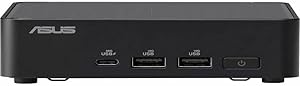
Asus RNUC14RVHU500000I NUC 14 Pro Mini PC

Intel Core Ultra 5 compute in a sub-4-inch cube delivers desktop-class CPU throughput at roughly one-tenth the footprint of a traditional tower.

$560.00*
Check availability

*Price sourced from Amazon.com. Last updated:Jul 14, 2026.Price and availability are subject to change.

Affiliate Disclosure: Studio Supplies may earn a commission from qualifying purchases made through links on this page, at no additional cost to you. This helps support our editorial team.

Notice a mistake? Let Us Know

Overview

The ASUS NUC 14 Pro (RNUC14RVHU500000I) is a barebone mini PC built on Intel's Core Ultra 5 (Meteor Lake) architecture — a significant departure from previous NUC generations in that Meteor Lake disaggregates compute, graphics, and I/O tiles on a single package. The integrated Intel Arc GPU replaces Iris Xe and provides approximately 2–3x the GPU throughput of its predecessor, relevant for multi-display setups, hardware video encode/decode pipelines, and light creative workloads. The embedded NPU handles AI inference tasks natively — background segmentation, noise reduction, and similar ML workloads — without consuming CPU or GPU resources. As a barebone, the chassis ships without RAM or storage; the two SO-DIMM slots accept DDR5 modules up to 96GB total, and the M.2 slots support PCIe Gen 4 NVMe drives. That modularity means you can build a 64GB/2TB workstation or a lean 16GB/512GB kiosk system from the same chassis.

The NUC 14 Pro targets power users and IT administrators who need desktop-class compute in constrained physical environments — behind-display VESA mounts, digital signage installations, compact home offices, or development workstations where multiple monitors and full CPU performance matter but desk space is limited. The Thunderbolt 4 ports make it a natural hub for a multi-display, multi-peripheral desk setup with a single cable run to a TB4 dock. It is not the right choice for users who need discrete GPU performance — 3D rendering, machine learning training at scale, or gaming above 1080p will saturate integrated graphics. But for productivity, development, media consumption, and light creative work, the Core Ultra 5's compute throughput and Arc's display engine deliver a workstation experience that is genuinely hard to replicate in a chassis this small.

Key Features

Easy to install

Environment friendly

Specifications

Brand
ASUS
Model
RNUC14RVHU500000I
Type
Barebone Mini PC
Processor
Intel Core Ultra 5 (Meteor Lake)
Graphics
Intel Arc (integrated, Meteor Lake)
NPU
Yes (Intel NPU for AI inference)
RAM
Not included (2x SO-DIMM DDR5, up to 96GB)
Storage
Not included (M.2 NVMe)
Operating System
Not included (Barebone)
Form Factor
Mini PC

Pros & Cons

👍 Pros

  • Intel Core Ultra 5 (Meteor Lake) with integrated NPU enables on-device AI inference, offloading tasks like background removal and noise reduction from the CPU cores.
  • Barebone configuration allows independent DDR5 RAM and NVMe SSD selection — users can install up to 96GB RAM and multi-TB storage tailored to specific workload requirements.
  • Thunderbolt 4 support enables 40Gbps peripheral bandwidth and 8K display output from a form factor small enough to VESA-mount behind a monitor.
  • Intel Arc graphics in Meteor Lake delivers meaningfully higher GPU throughput than previous Iris Xe — capable of driving multiple 4K displays and accelerating GPU-dependent encoding tasks.
  • Compact chassis reduces desk footprint and cabling overhead substantially compared to a mid-tower while maintaining full M.2 and DDR5 upgradability.

👎 Cons

  • Barebone configuration requires purchasing DDR5 SO-DIMMs and an NVMe SSD separately — the total system cost is higher than the unit price suggests and requires confident hands-on assembly.
  • No GPU upgrade path — Intel Arc is integrated into the Meteor Lake die; users with GPU-intensive workloads (3D rendering, gaming above 1080p) cannot add a discrete GPU to this platform.
  • Sparse feature listing in the product description makes it difficult to confirm exact I/O port count, Thunderbolt version, and supported RAM speeds without cross-referencing ASUS's spec sheet.
  • Chassis size limits cooling headroom — sustained multi-core workloads will ramp the fan audibly, and peak turbo frequencies may not be maintained as long as in a full desktop with aftermarket cooling.
  • Intel Arc integrated graphics share system memory bandwidth with the CPU — in memory-limited AI or GPU workloads, the unified memory architecture creates contention that a discrete GPU would not have.

Frequently Asked Questions

Barebone means the NUC 14 Pro ships with the chassis, motherboard, CPU, and cooling system pre-installed, but without RAM or storage. You will need to install DDR5 SO-DIMMs (up to 96GB across two slots) and an M.2 NVMe SSD before the system will POST and boot. This modular approach lets you spec memory and storage independently rather than paying for a bundle you don't need.
The RNUC14RVHU500000I SKU is built around the Intel Core Ultra 5 processor (Meteor Lake architecture). It features Intel's NPU (Neural Processing Unit) for AI inference workloads offloaded from the CPU and GPU, and Intel Arc graphics replacing the previous-generation Iris Xe — delivering meaningfully higher GPU throughput for light creative and display-intensive tasks.
The NUC 14 Pro supports multiple simultaneous displays via Thunderbolt 4, HDMI 2.1, and USB4 ports depending on the specific port configuration of this SKU. Thunderbolt 4 supports up to 8K display output and daisy-chaining — confirm the rear I/O layout in the full spec sheet for exact display count limits.
ASUS's smart cooling system in the NUC 14 Pro uses a redesigned fan and vapor chamber heatsink path to manage the Core Ultra 5's configurable TDP. Under sustained multi-core loads the system manages thermals through fan ramp — audible under heavy compute — but avoids the sustained throttling that plagued earlier NUC generations. In light-to-moderate office workloads the system is near-silent.
Yes. The Thunderbolt 4 and HDMI 2.1 ports provide sufficient bandwidth for simultaneous dual 4K/60Hz output. Triple or quad display configurations are possible with Thunderbolt daisy-chaining or a Thunderbolt dock, though this depends on the display adapter chain and is subject to Intel's display engine limits.