
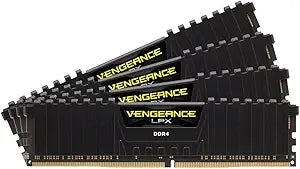


Corsair Vengeance LPX DDR4 3200MHz — Editorial Review & Buying Guide
The Corsair Vengeance LPX DDR4 3200MHz family (CMK8GX4M1E3200C16, CMK16GX4M2B3200C16, CMK32GX4M2E3200C16 and similar SKUs) is Corsair's mainstream-popular DDR4 desktop RAM line — low-profile aluminum heatspreaders, XMP 2.0 profile for 3200MHz at CL16 latency on Intel Z-series + AMD Ryzen X570/B550/B650 motherboards. Per Corsair's official Vengeance LPX product family page, the line targets gaming + content-creator builds with reliable XMP timings, 8-layer PCB construction for memory signal integrity, and limited lifetime warranty. Available in 8GB single, 2×8GB (16GB), 2×16GB (32GB), and 2×32GB (64GB) kits.
What Vengeance LPX DDR4 3200 Specifically Wins
- 3200MHz at CL16 is the AMD Ryzen sweet spot — per AMD's official memory documentation for Zen 2 / Zen 3 / Zen 4 platforms, 3200MHz CL16-18-18-36 is the highest officially-supported speed for stable 1:1 FCLK / UCLK / MEMCLK ratio on Ryzen — beyond this you enter 2:1 mode with worse latency
- Low-profile heatspreader (34mm tall) — clears tower-style CPU coolers (Noctua NH-D15, be quiet! Dark Rock 4, Deepcool AK620) without RAM-slot conflicts. Critical for ATX builds with large coolers
- XMP 2.0 profile — one-click BIOS enable for advertised speeds; no manual timings configuration needed
- Lifetime warranty — Corsair stands behind the product; replacement is straightforward via Corsair RMA
- Wide motherboard compatibility — works with Intel Z270/Z370/Z390/Z490/Z590/Z690/Z790, AMD X470/X570/B550/X670/B650 (where DDR4 motherboards exist for AM5)
- Single rank (8GB modules) or dual rank (16/32GB modules) — single rank typically benchmarks slightly faster on Intel; dual rank slightly faster on AMD. Either works
- Consistent SKU naming — CMK[size]GX4M[count][model][speed][cas] — easier to parse than competing brands' codes
Where Vengeance LPX 3200 Specifically Fits
- Gaming desktop builds (Ryzen 5/7/9 + Intel i5/i7/i9) — 16GB is the modern gaming floor, 32GB is the sweet spot
- Content creator workstations (video editing, photo, design) — 32GB for moderate work, 64GB for video editing / 3D / VFX
- Compact ITX builds with low-profile coolers (Noctua NH-L9i, ID-Cooling IS-55) where heatspreader height matters
- Twitch / YouTube streaming PCs running OBS + game + browser + Discord — 32GB minimum for smooth multi-app workflows
- Office / productivity builds — 16GB Vengeance LPX provides better-than-default RAM at marginal cost over commodity OEM RAM
- Mid-tier home server / NAS builds (FreeNAS / TrueNAS / Unraid) needing ECC-compatible motherboard support
- VR-ready gaming setups — Quest 2/3 Link + heavy game requires 32GB+ for smooth streaming
Honest Limits Buyers Should Know
- DDR4 only — not for DDR5 motherboards. Current Intel 12th/13th/14th gen + AMD Ryzen 7000 series motherboards mostly use DDR5. Verify the motherboard's memory generation before purchase — DDR4 RAM does NOT fit DDR5 slots
- 3200MHz is mainstream — not high-end. Faster Vengeance LPX kits exist at 3600/3866/4000MHz with lower CL latencies for enthusiast overclocking. The 3200/CL16 spec is the "safe and stable" default; performance gains from 3600+ are modest for typical use
- Limited overclocking headroom on AMD Ryzen. Beyond AMD's official 3200MHz sweet spot, manual timing tuning is required + benefits are platform-specific. Intel platforms tolerate higher speeds more easily
- No RGB. Vengeance LPX is the non-RGB line. For RGB lighting, step up to Vengeance RGB Pro / RGB Pro SL / Dominator Platinum RGB. Note: RGB adds ~30% to memory cost without performance benefit
- Heatspreader is decorative on DDR4. DDR4 at 3200MHz doesn't generate enough heat to require active cooling; the heatspreader is more cosmetic than functional
- Compatibility quirks on first-gen Ryzen (Ryzen 1000/2000). Earlier Zen 1 / Zen+ platforms struggled with 3200MHz Hynix die memory. Sample Vengeance LPX kits with Samsung B-die or Micron E-die typically work; pure Hynix CJR / DJR can require manual tuning. Modern Zen 3+ has resolved this
- Non-ECC. For mission-critical workstations / servers needing error correction, look at Crucial / Kingston Server Premier ECC variants
- Multi-stick kits required for dual-channel operation. Single-stick installations work but lose ~30% bandwidth vs matched-kit dual-channel. Buy as 2-stick kit, never single + single matched-spec
Where Buyers Should Look Elsewhere
- DDR5 platforms (Intel 12th+ / AMD Ryzen 7000+) → Corsair Vengeance DDR5 (different SKU prefix), G.SKILL Trident Z5
- Highest possible RAM speed for Intel → G.SKILL Trident Z Royal / Z5 RGB / Neo at 4000-7600MHz
- RGB aesthetic → Corsair Vengeance RGB Pro SL, G.SKILL Trident Z5 RGB
- ECC server / workstation → Kingston Server Premier ECC, Crucial Server ECC
- Pure budget (acceptable speed loss) → Crucial Ballistix DDR4 2400/2666 or Kingston Fury Beast DDR4 2666/3000
- Premium SK Hynix die for tight subtimings → G.SKILL Trident Z Royal, Crucial Ballistix RGB
Sources & Citations
- Corsair, "Vengeance LPX 3200MHz product page," corsair.com (accessed 2026-05-18)
- AMD, "Ryzen memory documentation and supported DDR4 speeds," amd.com (accessed 2026-05-18)
- Tom's Hardware, "DDR4 3200 memory comparison and benchmarks," tomshardware.com (accessed 2026-05-18)
- AnandTech, "DDR4 memory review coverage," anandtech.com (accessed 2026-05-18)
Last verified: 2026-05-18

