

Crucial
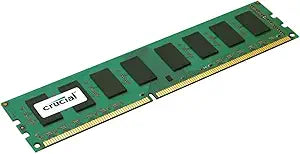
Crucial CT25664BA160B 2GB DDR3 1600MHz Desktop Memory
Drop in 2GB of DDR3-1600 and immediately reduce swap file pressure on any legacy desktop — a precise, low-risk upgrade for underpowered DDR3 platforms.
$12.96*
View on Amazon
✓ In Stock on Amazon.com
*Price sourced from Amazon.com. Last updated:Oct 22, 2026.Price and availability are subject to change — details.
Affiliate Disclosure: As an Amazon Associate, Studio Supplies earns from qualifying purchases made through links on this page, at no additional cost to you. This helps support our editorial team.
Notice a mistake? Let Us Know
Overview
Key Features
Capacity: 2 GB
Memory Type: DDR3 SDRAM - DIMM 240-pin
Upgrade Type: Generic
Increases system performance
Easy to install
Premium quality memory from a trusted brand
100% Tested
Specifications
Brand
Crucial
Model
CT25664BA160B
Capacity
2GB
Speed
1600 MT/s (DDR3-1600)
Memory Type
DDR3 SDRAM
Form Factor
UDIMM 240-pin
Latency
CL11
Upgrade Type
Generic
Similar Products
Other products from the same family that visitors often consider:
 ✓ Available
Crucial BLS2G3D1609DS1S00 2GB DDR3 1600MHz Memory
$28.99
View on Amazon → ✓ Available
Crucial BLS4G3D169DS3 4GB DDR3 1600MHz Desktop Memory
$29.99
View on Amazon → ✓ Available
Crucial CT51264BD160BJ 4GB DDR3 1600MHz Desktop Memory
$13.88
View on Amazon → ✓ Available
Crucial CT2KIT25664BA160B 4GB DDR3 1600MHz Desktop Memory Kit
$24.99
View on Amazon → ✓ Available
Crucial CT2K102464BD160B 16GB DDR3 1600MHz Desktop RAM
View on Amazon →Frequently Asked Questions
Is DDR3-1600 backward compatible with DDR3-1333 motherboards?
Yes — DDR3-1600 modules are backward compatible with DDR3-1333 and DDR3-1066 systems. The module will automatically downclock to the motherboard's supported maximum speed (typically 1333MHz if that's the platform spec). You lose the speed headroom but gain full compatibility without any BIOS configuration.
What form factor and pin count does the CT25664BA160B use, and is it compatible with laptops?
This is a 240-pin UDIMM (Unbuffered DIMM) in the standard DDR3 desktop form factor. It is not compatible with laptop SO-DIMM slots, which use a different 204-pin format. Confirm your motherboard has a standard desktop DIMM slot before ordering.
What are the exact speed and latency specs of the CT25664BA160B?
The module runs at 1600 MT/s (DDR3-1600) with CL11 latency. At those specs, effective memory latency calculates to approximately 13.75 nanoseconds — adequate for legacy platform workloads and within the standard DDR3-1600 specification.
Will this 2GB module work alongside existing RAM sticks for dual-channel?
Dual-channel operation requires matched pairs — same capacity, speed, and ideally the same manufacturer — installed in the appropriate DIMM slots as specified in your motherboard manual. Adding a single 2GB stick alongside an existing 2GB or 4GB DIMM will likely drop the system to single-channel mode for the mixed capacity, depending on motherboard implementation. For dual-channel, purchase a matched pair.
What form factor is this, and will it fit my motherboard?
This is a 240-pin UDIMM (Unbuffered DIMM) — the standard form factor for desktop DDR3 motherboards. It does not fit laptops (which use 204-pin SODIMMs) or servers that require registered/ECC DIMMs. Confirm your desktop motherboard supports DDR3 unbuffered non-ECC memory before installing.
What happens if I mix this 1600 MT/s module with slower RAM already in my system?
DDR3 is backward speed-compatible, but the entire system will operate at the speed of the slowest installed stick. Adding this 1600 MT/s module to a system running DDR3-1333 will result in all installed modules clocking down to 1333 MT/s.
Will this single module run in dual-channel mode?
No — a single DIMM operates in single-channel mode, which reduces effective memory bandwidth compared to a matched pair installed in the correct paired slots. For dual-channel bandwidth, install an identical second CT25664BA160B in the paired slot per your motherboard manual.
What does CL11 latency mean, and does it matter for everyday use?
CL11 (CAS Latency 11) is the number of clock cycles the module takes to respond to a memory request. At 1600MHz, lower latency (CL9 or CL10) provides marginally faster response times in latency-sensitive workloads like gaming or real-time audio. For document work, web browsing, and general office use, the difference between CL9 and CL11 is imperceptible in daily use.
What's the maximum RAM most DDR3 desktop platforms support?
DDR3 desktop platforms typically support 16GB–64GB depending on the chipset and the number of DIMM slots. A dual-slot board maxes at 16GB with 8GB DIMMs; a quad-slot board can reach 32GB at 8GB per slot. The 2GB module in this listing is more relevant for systems being brought back to minimum operational spec than for systems being maxed out.
Is this module compatible with both Intel and AMD DDR3 desktop platforms?
Yes — the 240-pin UDIMM DDR3 standard is platform-agnostic. The CT25664BA160B is compatible with Intel LGA775, LGA1155, and LGA1156 platforms, as well as AMD AM3 and AM3+ boards, among others, provided the motherboard supports DDR3 at 1600 MT/s.
Related Products


