

Dell
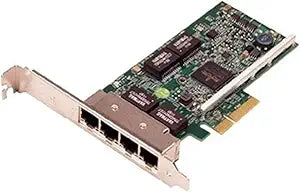
Dell 540-BBGX Broadcom 5719 QP 1Gb Network Interface Card
Four independent 1GbE ports on one PCIe slot — the Broadcom 5719 NIC maximizes network interface density per expansion slot in multicore server deployments.
$92.00*
View on Amazon
✓ In Stock on Amazon.com
*Price sourced from Amazon.com. Last updated:Oct 07, 2026.Price and availability are subject to change — details.
Affiliate Disclosure: As an Amazon Associate, Studio Supplies earns from qualifying purchases made through links on this page, at no additional cost to you. This helps support our editorial team.
Notice a mistake? Let Us Know
Overview
Key Features
The Gigabit Ethernet PCI-Express® Network Interface Card from Dell™ is ideal for connecting your server to your network. The Gigabit Quad Port Server Adapter proven to be reliable and sta
Specifications
Model
540-BBGX
Controller
Broadcom BCM5719
Ports
4x 10/100/1000Base-T (RJ-45)
Host Interface
PCI Express
Network Technology
10/100/1000Base-T
Form Factor
Plug-in Card (Server)
Features
TCP/IP Offload, iSCSI Offload, PXE Boot, Wake-on-LAN, 802.3az EEE, LACP 802.3ad
Frequently Asked Questions
What PCIe slot does the Dell Broadcom 5719 NIC require, and what slot widths are compatible?
The card uses a PCIe host interface and is designed for server installation. PCIe cards are typically backward and forward compatible across slot widths (x1, x4, x8, x16) — a PCIe x4 or larger slot will accommodate the card physically and provide full bandwidth. Verify the card's lane requirement against your server's available PCIe slots to confirm full electrical bandwidth.
What servers is this NIC compatible with?
The Dell 540-BBGX is a Dell OEM card designed for Dell PowerEdge servers with compatible PCIe slots. Verify compatibility against your specific PowerEdge model's Hardware Compatibility List (HCL) before installation — Dell OEM NICs may carry firmware dependencies tied to specific server generations and BIOS versions.
Does this card support link aggregation across its four ports?
Yes — the Broadcom BCM5719 supports IEEE 802.3ad LACP link aggregation. Four ports can bond into a single logical 4Gbps link where supported by the upstream switch, or be segmented into independent network paths for VLAN-segregated or multi-tenant environments.
Can all four ports on the BCM5719 be used simultaneously, or is bandwidth shared?
The Broadcom BCM5719 controller supports independent operation across all four ports — each port is a fully independent 10/100/1000Base-T MAC and transceiver. All four ports can sustain simultaneous gigabit traffic. Aggregate throughput across all four ports is limited by the PCIe host interface bandwidth, which at PCIe x4 Gen 2 is well above 4Gbps, so the PCIe bus is not a bottleneck at 4× 1GbE saturation.
Does this card support NIC teaming or link aggregation across its four ports?
Yes — the BCM5719 supports IEEE 802.3ad link aggregation (LACP) and various teaming configurations including active-backup failover, round-robin load balancing, and 802.3ad dynamic teaming. This requires a managed switch that supports LACP on the switch side for full link aggregation functionality.
What is the power draw of the BCM5719 quad-port NIC?
The BCM5719 supports Energy Efficient Ethernet (IEEE 802.3az), reducing power draw during low-utilization periods. No supplemental PCIe power connectors are required — the card runs entirely on slot power, simplifying deployment in servers with limited auxiliary power headers.
Does this NIC support iSCSI, PXE boot, and Wake-on-LAN?
Yes — the BCM5719 platform supports hardware iSCSI offload, PXE boot across all four ports, and Wake-on-LAN. These are standard enterprise NIC features relevant for SAN connectivity, automated bare-metal provisioning workflows, and remote power management.
Is this card compatible with VMware ESXi and other hypervisor environments?
The Broadcom BCM5719 has broad hypervisor support — it is in VMware's Hardware Compatibility List for ESXi and is supported under Microsoft Hyper-V and Linux KVM. Driver availability should be confirmed for your specific ESXi or hypervisor version before deployment, particularly on newer ESXi releases where inbox driver support may vary.
What is the power consumption of the BCM5719 quad-port NIC, and does it require auxiliary power?
The BCM5719 is designed for energy-efficient operation — Broadcom markets the controller for its low power draw relative to performance. It draws power entirely from the PCIe slot with no auxiliary power connector required. Exact TDP depends on port utilization; at full quad-port saturation, power draw remains modest relative to the card's throughput.
Which operating systems and hypervisors support this NIC?
The Broadcom 5719 has native driver support in Windows Server (2008 R2 through 2022), major Linux distributions (RHEL, SLES, Ubuntu LTS), and VMware ESXi. Dell OEM firmware may require downloading drivers from Dell's support site rather than using generic Broadcom drivers for full feature availability.
Related Products


