



Dell
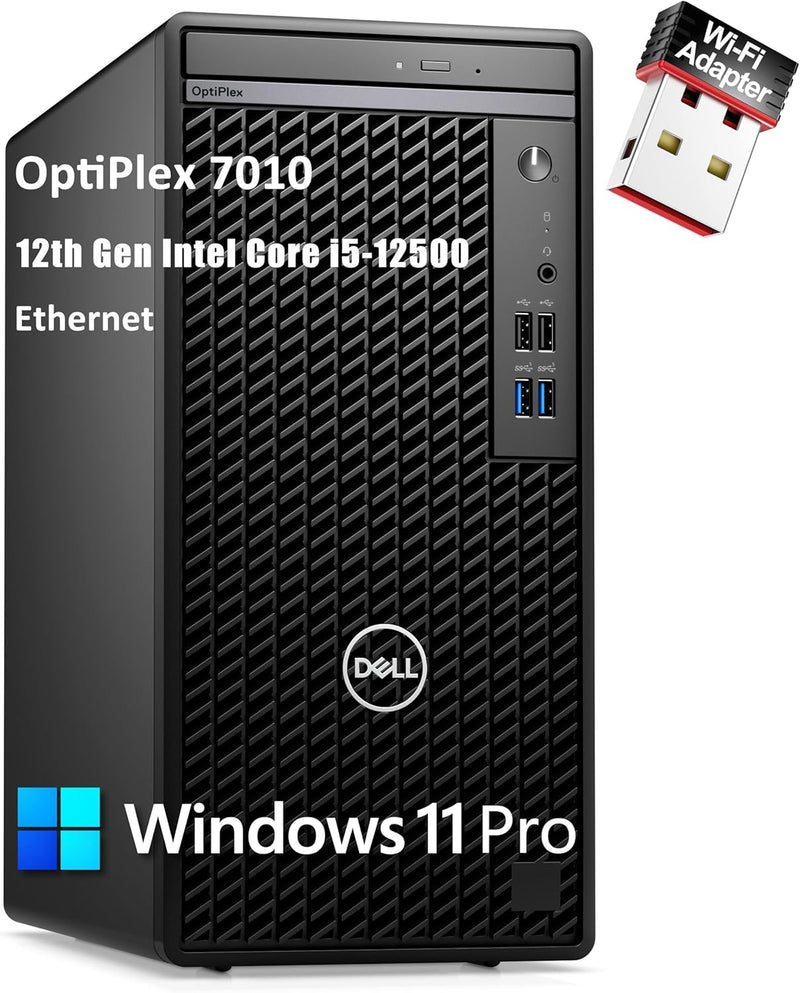
Dell OptiPlex 7010 Tower i5-12500 32GB 1TB SSD Win 11 Pro
★★★★★
UHDi5-1250032GB DDR41TB SSDUSB 3.1
A 12th Gen Core i5 tower with 32GB RAM and 1TB SSD that handles every modern business workload without breaking a sweat.
$729.99*
Check availability
*Price sourced from Amazon.com. Last updated:Jun 07, 2026.Price and availability are subject to change.
Affiliate Disclosure: Studio Supplies may earn a commission from qualifying purchases made through links on this page, at no additional cost to you. This helps support our editorial team.
Notice a mistake? Let Us Know
Overview
Key Features
CPU: 12th Gen Intel Core i5-12500 Processor @ 3.00 GHz (6 cores, 12 threads, 18 MB cache, to 4.60 GHz Turbo).
RAM: 32GB DDR4 SDRAM; Hard Drive: 1TB PCIe SSD; Optical Drive: DVD+/-RW.
Graphics: Intel UHD Graphics 770 with shared graphics memory
【Note: No Built-in W-i-F-i】 USB WiFi for PC. Port: 4 x USB Type-A (USB 3.1 / USB 3.2 Gen 1), 4 x USB Type-A (USB 2.0), 1 RJ-45 port 10/100/1000 Mbps, 1 x HDMI 1.4, 1 x DisplayPort 1.4, 1 x 1/8" / 3.5 mm Headphone/Microphone Input/Output, 1 x 1/8" / 3.5 mm Line Input/Output.
OS: Windows 11 Professional English 64bit.
Specifications
Processor
12th Gen Intel Core i5-12500 Processor
Processor Speed
3.00 GHz (up to 4.60 GHz Turbo)
Processor Cores
6 cores
Processor Threads
12 threads
Processor Cache
18 MB
RAM
32GB DDR4 SDRAM
Hard Drive
1TB PCIe SSD
Optical Drive
DVD+/-RW
Graphics
Intel UHD Graphics 770
Operating System
Windows 11 Professional English 64bit
USB Type-A Ports
4 x USB 3.1 / USB 3.2 Gen 1, 4 x USB 2.0
Ethernet Port
1 RJ-45 (10/100/1000 Mbps)
HDMI Port
1 x HDMI 1.4
DisplayPort
1 x DisplayPort 1.4
Audio Ports
1 x 1/8" / 3.5 mm Headphone/Microphone, 1 x 1/8" / 3.5 mm Line Input/Output
Wireless Connectivity
USB WiFi for PC (No Built-in Wi-Fi)
Pros & Cons
👍 Pros
- 32GB DDR4 RAM is double the typical business desktop spec — it handles heavy browser multitasking, virtual machines, and large spreadsheets without memory pressure limiting performance.
- The 1TB PCIe NVMe SSD delivers sequential read speeds several times faster than SATA alternatives, making boot times and application launches genuinely quick under real-world use.
- The i5-12500's 6-core, 12-thread architecture with 4.60 GHz Turbo handles parallel workloads efficiently — meetings, document processing, and background sync run simultaneously without noticeable lag.
- DVD+/-RW optical drive is increasingly rare on modern business desktops — its inclusion matters for organizations that still distribute or archive to physical media.
- Windows 11 Pro licensing includes enterprise-grade security features — BitLocker, Remote Desktop, and Hyper-V — that Home edition omits.
👎 Cons
- No integrated Wi-Fi card means wireless connectivity relies on the included USB adapter, which is a less reliable and lower-performance solution than an internal PCIe wireless card.
- Intel UHD Graphics 770 uses shared system RAM as VRAM — under GPU-intensive workloads it draws from the 32GB pool, reducing available memory for CPU-bound tasks running simultaneously.
- At 14.38 lbs and 154 x 292 x 324mm, the tower form factor consumes meaningful desk or floor space compared to mini-PC or SFF alternatives.
- HDMI 1.4 output limits the primary video connection to 4K at 30Hz — users running a 4K display at 60Hz need to use the DisplayPort 1.4 output instead.
- The 180W 80 Plus Bronze power supply leaves limited headroom for adding a discrete GPU later — upgrading the PSU would be necessary before adding a power-hungry graphics card.
Frequently Asked Questions
What does the i5-12500's 4.60 GHz Turbo Boost speed mean for everyday business tasks?
The i5-12500 boosts individual cores up to 4.60 GHz under single-threaded load — which directly translates to responsiveness in tasks like opening applications, rendering documents, and running web-based tools. The 6-core, 12-thread architecture handles simultaneous workloads (multiple browser tabs, Teams calls, background sync) without visible slowdown.
Does the 32GB DDR4 configuration support dual-channel, and does it matter?
32GB is a strong specification for this class of business tower. Whether it runs in dual-channel depends on how the DIMMs are installed — dual-channel doubles memory bandwidth over single-channel, which benefits Intel UHD Graphics 770 performance (shared memory GPU) and large-dataset operations. Confirm DIMM slot population with Dell's configuration spec sheet.
What type is the 1TB SSD, and how does PCIe compare to SATA for real-world use?
The 1TB drive is a PCIe (NVMe) SSD, which delivers sequential read speeds typically in the 3,000–5,000 MB/s range — roughly 5–10x faster than a SATA SSD and over 100x faster than a traditional hard drive. Boot times, application launches, and large file operations are noticeably faster than older SATA-equipped systems.
The listing says no built-in Wi-Fi — how is the included USB Wi-Fi adapter different from an internal card?
The included USB Wi-Fi adapter provides wireless connectivity via a USB port rather than an internal PCIe Wi-Fi card. USB adapters are generally less reliable and slower than internal cards, particularly in environments with signal congestion. For a permanently deskbound machine, the onboard RJ-45 ethernet is the more stable choice.
Can the Intel UHD Graphics 770 drive dual monitors, and is it suitable for light creative work?
Yes — the UHD 770 supports HDMI 1.4 and DisplayPort 1.4 simultaneously for dual-display output. It handles office productivity, video conferencing, and web content comfortably. For sustained GPU-compute tasks — video transcoding, CAD, or gaming — a dedicated discrete GPU would be required, as the UHD 770 uses shared system RAM rather than dedicated VRAM.
Related Products


