



Dell
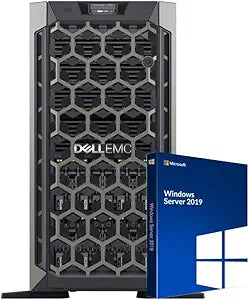
Dell ASISVR75 PowerEdge T640 Tower Server (Renewed)
256GB DDR4
Power and Scalability for Growing BusinessesThe Dell PowerEdge T640 Tower Server provides a robust and scalable solution for small businesses, branch locations, and home offices. Featuring dual Intel Silver processors, ample DDR4 memory, and high-performance SAS SSDs, this server delivers excepti...
View price on Amazon
Affiliate Disclosure: Studio Supplies may earn a commission from qualifying purchases made through links on this page, at no additional cost to you. This helps support our editorial team.
Notice a mistake? Let Us Know
Overview
Power and Scalability for Growing Businesses
The Dell PowerEdge T640 Tower Server provides a robust and scalable solution for small businesses, branch locations, and home offices. Featuring dual Intel Silver processors, ample DDR4 memory, and high-performance SAS SSDs, this server delivers exceptional performance and reliability.
- Chassis: 16-Bay 2.5" Chassis
- Processors: Dual (2) Intel Silver 4110 8-Core 2.1GHz 11MB CPUs
- Memory: 256GB DDR4 PC4-21300 2666MHz Registered Memory
- Storage: 3.2TB (4 x 800GB) Enterprise SAS SSDs
- RAID Controller: PERC H730P 12Gb/s with 2GB NV Cache
- Power Supplies: Redundant
- Remote Access: iDRAC9 Express
- Network Interface: On-Board Broadcom 5720 Dual Port 1Gb LOM
- Operating System: Windows Server 2019 Standard, Retail
Key Features
Dell PowerEdge T640 Tower Server and Operating System for Small Businesses, Branch Locations, and Home Offices
Dual (2) Intel Silver 4110 8-Core 2.1GHz 11MB CPUs; 256GB DDR4 PC4-21300 2666MHz Registered Memory
3.2TB (4 x 800GB) Enterprise SAS SSDs for Fast Application Storage; PERC H730P 12Gb/s RAID Controller with 2GB NV Cache
iDRAC9 Express; On-Board Broadcom 5720 Dual Port 1Gb LOM; Windows Server 2019 Standard Retail
Pros & Cons
👍 Pros
- Dual 8-core Silver 4110 processors deliver 32 threads for multi-VM or multi-service workloads without requiring rack infrastructure.
- Dual Xeon Silver 4110 processors deliver 32 threads total for sustained parallel workloads — virtualization, database, and ERP applications benefit directly from the multi-socket architecture.
- 256GB DDR4 ECC Registered memory provides a large, error-corrected memory footprint appropriate for running multiple VMs or large in-memory datasets concurrently.
- 256GB of DDR4-2666 RDIMM is enough to run memory-intensive workloads like SQL Server in-memory tables or large VDI deployments out of the box.
- PERC H730P with 2GB NV cache provides hardware-accelerated RAID with write-back safety — critical for database and transactional workloads.
- PERC H730P with 2GB non-volatile write cache accelerates write performance while protecting cached data through power events — enterprise-grade RAID resilience.
- Redundant power supplies eliminate single power supply failure as a point of downtime — critical for always-on workloads.
- Redundant power supplies eliminate single-point-of-failure risk on the power side with no additional hardware purchase required.
- 16-bay chassis with only four drives installed leaves twelve bays for future expansion without chassis replacement.
- Windows Server 2019 Standard Retail license included, reducing total cost of ownership compared to purchasing the OS separately.
👎 Cons
- Dual 1Gb LOM networking is a throughput ceiling for high-traffic file serving or iSCSI workloads — 10GbE requires adding a PCIe NIC.
- Intel Silver 4110 processors are Skylake-SP generation (2017) — per-core performance and power efficiency are below current-generation Xeon alternatives, which matters for latency-sensitive single-threaded workloads.
- iDRAC9 Express has limited functionality compared to iDRAC9 Enterprise — advanced features like virtual console in HTML5, vFlash media, and full remote OS deployment require an upgrade license.
- iDRAC9 Express lacks full KVM-over-IP functionality; remote console access is limited compared to the Enterprise license.
- As a renewed unit, drive health history and RAID controller cache wear are unknown — independent S.M.A.R.T. verification and cache diagnostics are strongly advised before production deployment.
- The 4x800GB SAS SSD configuration totals 3.2TB raw — after RAID 10 overhead, effective usable capacity is approximately 1.6TB, which may require capacity expansion for data-heavy workloads.
- On-board Broadcom 5720 Dual Port 1Gb LOM is a 1GbE interface — a 10GbE NIC upgrade would be required for workloads demanding higher network throughput.
- The Silver 4110's 2.1GHz base clock limits single-threaded performance for workloads that don't parallelize well — not the right platform for latency-sensitive single-threaded applications.
- Tower form factor requires floor or desk space; unsuitable for environments where rack density is a priority.
- Tower form factor limits rack-density scalability — organizations planning to move to a rack environment will need a tower-to-rack conversion kit.
Frequently Asked Questions
What workloads does the dual Silver 4110 configuration handle well?
Each Silver 4110 delivers 8 cores at 2.1GHz with a 85W TDP, and with two of them you get 16 physical cores and 32 threads. That headroom comfortably supports virtualization hosts running 20–40 lightweight VMs, SQL Server instances with moderate concurrency, or file/print serving for a 50–150 user branch office.
What does dual Intel Silver 4110 processing mean for workload capacity?
Two Silver 4110 CPUs provide 16 physical cores and 32 threads total running at 2.1GHz base with 3.0GHz Turbo Boost. For workloads that parallelize across cores — virtualization, database engines, ERP systems, rendering — this dual-socket configuration enables concurrency that a single high-frequency consumer processor cannot match. The trade-off versus newer Intel Xeon generations is efficiency and peak single-core speed.
What does the PERC H730P RAID controller with 2GB NV Cache provide?
The H730P is a 12Gb/s SAS RAID controller with 2GB of non-volatile write cache, meaning cached writes survive a power loss without data corruption. It supports RAID 0, 1, 5, 6, 10, 50, and 60. For the current 4x800GB SSD configuration, RAID 10 provides redundancy and read performance; RAID 5 or 6 trades some write performance for storage efficiency.
How does the PERC H730P RAID controller affect storage performance?
The H730P runs a 12Gb/s SAS bus and carries a 2GB non-volatile write cache backed by a supercapacitor. That NV cache is the key spec — it allows write-back caching without data loss risk on power failure, translating to significantly lower write latency on the 4 x 800GB SAS SSD array compared to a controller without NV backing.
Is 256GB of DDR4 the maximum memory capacity for this system?
No. The T640 supports up to 3TB of DDR4 across 24 DIMM slots. The 256GB configuration uses registered (RDIMM) DDR4-2666 modules; you can add capacity incrementally in matched pairs without rebuilding.
Is the 256GB DDR4 ECC memory configuration meaningful for server use?
Yes. ECC (Error-Correcting Code) memory detects and corrects single-bit memory errors silently, preventing silent data corruption that can undermine database integrity, VM stability, and scientific computation accuracy. The 2666MHz DDR4 Registered DIMMs are the appropriate memory type for this platform.
What does iDRAC9 Express provide for server management?
iDRAC9 Express is Dell's out-of-band management interface — it provides remote access to the server's BIOS, power controls, system health monitoring, and console via a dedicated network interface that operates independently of the host OS. This enables remote troubleshooting, OS reinstalls, and hardware monitoring without physical access to the server.
What does iDRAC9 Express provide vs. iDRAC9 Enterprise?
iDRAC9 Express gives you remote power control, hardware health monitoring, system event logs, and a basic virtual console — enough for most SMB remote management scenarios. Enterprise adds full KVM-over-IP, virtual media mounting, and vFlash. For most branch deployments, Express is sufficient.
Is the 16-bay 2.5" chassis fully populated in this configuration?
No. The four 800GB SAS SSDs occupy four of the sixteen 2.5" bays, leaving twelve bays free for additional SAS or SATA drives as storage needs grow.
Does this server ship with Windows Server 2019 Standard already licensed?
Yes. The listing specifies Windows Server 2019 Standard Retail — a full retail license that includes two virtual machine guest licenses. This is a meaningful inclusion for SMB buyers who factor OS licensing cost into total procurement cost.
Related Products


