



Dell
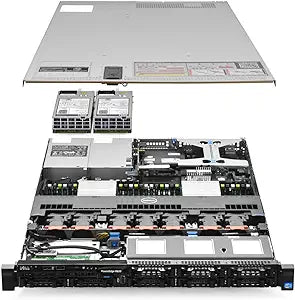
Dell PowerEdge R620 Server: Dual E5-2680, 128GB, H710P, Renewed
★★★★★
Dual Xeon E5-2680 processors and 128 GB of ECC DDR3 give this 1U server 32 threads of enterprise compute at a fraction of new-hardware cost.
View price on Amazon
Affiliate Disclosure: Studio Supplies may earn a commission from qualifying purchases made through links on this page, at no additional cost to you. This helps support our editorial team.
Notice a mistake? Let Us Know
Overview
Reliable Performance for Demanding Workloads
This renewed Dell PowerEdge R620 8-Bay Server offers a powerful and dependable solution for a variety of computing needs. Featuring dual Intel Xeon processors, ample memory, and a high-performance RAID controller, this server is ready to tackle demanding workloads.
- Model: Dell PowerEdge R620 8-Bay Server with 2.5'' Bays
- Processors: 2x 2.70Ghz E5-2680 8 Core Processors - Total of 16x Cores
- Memory: 16x 8GB PC3-10600R RAM - Total of 128GB Memory
- Hard Drives: 4x Caddies / Sleds (drives not included)
- Power Supplies: 2x 750W Platinum Power Supplies with 2x Power Cords
- RAID Controller: H710P Mini RAID Controller 1GB Cache
- Optical Drive: DVD-ROM Installed
- Remote Access Controller: iDRAC7 Express
- Network Interface: 4 x Gigabit Ethernet
- Graphics Card: Integrated Video Card
Key Features
Dell PowerEdge R620 8 Bay 2.5” Server
2x Intel Xeon E5-2680 8-Core 2.7GHz (16 Cores / 32 Threads total)
128GB DDR3 – 4x HDD Trays – H710p RAID
iDRAC7 Express - 4 Port 1GbE NIC
2x 750W Redundant Power Supplies
Pros & Cons
👍 Pros
- 32 total threads (2× E5-2680, 8 cores each at 2.7 GHz base / 3.5 GHz Turbo) provide genuine multi-tenant VM headroom at a price point that new-hardware equivalents cannot match.
- 128 GB ECC DDR3 RAM installed and tested — enough capacity to run multiple VMs or a moderate-scale database server without immediate memory expansion.
- H710P Mini RAID controller with 1 GB cache enables protected write-back RAID 5/6 configurations, delivering both redundancy and write performance on SSD arrays.
- Dual 750W Platinum-rated redundant PSUs provide N+1 power fault tolerance and measurably better efficiency at partial load compared to non-Platinum units.
- iDRAC7 Express remote management enables headless data center deployment without a dedicated KVM infrastructure investment.
👎 Cons
- DDR3 memory architecture caps maximum bandwidth per channel at ~51 GB/s aggregate — a hard bottleneck for memory-intensive analytics workloads that would benefit from DDR4's higher bandwidth.
- 1U chassis limits the R620 to eight 2.5" drive bays, constraining raw storage capacity relative to 2U alternatives; large-scale storage workloads will require external JBODs or NAS offload.
- iDRAC7 Express does not include virtual media or advanced licensing features of iDRAC7 Enterprise — remote OS provisioning requires an upgrade license or physical access for initial deployment.
- As a renewed/refurbished unit, the condition of the H710P's BBU (battery backup unit for write-cache protection) must be independently verified; a failed BBU silently degrades the RAID controller to write-through mode, eliminating the 1 GB cache performance benefit.
- The Sandy Bridge-EP architecture (2011 socket) has no PCIe 4.0 or NVMe native support — high-speed NVMe SSDs require a PCIe adapter card and the available PCIe 3.0 slots limit this option.
Frequently Asked Questions
What workloads is the dual E5-2680 configuration best suited for?
The two E5-2680 processors deliver 16 cores / 32 threads at a 2.7 GHz base clock with 20 MB L3 cache per socket. This configuration is well-matched to multi-threaded workloads that scale across cores — virtualization hosts (VMware ESXi, Proxmox), database servers (MySQL, PostgreSQL), CI/CD build farms, and containerized workloads via Docker or Kubernetes. Single-threaded tasks will feel the age of the architecture.
Does the 128 GB DDR3 memory leave room to expand?
The R620 supports up to 768 GB of DDR3/DDR3L RAM across 24 DIMM slots (12 per CPU). The configuration ships with 16× 8 GB DIMMs, leaving 8 slots unpopulated. You can upgrade to 16 GB or 32 GB LRDIMMs per slot — though sourcing DDR3 registered ECC in large capacities is increasingly a secondary-market operation.
What does the H710P Mini RAID controller with 1 GB cache enable?
The H710P supports RAID 0, 1, 5, 6, 10, 50, and 60 across up to 16 devices via an expander. The 1 GB write-back cache with battery backup unit (BBU) — confirm BBU status on the unit you receive — significantly improves write throughput on RAID 5/6 arrays compared to write-through operation. For eight 2.5" bays of SAS/SATA SSDs this controller is not the performance bottleneck.
Does this server come with hard drives installed?
No. The listing specifies four drive caddies/sleds are included, but drives are not. You will need to source 2.5" SAS or SATA HDDs or SSDs separately, formatted to your OS and RAID configuration of choice.
Can I manage this server remotely without a KVM switch?
Yes. iDRAC7 Express provides out-of-band remote management including power control, hardware health monitoring, and a virtual console via a dedicated management Ethernet port. Note that iDRAC7 Express does not include the virtual media feature of iDRAC7 Enterprise — remote OS installation requires either iDRAC Enterprise licensing or a physical connection for the initial OS deploy.
Related Products


