



Dell
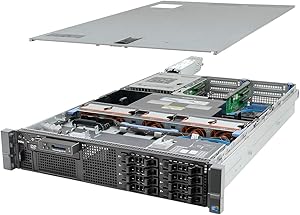
Dell Dell PowerEdge R710 Server 2 x 2.26Ghz E5520 QC 32GB (Renewed)
★★★★★
Dual Xeon E5520 quad-core processors, 32GB DDR3 ECC, and a battery-backed H700 RAID controller deliver enterprise-class virtualization infrastructure at a fraction of current-generation server hardware cost.
View price on Amazon
Affiliate Disclosure: Studio Supplies may earn a commission from qualifying purchases made through links on this page, at no additional cost to you. This helps support our editorial team.
Notice a mistake? Let Us Know
Overview
Get Reliable Server Performance at an Economical Price
The Economy Dell PowerEdge R710 Server (Renewed) provides a cost-effective solution for your server needs. Equipped with dual Intel Xeon processors and ample memory, this server offers reliable performance for a variety of applications.
Specifications:
- Processors: 2 x 2.26Ghz E5520 QC
- Memory: 32GB DDR3
- Drive Bays: 8 x 2.5" hot-swap bays
- Power Supplies: 2x 570W
- RAID Controller: H700 RAID Controller with 512MB Cache
- Remote Access Controller: iDRAC6
Key Features
DELL PowerEdge R710 Server
2 x 2.26Ghz E5520 QC
32GB DDR3
8 x 2.5" hot-swap bays
H700 RAID Controller with 512MB Cache
Pros & Cons
👍 Pros
- 16 logical threads across dual E5520 processors provide adequate virtualization scheduling headroom for 4–8 concurrent lightly loaded VMs on VMware ESXi, Hyper-V, or Proxmox at a cost tier well below current-generation server hardware
- 32GB DDR3 ECC RAM provides error-correcting memory protection for production workloads and sufficient working memory for moderate-density VM hosting without immediate expansion
- H700 RAID controller with 512MB battery-backed write cache enables hardware RAID 5/6/10 with write acceleration and data integrity protection on power loss — no software RAID compromise required
- Dual redundant 570W power supplies ensure a single PSU failure does not cause downtime — hot-swap replacement is possible without server shutdown on a properly configured power feed
- iDRAC6 remote access controller enables full out-of-band management including console redirection and power control without physical access to the machine
👎 Cons
- Intel Xeon E5520 is first-generation Nehalem architecture — at 80W TDP per socket (160W total for both CPUs), power consumption per unit of compute is significantly higher than current-generation server processors, increasing operating cost at scale
- DDR3 memory architecture is incompatible with DDR4 — expansion requires sourcing legacy DDR3 registered ECC server DIMMs, which are increasingly difficult to find at high-density capacities
- 2U rack form factor generates meaningful fan noise at operational RPM — the R710's cooling fans are loud enough to be disruptive in open office or home environments without acoustic isolation
- The H700 controller's compatibility with modern high-density SAS drives requires validation — firmware support for drives larger than those available at the R710's release era may require controller firmware updates
- Renewed status introduces unknown service history — fan bearing hours, capacitor age, and backplane connector wear are legitimate reliability concerns that new hardware purchases do not carry
Frequently Asked Questions
What CPUs are installed and what is the combined compute capacity?
Two Intel Xeon E5520 quad-core processors running at 2.26GHz. Each E5520 supports Intel Hyper-Threading, presenting 8 logical threads per socket — 8 physical cores and 16 logical threads total. For VMware ESXi, Hyper-V, or Proxmox virtualization hosts, 16 threads provides adequate scheduling headroom for 4–8 lightly loaded virtual machines running concurrently.
How much RAM is installed and can it be expanded?
32GB DDR3 registered ECC is installed across the available DIMM slots. The PowerEdge R710 supports up to 288GB of DDR3 RAM across 18 DIMM slots depending on configuration. Expansion requires sourcing DDR3 registered ECC server DIMMs — DDR4 is not compatible with this platform. DDR3 server ECC modules are available on the used market but increasingly scarce at the high-density sizes.
What RAID levels does the H700 controller support, and what does the 512MB cache contribute?
The PERC H700 supports RAID levels 0, 1, 5, 6, 10, 50, and 60 across up to 8 hot-swap drive bays. The 512MB battery-backed write cache allows the controller to acknowledge writes immediately and flush to disk asynchronously — this accelerates write-heavy workloads significantly compared to a write-through RAID configuration. The battery backup preserves cache contents during power loss, maintaining data integrity without forcing synchronous writes.
What remote management capabilities does the iDRAC6 provide?
iDRAC6 (Integrated Dell Remote Access Controller 6) provides out-of-band management including console redirection (KVM over IP), power cycle and reset control, hardware health monitoring, event logging, and firmware management — all accessible via a dedicated management network port without requiring the server's OS to be running. For headless deployments where physical server access is infrequent, iDRAC6 is the operational feature that separates this hardware from repurposed workstation alternatives.
What does the renewed designation mean for a server platform like the R710?
Renewed means the unit has been previously deployed in a production or lab environment, decommissioned, tested, and returned to service. Functional verification of processors, memory, RAID controller, and PSUs is standard in a reputable renewed process. However, component aging — fan bearing wear, capacitor condition, backplane connector integrity — cannot be inspected without disassembly. Buyers should run extended diagnostics immediately upon receipt and plan for higher-probability component replacement (fans, PSU capacitors) in the 2–4 year ownership window.
Related Products


