



Dell
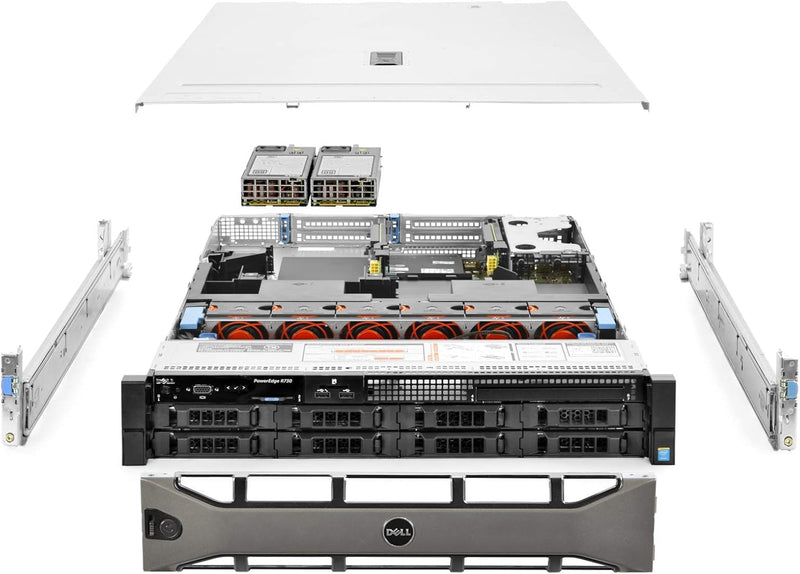
Dell Dell PowerEdge R730 Server (Renewed)
★★★★★
Dual 8-core Xeon power with 192GB RAM and 48TB raw storage tackles virtualization and database workloads at a fraction of new server cost.
View price on Amazon
Affiliate Disclosure: Studio Supplies may earn a commission from qualifying purchases made through links on this page, at no additional cost to you. This helps support our editorial team.
Notice a mistake? Let Us Know
Overview
Power Through Demanding Workloads with This Renewed Dell Server
This renewed Dell PowerEdge R730 server offers a robust and reliable solution for your business needs. Featuring dual Intel Xeon E5-2667 v3 processors, ample memory, and extensive storage, this server is ready to handle demanding applications and virtualized environments.
Specifications:
- Brand: Dell
- Model: PowerEdge R730
- Processors: 2 x Intel Xeon E5-2667 v3 3.20GHz (16 Cores Total)
- Memory: 192GB RAM
- Storage: 8 x 6TB Hard Drives
- RAID Controller: H730
Pros & Cons
👍 Pros
- Dual E5-2667 v3 processors deliver 32 threads at a high 3.20GHz base clock, outperforming lower-clocked alternatives in per-core performance
- 192GB DDR4 ECC RAM provides substantial headroom for virtualization, in-memory databases, and multi-tenant workloads
- 48TB raw storage across eight 6TB drives supports large datasets with flexible RAID configurations via the H730 controller
- The R730 chassis supports 2.5-inch or 3.5-inch drive bays, redundant hot-swap PSUs, and iDRAC8 for remote out-of-band management
- Renewed pricing puts enterprise-grade dual-socket compute at a fraction of equivalent new hardware cost
👎 Cons
- Haswell-EP architecture lacks support for newer instruction sets like AVX-512, limiting performance in specific HPC and ML inference workloads
- Eight mechanical 6TB drives will be the first failure point — plan for drive replacements and verify SMART data on arrival
- Power consumption of 300-450W and data-center fan noise make this impractical for home office or desktop-adjacent placement
- No NVMe support in the stock configuration — boot and cache drives are limited to SATA SSD speeds through the H730 controller
- As a renewed unit, remaining service life on components is unknown and Dell warranty support for this generation is limited
Frequently Asked Questions
What is the total core and thread count of this server's dual-processor configuration?
You get 16 physical cores and 32 threads total. Each E5-2667 v3 runs at 3.20GHz base with a 3.60GHz turbo, built on the Haswell-EP architecture. That high base clock makes this configuration particularly strong for single-threaded and lightly-threaded workloads compared to lower-clocked, higher-core-count Xeons from the same generation.
What RAID configurations does the H730 controller support with the eight drive bays?
The PERC H730 supports RAID 0, 1, 5, 6, 10, 50, and 60. With eight 6TB drives, a common configuration would be RAID 6 for dual-parity protection, giving you roughly 36TB of usable space, or RAID 10 for maximum read performance with 24TB usable. The H730 includes 1GB cache with battery backup for write-back caching.
Is this server suitable for running VMware ESXi or Hyper-V?
Yes. The R730 is on VMware's HCL for ESXi 6.x and 7.x, and fully supports Hyper-V. With 192GB RAM across dual processors, you can comfortably run 15-25 virtual machines depending on workload density. The platform supports up to 768GB RAM if you need to expand later using DDR4 ECC RDIMMs.
What is the power draw and noise level I should expect?
Under typical mixed workloads, expect 300-450W at the wall with dual PSUs. The R730 uses redundant hot-swap power supplies and enterprise-grade fans — it is designed for a data center or dedicated server closet, not an office environment. Fan noise at idle sits around 45-50dB.
What does "renewed" mean for server hardware reliability?
This unit has been inspected, tested, and restored to working condition. Key wear items to monitor are the mechanical hard drives, which have moving parts with finite lifespans. The processors and RAM are solid-state and rarely fail. Running a SMART check on all eight drives after delivery is strongly recommended.
Related Products


