



Dell
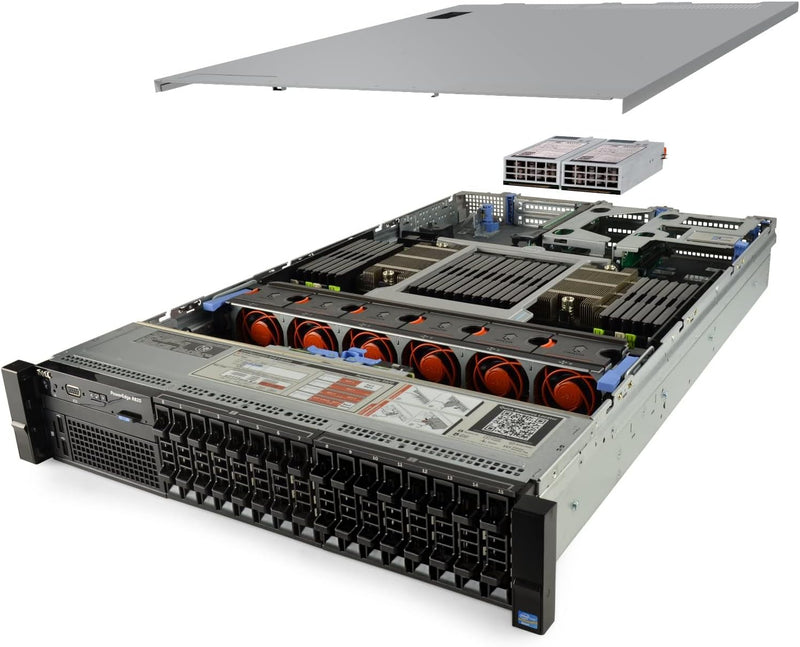
Dell Dell PowerEdge R820 40-Core 512GB H710 Server (Renewed)
★★★★★
160 threads, 512GB RAM, and dual 1100W platinum PSUs make this quad-socket R820 a serious contender for virtualization and HPC workloads on a refurbished budget.
View price on Amazon
Affiliate Disclosure: Studio Supplies may earn a commission from qualifying purchases made through links on this page, at no additional cost to you. This helps support our editorial team.
Notice a mistake? Let Us Know
Overview
Powerhouse Performance for Enterprise Computing
This Renewed Dell PowerEdge R820 Server delivers exceptional computing power with its quad-processor configuration and extensive memory capacity. Designed for demanding workloads and enterprise environments, this server is ready to handle your critical applications.
Specifications:
- Brand: Dell
- Model: Dell PowerEdge R820
- Processors: 4x Intel E5-4640 v2 2.20Ghz 10-Core (Total 40-Cores)
- Memory: 512GB DDR3 RAM
- Drive Bays: 16 x 2.5" hot-swap bays
- RAID Controller: H710 RAID Controller with 512MB Cache
- Power Supplies: 2x 1100W Platinum Power Supplies
- Network Interface: Quad Port NIC 4x 1GB RJ-45
- Condition: Renewed
Key Features
Dell PowerEdge R820 16-Bay Server with 2.5'' Drives
4x Intel E5-4640 v2 2.20Ghz 10-Core - Total of 40-Cores
512GB DDR3 RAM
No Drives or trays included
H710 RAID Controller with 512MB Cache
Pros & Cons
👍 Pros
- Quad-socket architecture delivers 40 cores and 80 threads — a thread count that holds its own against modern mid-range server SKUs at a fraction of the cost.
- 512GB DDR3 installed RAM eliminates the most expensive single upgrade cost typically associated with used server purchases.
- 16 x 2.5" hot-swap bays provide enough storage density for tiered SAN-replacement or high-VM-count datastores without external expansion.
- Dual 1100W 80 Plus Platinum power supplies provide redundant, efficient power delivery with hot-swap failover for production uptime requirements.
- Quad-port 1GbE NIC enables immediate multi-network segmentation (management, storage, VM traffic) without adding a PCIe card.
👎 Cons
- DDR3 memory is a generational ceiling — maximum memory bandwidth per socket tops out well below DDR4 or DDR5 platforms, which becomes a bottleneck for in-memory analytics workloads.
- No drives or trays included means real acquisition cost is higher than the unit price; sourcing 16 Dell-compatible 2.5" SAS trays adds time and expense.
- The E5-4640 v2 is a Sandy Bridge-EP/Ivy Bridge-EP era CPU — no AVX-512, no PCIe 3.0 on this chipset generation, limiting GPU and NVMe expansion bandwidth.
- Four-socket NUMA topology requires careful VM and workload pinning to avoid cross-socket memory latency penalties that can degrade performance unpredictably.
- Renewed condition means component age is unknown — BBU on the H710, DIMM health, and PSU capacitor wear should be validated before production deployment.
Frequently Asked Questions
What is the total thread count, and what workloads benefit most from 40 cores across four sockets?
Four E5-4640 v2 processors deliver 40 physical cores and 80 threads via Hyper-Threading. This topology excels at NUMA-aware workloads — VMware ESXi with high VM density, Oracle databases licensed per-socket, or parallel HPC jobs that benefit from distributed memory access across four independent memory controllers.
What RAID configurations does the H710 controller support, and is the 512MB cache battery-backed?
The H710 supports RAID 0, 1, 5, 6, 10, 50, and 60. The 512MB cache is backed by a Battery Backup Unit (BBU) — confirm the BBU is functional or budget for a replacement, as a failed BBU causes the controller to drop to write-through mode, significantly reducing write performance.
Does this unit include drives or drive trays?
No. The listing explicitly states no drives or trays are included. The 16 x 2.5" hot-swap bays accept SAS or SATA drives, and you will need to source compatible Dell SAS trays separately — third-party trays work but verify the backplane connector pinout.
What memory configuration delivers 512GB across four sockets?
The E5-4600 v2 platform uses an eight-channel DDR3 memory architecture per socket across four sockets — 32 DIMM slots total. 512GB is typically achieved with 16x 32GB LRDIMMs or 32x 16GB RDIMMs. Verify the installed configuration matches your latency tolerance, as LRDIMMs introduce slightly higher latency than RDIMMs.
Is this server compatible with modern hypervisors and operating systems?
Yes. VMware ESXi 6.5–7.0, Windows Server 2016/2019, and most Linux distributions (RHEL, Ubuntu LTS) support the E5-4640 v2 platform natively. ESXi 8.0 dropped support for this CPU generation — plan your hypervisor stack accordingly.
Related Products


