



Dell
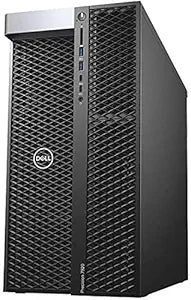
Dell Intel Xeon Precision T7920 Dual Bronze 128GB 1TB Win 11
Dual Xeon Bronze CPUs, 128GB ECC RAM, and M4000 workstation graphics deliver multi-threaded professional compute at renewed pricing.
$3,103.20*
View on Amazon
✓ In Stock on Amazon.com
*Price sourced from Amazon.com. Last updated:Jun 30, 2026.Price and availability are subject to change.
Affiliate Disclosure: Studio Supplies may earn a commission from qualifying purchases made through links on this page, at no additional cost to you. This helps support our editorial team.
Notice a mistake? Let Us Know
Overview
Specifications
Processors
2× Intel Xeon Bronze 3104, 1.7GHz, 6-core/6-thread each (12 total cores)
Memory
128GB DDR4
Storage
1TB
Graphics
NVIDIA Quadro M4000 8GB GDDR5
Operating System
Windows 11 (Renewed)
Platform
Dell Precision T7920
Condition
Renewed
Pros & Cons
👍 Pros
- Dual Xeon Bronze 3104 configuration delivers 12 physical cores for sustained parallel workloads — batch rendering, simulation, and multi-threaded compilation.
- 128GB RAM provides substantial headroom for large in-memory datasets, virtual machine hosting, and memory-intensive CAD assemblies.
- NVIDIA Quadro M4000 8GB is ISV-certified for professional CAD and 3D modeling applications where certified driver stability is required.
- T7920 chassis is enterprise-class with tool-less access and extensive expansion options for storage and PCIe cards.
- Renewed pricing delivers workstation-class hardware — typically thousands of dollars new — at a substantially reduced cost of entry.
👎 Cons
- Bronze 3104 has no Turbo Boost and no Hyper-Threading — single-threaded performance is significantly behind modern consumer processors, making single-threaded applications noticeably sluggish.
- The M4000's Maxwell-generation GPU architecture is no longer competitive for CUDA compute, ML inference, or real-time ray tracing workloads.
- 1.7GHz base clock on the Bronze 3104 is among the lowest in the Skylake-SP family — workloads that don't parallelize well across 12 cores will underperform relative to a modern 6-core desktop chip.
- Windows 11 on non-supported Xeon hardware may encounter driver edge cases or future update compatibility issues.
- 1TB storage is a single-drive configuration — no RAID redundancy is indicated, which matters for a workstation handling irreplaceable project data.
Frequently Asked Questions
What does "dual Xeon Bronze 3104" mean for multi-threaded workloads?
Each Bronze 3104 is a 6-core, 6-thread Skylake-SP chip at 1.7GHz with no Turbo Boost and no Hyper-Threading. Two of them give the T7920 12 physical cores and 12 threads. This configuration prioritizes parallel, sustained-throughput workloads — simulation, rendering farms, batch processing — over single-threaded responsiveness. Applications that don't scale across many cores will feel slower than a modern i7.
Does this workstation support ECC memory, and is the 128GB configuration ECC?
The Dell Precision T7920 platform is designed for ECC (Error-Correcting Code) registered memory, which detects and corrects single-bit memory errors in real time — a critical feature for scientific computing, financial modeling, and any workload where silent data corruption is unacceptable. The listing specifies 128GB RAM; confirm ECC status with the seller if data integrity is a hard requirement.
What is the NVIDIA Quadro M4000 capable of, and does it bottleneck the Xeon platform?
The M4000 is a professional-class GPU with 8GB GDDR5 at 192GB/s bandwidth, certified for OpenGL and DirectX workstation applications. It handles CAD, 3D modeling (3ds Max, Maya, SolidWorks), and multi-display output reliably. For GPU compute tasks (CUDA, machine learning inference), it trails modern workstation cards significantly — the M4000 is now an aging architecture, and demanding AI or rendering pipelines will feel its limits.
Can this workstation be upgraded with more RAM or faster storage?
The T7920 supports up to 3TB of DDR4 ECC registered LRDIMM across 12 slots per CPU — substantial headroom beyond the shipped 128GB. Storage expansion depends on available bays and PCIe slots; the T7920 chassis is designed for flexibility. Verify current bay configuration before purchasing additional drives.
Is Windows 11 officially supported on Xeon Bronze 3104 hardware?
Intel Xeon processors are not on Microsoft's official Windows 11 supported CPU list, which targets consumer Core and Ryzen platforms. However, workarounds at the OS installation level are commonly used on enterprise hardware, and this unit ships with Windows 11 installed. Driver and security update support may vary; verify with the seller for long-term supportability.
Related Products


