



Price history
Dell
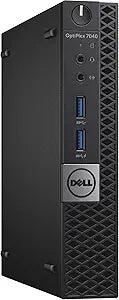
Dell OPTIPLEX7040M-I5-6500T Micro PC i5 256GB SSD (Renewed)
★★★★★
I5-6500T8GB DDR4256GB SSD
Six-generation Skylake efficiency in a chassis smaller than a hardback book — the OptiPlex 7040 Micro puts USB 3.1 and DisplayPort in a footprint that disappears behind a monitor.
$140.40*$163.99Save 14%
View on Amazon
✓ In Stock on Amazon.com
*Price sourced from Amazon.com. Last updated:Jul 17, 2026.Price and availability are subject to change.
Affiliate Disclosure: Studio Supplies may earn a commission from qualifying purchases made through links on this page, at no additional cost to you. This helps support our editorial team.
Notice a mistake? Let Us Know
Overview
Key Features
Intel Core i5-6500T 2.50GHz
8GB DDR4
256GB SSD
Specifications
Brand
Dell
Model
OPTIPLEX7040M-I5-6500T
Processor
Intel Core i5-6500T, 2.50GHz base / 3.1GHz Turbo, Quad-Core
Memory
8GB DDR4
Storage
256GB SSD
Operating System
Windows 10 Pro
Video Output
DisplayPort
USB
USB 3.1
Network
RJ-45 Ethernet; Wi-Fi
Form Factor
Micro (sub-1-liter)
Condition
Renewed
Frequently Asked Questions
What is the performance ceiling of the Core i5-6500T, and what workloads push it to its limits?
The i5-6500T is a quad-core Skylake processor with a 35W TDP, clocked at 2.5GHz base and 3.1GHz single-core turbo. It handles office productivity, web browsing, light development environments, and thin-client VDI sessions without bottlenecks. Video transcoding, large dataset analysis, or running multiple virtual machines simultaneously will saturate all four cores and expose the 2.5GHz base clock as a constraint.
Can the 8GB DDR4 RAM be upgraded?
The OptiPlex 7040 Micro supports up to 32GB of DDR4 RAM across two SO-DIMM slots. The current 8GB configuration uses one or both slots depending on the kit — confirm slot occupancy before purchasing an upgrade module to ensure compatibility and dual-channel pairing.
Does this unit support dual-monitor output?
Yes. The 7040 Micro provides both DisplayPort and likely a second video output (VGA or HDMI depending on configuration). The listed DisplayPort output supports up to 4K resolution at 60Hz for a single high-resolution display, making it usable with modern monitors beyond 1080p.
What does the 256GB SSD improve versus a traditional HDD in this class of machine?
Boot time, application launch speed, and file transfer responsiveness are all determined by storage I/O, not CPU speed, in productivity workloads. The 256GB SSD in this unit delivers sequential reads around 400–550 MB/s (SATA III ceiling) versus 80–120 MB/s from a spinning disk — that difference is perceivable within seconds of powering on.
What connectivity does this unit include?
The 7040 Micro includes USB 3.1 ports, DisplayPort video output, RJ-45 Ethernet, and Wi-Fi. The exact USB port count varies by rear/front panel configuration, but USB 3.1 Gen 1 (5Gbps) throughput supports external SSDs and fast peripherals without the USB 2.0 bottleneck found in older office hardware.
Related Products


