



Dell
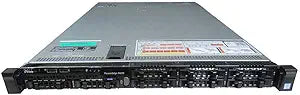
Dell PowerEdge R630 8B Server SSD (Renewed)
A dual-Xeon 1U rack server with all-SSD storage and redundant power, rebuilt and ready for production workloads.
View price on Amazon
Affiliate Disclosure: Studio Supplies may earn a commission from qualifying purchases made through links on this page, at no additional cost to you. This helps support our editorial team.
Notice a mistake? Let Us Know
Overview
High-Performance Server for Demanding Applications
The Dell PowerEdge R630 is a powerful 1U rack server designed for enterprise environments. Featuring two Intel Xeon E5-2637 V3 Quad Core processors, 96GB of RAM, and two 800GB SSDs, this renewed server provides high performance and ample storage capacity. With an H730 RAID controller and redundant power supplies, it offers reliability and scalability for your critical workloads.
- Form Factor: 1U Rack Server
- Processors: 2x Intel Xeon E5-2637 V3 Quad Core 3.5Ghz
- Memory: 96GB RAM
- Storage: 2x 800GB 6Gbps SAS 2.5" SSD
- RAID Controller: H730 1GB 12Gbps
- Power Supplies: 2x 750W Redundant
Key Features
Dell Inc. is an American technology company that develops, sells, repairs, and supports personal computers (PCs), servers, data storage devices, network switches, software, computer peripherals including printers and webcams among other products and services.
Dell is among the world's leading technology companies helping to transform people's lives with extraordinary capabilities.
Their higher-end devices feature exceptional build quality, performance, and unique designs.
Pros & Cons
👍 Pros
- Dual Xeon E5-2637 V3 processors provide 8 cores and 16 threads of high-clock-speed server performance
- Two 800GB SAS SSDs deliver fast storage I/O with no spinning disk bottleneck
- 96GB RAM supports substantial virtualization and database workloads out of the box
- H730 RAID controller with 1GB cache enables flexible and protected storage configurations
- Redundant 750W power supplies ensure uptime during a single PSU failure
👎 Cons
- 1U chassis produces considerable fan noise unsuitable for office or home environments
- Only 2 of the 8 available drive bays are populated, requiring additional drives for expanded storage
- Renewed server has unknown prior runtime hours and component wear
- Older DDR4 and Xeon V3 platform lacks support for current-generation memory and processors
- Power consumption of dual Xeon processors adds ongoing electricity cost
Frequently Asked Questions
What type of workloads is the PowerEdge R630 best suited for?
The R630 excels at virtualization (VMware, Hyper-V), database hosting, web serving, and application hosting where high core count, ample RAM, and fast SSD storage are required in a compact 1U form factor.
What RAID configurations does the H730 controller support?
The Dell PERC H730 supports RAID 0, 1, 5, 6, 10, 50, and 60. With the two included 800GB SSDs, you can configure RAID 0 for maximum capacity (1.6TB) or RAID 1 for mirrored redundancy (800GB usable).
Does "renewed" affect the server's reliability for production use?
Renewed servers are thoroughly tested, cleaned, and certified for operation. Many organizations run renewed PowerEdge servers successfully in production. The redundant power supplies and enterprise-grade components provide built-in fault tolerance.
How loud is this server, and can it be used outside of a data center?
The R630 uses high-speed fans designed for rack-mounted data center environments and produces significant noise. It is not practical for use in an office or home setting without a sound-dampened server closet or rack enclosure.
Can the memory and storage be expanded?
Yes, the R630 supports up to 24 DIMM slots for a maximum of 1.5TB RAM, and the 8-bay 2.5-inch chassis can accommodate additional SAS or SATA SSDs and HDDs beyond the two drives included.
Related Products


