



Dell
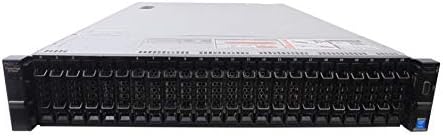
Dell PowerEdge R730xd 2X E5-2690 v4 192GB RAM Server (Renewed)
Dual 14-core Xeon E5-2690 v4s and 192GB DDR4 in a 2U chassis deliver the raw multi-threaded compute and memory bandwidth that enterprise virtualization demands — at a renewed hardware price.
View price on Amazon
Affiliate Disclosure: As an Amazon Associate, Studio Supplies earns from qualifying purchases made through links on this page, at no additional cost to you. This helps support our editorial team.
Notice a mistake? Let Us Know
Overview
Maximize Your Data Center with the Dell PowerEdge R730xd
The Dell PowerEdge R730xd is a versatile and ultra-dense rack server designed for high performance in virtualization, large business applications, and databases. Equipped with dual Intel Xeon E5-2690 v4 processors, ample DDR4 memory, and extensive storage options, this server delivers the power and scalability your data center needs.
Specifications:
- Processors: 2x Intel Xeon E5-2690 v4 2.6GHz 14-Core
- Memory: 192GB DDR4 RAM
- Storage Controller: Dell PERC H330
- Hard Drive Bays: 24x 2.5" Trays (No Hard Drives Included)
- Network: Dell Mellanox ConnectX-4 CX422A Dual Port 25Gb SFP+
- Power Supplies: 2x 750W
- Management: iDRAC8 Express
Frequently Asked Questions
What is the total core and thread count across both processors, and what workloads benefit most?
Two Intel Xeon E5-2690 v4 processors provide 28 physical cores and 56 threads total. This configuration directly benefits hypervisor workloads — VMware ESXi, Microsoft Hyper-V, and Proxmox VE can host dozens of concurrent VMs without CPU contention. Database servers running complex parallel queries, compile farms, and rendering nodes also see near-linear scaling benefits from the full thread count.
Are the 24x 2.5" drive bays compatible with both SAS and SATA drives, and does the PERC H330 support RAID configurations?
The 24-bay backplane in the R730xd supports both 2.5" SAS and SATA drives. The Dell PERC H330 controller supports RAID 0, 1, 5, 10, and 50 configurations. Note that the H330 is an entry-tier PERC card — it lacks a battery-backed write cache, which limits write performance in heavy I/O scenarios compared to the H730 or H730P. No hard drives are included; storage must be sourced separately.
What does the dual-port 25GbE ConnectX-4 NIC mean for network-intensive workloads?
The Mellanox ConnectX-4 CX422A provides two 25Gb SFP+ ports — 25Gbps per port, 50Gbps aggregate. For a server hosting multiple VMs with high-bandwidth workloads (NFS storage backends, video streaming, database replication), this is a substantial advantage over the standard 1GbE onboard ports. You'll need a 25GbE-capable switch or DAC cables to a compatible peer to realize that throughput.
How does iDRAC8 Express compare to iDRAC8 Enterprise for remote management?
iDRAC8 Express provides web-based remote management including power control, system health monitoring, and BIOS configuration — sufficient for basic remote administration. iDRAC8 Enterprise adds a dedicated remote KVM console (Virtual Console), virtual media mounting, and vFlash SD card support. For a production environment where out-of-band console access is critical, upgrading to an Enterprise license or iDRAC8 Enterprise card is recommended.
What are the power requirements, and is 2x 750W sufficient for a fully loaded configuration?
The dual 750W PSUs provide 1500W total with redundancy — if one fails, the other carries the full load. For a 24-drive, dual-CPU, 192GB RAM configuration, peak draw under full load can approach 500-650W, leaving adequate headroom. The redundant PSU configuration is critical for production environments where power supply failure cannot mean server downtime.
Related Products


