
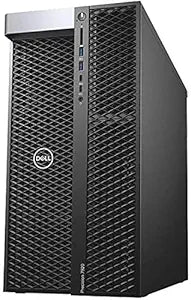
Dell Precision T7920 Tower Workstation (Renewed, Xeon Bronze 3104 / 96 GB / 250 GB SSD) — Editorial Review
The Dell Precision T7920 is Dell's flagship dual-Xeon tower workstation, originally launched in 2017 on Intel's Skylake-X platform. This specific SKU is the Renewed (Amazon refurbished) configuration: single Intel Xeon Bronze 3104 (6-core, 1.7 GHz, no boost) + 96 GB ECC DDR4 + 250 GB SSD. Per Dell's official Precision 7920 product page, the platform supports dual Intel Xeon Scalable processors, multiple GPU configurations, and ISV certifications for major CAD / DCC / scientific computing software packages. The findings below aggregate independent coverage from ServeTheHome and other professional-workstation publications.
ServeTheHome's Independent Review
ServeTheHome's Dell Precision T7920 dual Intel Xeon workstation review documents the platform's strengths and trade-offs. Key findings:
- Tool-less chassis design. Per ServeTheHome, "all of this is housed in an easy-to-service tool-less chassis, with blue tabs throughout the inside that are tool-less locking tabs allowing for easy removal of components such as PCIe devices and fans." This is meaningful for workstation operators who upgrade GPUs, expand storage, or service the system over a multi-year deployment
- Quiet operation despite serious cooling. ServeTheHome documented nine 90 mm variable-speed internal fans that spin up/down based on thermal load. "At default speeds, the system is whisper-quiet." For office and home-studio environments where fan noise matters, this is a real advantage versus loud server-class workstations
- Expandable architecture. The T7920 scales from a single processor + single GPU configuration to dual CPUs, multiple GPUs, full-bandwidth NVMe storage, and multiple network options. Buyers planning multi-year capability growth can upgrade in-chassis instead of replacing the whole system
- ISV certifications. Dell's Precision-tier workstations are explicitly certified for major engineering and creative software — meaningful when the workload involves AutoCAD, SolidWorks, Avid Media Composer, Adobe Premiere Pro, DaVinci Resolve, or scientific applications where vendor-certified driver support reduces troubleshooting overhead
About This Specific Configuration (Xeon Bronze 3104 / 96 GB / 250 GB SSD)
The Xeon Bronze 3104 is the entry-tier Skylake-SP Xeon Scalable processor — 6 cores, 1.7 GHz base clock, no Turbo Boost, 8.25 MB L3 cache. It's the workstation-class equivalent of an "office productivity CPU" — fully ECC-memory compatible, supports the T7920's professional motherboard features, but does not deliver the per-core performance that Xeon Gold or Platinum processors offer. The 96 GB ECC RAM is meaningful: workloads constrained by memory capacity (large dataset Excel / Python / R analyses, multi-VM virtualization, large CAD assemblies) benefit from the high-capacity ECC tier far more than they suffer from the modest single-CPU compute.
Where This Configuration Specifically Fits
- Engineering and CAD users on memory-bound workflows — SolidWorks large-assembly editing, AutoCAD 3D modeling, FEA simulation preparation — where 96 GB ECC RAM matters more than per-core CPU speed
- Data scientists and analysts running pandas / NumPy / R workflows on multi-GB datasets that fit comfortably in RAM and don't need many CPU cores
- Virtualization labs and homelab operators running 4-8 VMs simultaneously on a single physical machine — ECC RAM + workstation-class chassis + Dell ISV-certified hardware are the right tier
- Renewed-tier buyers seeking workstation-grade hardware at a fraction of new-equipment pricing — the T7920 platform is mature, well-documented, and the Dell tool-less chassis design simplifies any in-warranty service
- Buyers needing high-capacity ECC RAM at a budget price point — 96 GB ECC + workstation motherboard at the Renewed tier is genuinely difficult to match on a current-generation new-equipment budget
Honest Limits Buyers Should Know
- Xeon Bronze 3104 is the entry-tier Xeon Scalable. Single-threaded performance is meaningfully below current-generation Xeon W or AMD Threadripper Pro processors. Workloads bottlenecked on single-thread performance (older single-threaded CAD operations, some single-process compile workflows, real-time audio processing) will run faster on a current-generation workstation with higher per-core clocks
- The 250 GB SSD is small for a workstation. Even modest creative or engineering workloads can fill 250 GB rapidly. Buyers should plan to add NVMe expansion drives (the T7920 chassis supports multiple M.2 + 2.5" SATA + 3.5" SAS/SATA bays). Per StorageReview's Precision 7920 review, the chassis is well-equipped for storage expansion
- 2017-launch platform. The T7920 is several Xeon generations behind current (the current Dell Precision 7980 / 7960 are the successor models on newer Xeon W or Xeon Scalable architecture). For buyers wanting the absolute latest CPU + chipset + PCIe Gen5 + DDR5 memory, the current-generation Precision lineup is the appropriate tier
- Skylake-SP is end-of-life for new Intel platform support. Intel's mainstream chipset support and motherboard refresh cycles have moved past Skylake-SP. Buying a Skylake-SP workstation in 2026 means committing to the existing platform; no future CPU upgrade path within the same socket
- Power consumption is workstation-class, not desktop-class. Even at the Bronze 3104's modest TDP, the T7920's redundant-PSU-capable platform draws meaningful idle power. Home-use buyers should factor the electricity cost of an always-on workstation
- Renewed condition variability. "Renewed" can mean Apple-style certified-refurbished or third-party refurbished — buyers should confirm the Amazon listing's specific refurbishment program and warranty terms before purchase
Where Buyers Should Look Elsewhere
- Workloads bottlenecked on single-thread performance → AMD Ryzen 9 7950X or 9950X3D consumer workstation builds; or current-generation Xeon W tier (Dell Precision 5680 / 7780 / 7960)
- Heavy GPU-render or AI/ML training workloads → multi-GPU current-generation workstations supporting NVIDIA RTX 6000 Ada / 5880 Ada or multi-A100 / multi-H100 configurations
- Mobile workstation use → Dell Precision 7780 mobile workstation or HP ZBook Fury G11 for users needing workstation-class capability in a portable form factor
- Consumer-tier creative work that doesn't need ECC RAM → consumer high-end PC builds (Ryzen 9 + 64 GB DDR5 + RTX 4080) deliver more raw performance per dollar for typical 4K video editing, Blender, and music production
Sources & Citations
- Dell, "Precision 7920 Tower Workstation product page," dell.com (accessed 2026-05-18)
- ServeTheHome, "Dell Precision T7920 Dual Intel Xeon Workstation Review," servethehome.com (accessed 2026-05-18)
- StorageReview, "Dell Precision 7920 Tower Workstation Review," storagereview.com (accessed 2026-05-18)
Last verified: 2026-05-18


