G.Skill

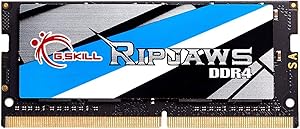
G.Skill F4-3200C22S-32GRS 32GB DDR4 3200MHz SODIMM Memory

4.7 (189 reviews)
32GB DDR4

A 32GB single DDR4-3200 SO-DIMM at 1.20V fills the memory ceiling of NUC and SFF systems in a single module, eliminating multi-kit compatibility risk.

$239.98*
In Stock on Amazon.com
View on Amazon

*Price sourced from Amazon.com. Last updated:Jun 04, 2026.Price and availability are subject to change.

Affiliate Disclosure: Studio Supplies may earn a commission from qualifying purchases made through links on this page, at no additional cost to you. This helps support our editorial team.

Notice a mistake? Let Us Know

Overview

The G.Skill RipJaws F4-3200C22S-32GRS is a 32GB single-module DDR4 SO-DIMM running at 3200MHz (PC4-25600) with CL22-22-22-52 timings at 1.20V — the standard JEDEC operating voltage for DDR4. In a single-slot form factor, 32GB represents the practical capacity ceiling for most NUC and compact SFF platforms currently in service, making this module the logical choice when maximum RAM without additional slots is the constraint. The 260-pin SO-DIMM interface is the universal standard for laptop and small-form-factor desktop memory, providing compatibility across Intel NUC 10/11/12, AMD-based SFF desktops, and conventional laptop memory bays without adapters. The JEDEC default SPD ensures the module initializes at a conservative baseline frequency on any compatible system regardless of BIOS XMP support, providing a safe floor for deployment across varied hardware.

This module is purpose-built for users upgrading memory-constrained NUC or SFF systems for more demanding workloads — virtualization, software development environments, large browser sessions with 30+ tabs, and Lightroom catalogs or video editing projects that saturate 16GB configurations. At 32GB, the system stops paging to disk in typical professional productivity workloads, which is the most meaningful real-world improvement over 16GB configurations. The single-module design is a practical trade-off: maximum capacity in minimum slots, at the cost of dual-channel bandwidth. For platforms where a second slot is available, pairing two 16GB RipJaws modules at the same speed yields measurably better memory throughput — particularly for integrated graphics pipelines that are bandwidth-limited in GPU-dependent tasks.

Key Features

G.SKILL Ripjaws DDR4 SO-DIMM Series DDR4 SO-DIMM Memory Kit, Model: F4-3200C22S-32GRS

32GB total capacity kit containing 1x32GB module, rated for up to DDR4-3200 CL22-22-22-52 at 1.20V

Non-ECC, DDR4 SO-DIMM, 260-pin, for Laptop/Notebook

Includes JEDEC default profile

Do not mix memory kits. Memory kits are sold in matched kits that are designed to run together as a set. Mixing memory kits will result in stability issues or system failure.

Refer to G.SKILL memory QVL or RAM Configurator tool on the G.SKILL website for more details on validated motherboard and hardware.

Usage in any manner inconsistent with manufacturer specifications, warnings, designs, or recommendations will result in lower speeds, system instability, or damage to the system or its components.

Memory kits will boot at JEDEC default SPD speed at default BIOS settings with compatible hardware.

Specifications

Model
F4-3200C22S-32GRS
Capacity
32GB (1 x 32GB module)
Memory Type
DDR4 SO-DIMM
Speed
3200MHz
CAS Latency
CL22
Voltage
1.20V
Pin Count
260-pin
ECC Support
Non-ECC
Compatibility
Laptop/Notebook

Similar Products

Other products from the same family that visitors often consider:

Pros & Cons

👍 Pros

  • 32GB in a single SO-DIMM slot maximizes capacity in single-slot NUC and SFF systems where only one memory slot is available, providing the maximum possible RAM without a platform upgrade.
  • DDR4-3200 at 1.20V operates at the standard JEDEC voltage specification, requiring no voltage increase to reach rated speed and maintaining compatibility with platform power delivery specifications.
  • 260-pin DDR4 SO-DIMM form factor is universally compatible across NUC, SFF desktop, and laptop platforms that support this standard — no adapter or modification required.
  • The JEDEC default SPD profile guarantees the module boots and initializes at a stable baseline frequency on any compatible system, even before XMP is enabled.
  • G.Skill's QVL validation database provides motherboard-level compatibility verification, reducing the guesswork in confirming support for specific NUC and SFF platforms.

👎 Cons

  • CL22 primary timings are among the loosest available for DDR4-3200 — users seeking maximum bandwidth efficiency from the 3200MHz frequency will find tighter CL16 or CL18 alternatives at modest cost premiums.
  • Single-module operation forfeits dual-channel bandwidth — for NUC and SFF systems with integrated graphics that depend on memory bandwidth, the GPU performance delta versus a 2×16GB dual-channel kit is measurable.
  • DDR4-3200 XMP availability depends on the platform's BIOS exposing XMP settings — some NUC BIOS implementations do not provide user-accessible XMP controls, leaving the module locked at JEDEC 2133MHz.
  • 32GB single-die SO-DIMM modules are not supported on all platforms — older memory controllers that cap per-slot capacity at 16GB will not recognize or initialize this module correctly.
  • No heat spreader on the SO-DIMM — while standard for laptop-form SO-DIMMs designed for enclosed chassis with limited airflow, sustained heavy workloads in NUC systems can produce thermal conditions that affect memory stability without active airflow.

Frequently Asked Questions

At default JEDEC SPD, the module boots at 2133MHz on most platforms. To reach the rated DDR4-3200 at CL22, you must enable XMP (Intel platforms) or EXPO/DOCP (AMD platforms) in the BIOS. Not all NUC and SFF systems expose XMP settings in accessible BIOS menus — consult your specific platform's documentation before assuming DDR4-3200 is achievable without manual intervention.
32GB in a single slot provides capacity but sacrifices dual-channel memory bandwidth — running a single module puts the memory controller in single-channel mode, delivering approximately 50% of the bandwidth of a matched 2×16GB dual-channel configuration. For NUCs with integrated graphics (Intel Iris Xe, AMD Radeon), dual-channel bandwidth is particularly important because the GPU shares system memory bandwidth. A 2×16GB setup will measurably outperform this single-slot configuration in GPU-dependent workloads.
The F4-3200C22S-32GRS is a standard 260-pin DDR4 SO-DIMM, compatible with any laptop, NUC, or SFF system that uses this form factor. Compatibility with a specific system depends on the memory controller's support for 32GB single-die modules — verify your platform's maximum per-slot capacity before purchasing, as some older systems cap single-slot support at 16GB.
CL22 is a relatively relaxed primary timing for DDR4-3200, meaning there is more latency between a memory request and data delivery compared to CL16 or CL18 kits at the same frequency. The performance difference in real-world benchmarks is typically small — 2–5% in latency-sensitive workloads — but users prioritizing maximum memory performance for the same frequency can find tighter-latency alternatives at a small cost premium.
G.Skill's own documentation explicitly warns against mixing memory kits. Running this module alongside a different brand, capacity, or speed SO-DIMM will force the system to operate at the slowest JEDEC common denominator between the two modules, and may introduce instability depending on the memory controller's tolerance for mixed module profiles. For maximum stability, pair with an identical module or run this as the sole installed DIMM.