G.Skill

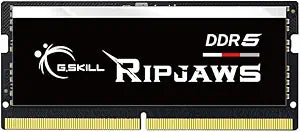
G.Skill F5-4800S4039A16GA1-RS RipJaws 16GB DDR5 SO-DIMM

4.7 (15 reviews)
16GB DDR5

DDR5-4800 SO-DIMM at 1.10V gives your laptop the bandwidth ceiling it needs for modern workloads without the power penalty.

Check availability
Affiliate Disclosure: Studio Supplies may earn a commission from qualifying purchases made through links on this page, at no additional cost to you. This helps support our editorial team.

Notice a mistake? Let Us Know

Overview

The G.Skill RipJaws F5-4800S4039A16GA1-RS is a 16GB DDR5 SO-DIMM operating at 4800 MHz with CL40-39-39-76 timings at 1.10V. To interpret those specifications: DDR5-4800 is the JEDEC baseline speed for the DDR5 generation, delivering roughly 38.4 GB/s peak theoretical bandwidth — the foundation for a meaningful performance step over DDR4's bandwidth ceiling. The 262-pin SO-DIMM form factor targets laptops and small form factor PCs that have adopted Intel 12th/13th generation, AMD Ryzen 6000/7000 series, or newer platforms requiring DDR5. At 1.10V, the module draws less power than DDR4 counterparts, which on a laptop platform means the memory subsystem is no longer the largest voltage consumer in the package.

This module is built for users upgrading from stock low-frequency DDR5 or from DDR4 platforms that have since been replaced — specifically the enthusiast or professional laptop user who wants the best single-module option available before deciding on a dual-channel configuration. G.Skill's IC screening process is the key reliability differentiator here: each module is validated to operate at rated frequency under load, rather than relying on JEDEC minimum compliance alone. The single-channel architecture of a one-module configuration is worth understanding before purchase — integrated graphics workloads and memory-bandwidth-sensitive tasks benefit substantially from dual-channel operation, so if your platform has a second SO-DIMM slot and GPU performance matters to your workflow, a matching second module is worth the additional investment. For users whose primary bottleneck is raw memory capacity rather than bandwidth, this 16GB module is a clean, stable upgrade.

Key Features

Brand: G.Skill, Series: RipJaws DDR5 SO-DIMM, Model: F5-4800S4039A16GA1-RS

16GB kit containing 1 x 16GB modules, DDR5-4800, 262-Pin, CAS Latency CL40 (40-39-39-76) at 1.10V

ECC: No, Single Channel Kit, Recommended Use: High Performance or Gaming Memory

Rated frequency & stability depends on MB & CPU capability

Specifications

Brand
G.Skill
Series
RipJaws DDR5 SO-DIMM
Model
F5-4800S4039A16GA1-RS
Capacity
16GB (1 x 16GB)
Memory Type
DDR5
Form Factor
262-Pin SO-DIMM
Speed
4800 MHz (PC5-38400)
CAS Latency
CL40-39-39-76
Voltage
1.10V
Channel
Single Channel
ECC
No

Pros & Cons

👍 Pros

  • DDR5-4800 delivers approximately 38.4 GB/s peak bandwidth per channel — a substantial improvement over the ~34 GB/s ceiling of DDR4-4266, which benefits memory-bandwidth-sensitive workloads like data processing and integrated graphics.
  • The 1.10V operating voltage is more power-efficient than DDR4's 1.2V standard, contributing to improved battery efficiency on laptop platforms.
  • G.Skill's IC chip screening process targets modules that meet rated specifications reliably rather than binning down from failed higher-speed parts — stability under sustained load is a key quality claim.
  • 262-pin SO-DIMM form factor is universal across DDR5 laptop platforms — physical compatibility is straightforward on any DDR5-capable system.
  • 16GB single-module capacity leaves the second SO-DIMM slot free for a future upgrade path to 32GB dual-channel without discarding existing hardware.

👎 Cons

  • Single-module single-channel operation leaves integrated GPU performance below what a dual-channel 2x8GB or 2x16GB configuration would achieve — on platforms where the iGPU shares system memory bandwidth, this is a measurable gap.
  • CL40 timings are at the looser end of DDR5-4800 — tighter-timed alternatives exist, though the real-world impact for most workloads is minimal.
  • DDR5 is not backward-compatible with DDR4 systems — this is a platform-specific upgrade, not a universal one.
  • Actual 4800 MHz operation is contingent on the host platform's memory controller; some older DDR5-capable platforms may default to lower speeds.

Frequently Asked Questions

No. DDR5 and DDR4 are physically and electrically incompatible — the 262-pin DDR5 SO-DIMM connector does not fit a DDR4 slot. Your laptop must explicitly support DDR5 to use this module.
DDR5-4800 is the JEDEC standard speed for this module — it should run at 4800 MHz on any DDR5-compatible platform without enabling XMP profiles. That said, actual achieved speed depends on your motherboard and CPU's memory controller capability.
Yes. A single module operates in single-channel mode. If your laptop has two SO-DIMM slots and you want dual-channel bandwidth — which can improve integrated GPU performance notably — you would need a second matching module.
The module runs at 1.10V, which is the DDR5 standard and lower than DDR4's typical 1.2V. The reduced voltage contributes to better power efficiency, which translates to marginal but measurable battery life improvement on mobile platforms.
CL40-39-39-76 at 4800 MHz. At DDR5-4800, CL40 is standard JEDEC timing — it represents a higher absolute latency number than DDR4 but a lower cycle time due to the higher operating frequency, so real-world latency is comparable.