



HP
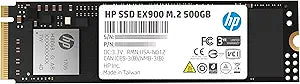
HP 2YY44AA#ABC EX900 500GB NVMe M.2 Internal SSD
★★★★★
500GB NVMe
The HP EX900 delivers up to 2,100 MB/s sequential reads over PCIe 3.0 x4, turning a SATA-bound system into a 4x throughput leap for large file transfers, OS boot, and application launches.
$45.99*
Check availability
*Price sourced from Amazon.com. Last updated:Jul 14, 2026.Price and availability are subject to change.
Affiliate Disclosure: Studio Supplies may earn a commission from qualifying purchases made through links on this page, at no additional cost to you. This helps support our editorial team.
Notice a mistake? Let Us Know
Overview
Key Features
M. 2 2280, HP controller Offering with 4 flash memory channels that support PCIe 3. 1 x4 and NVMe 1. 3
Sequential read/write speeds up to 2, 100 Mbps/ 1, 500 Mbps, an industry top leading reliability (MTBF) 2M hours, and endurance (TBW) up to 200 TBW
Higher order LDPC error Correction for high speed parallel decoding and real time error Correction to ensure data integrity and security
Works on all Windows PC, Full compatibility with host. Exe (HP software pre-installation environment). Ideal upgrade for HP PCs
Manufactured to HP high quality standards and fully tested and CERTIFIED in HP laboratories. Not intended for use in HP workstations
Specifications
Capacity
500GB
Form Factor
M.2 2280
Interface
PCIe 3.1 x4, NVMe 1.3
NAND Type
3D TLC
Flash Channels
4
Sequential Read
Up to 2,100 MB/s
Sequential Write
Up to 1,500 MB/s
4KB Random Read
Up to 100,000 IOPS
4KB Random Write
Up to 80,000 IOPS
Read Latency
0.021ms
Write Latency
0.029ms
MTBF
2,000,000 hours
Endurance (TBW)
200 TBW
Power (Idle)
0.68W
Power (Active)
3.52W
Operating Temperature
0°C to +70°C
Storage Temperature
-40°C to +85°C
Shock Resistance
100G / 6ms
Vibration Resistance
3.1g (2–500 Hz)
Dimensions
22mm x 80mm x 2.4mm
Weight
5.4g
Pros & Cons
👍 Pros
- 2,100 MB/s sequential read over PCIe 3.0 x4 delivers measurably faster OS boot and application load times versus any SATA SSD at any capacity point
- 200 TBW write endurance at 500GB capacity provides strong long-term reliability for workstation-level daily write volumes
- LDPC error correction with higher-order parallel decoding actively protects data integrity without a measurable performance penalty under sustained read/write cycles
- 4-channel controller with 3D TLC NAND maintains random read performance at 100,000 IOPS — adequate for multitasking and mixed-access workloads
- M.2 2280 form factor at 5.4g and 2.4mm height fits virtually every modern desktop, laptop, and NUC motherboard with a PCIe M.2 slot
👎 Cons
- PCIe 3.0 x4 tops out at 2,100 MB/s — systems with PCIe 4.0 M.2 slots gain no interface benefit from this drive, where Gen 4 NVMe options in the same price range offer 5,000+ MB/s
- 4KB random write IOPS at 80,000 trails competitive Gen 3 drives like the WD Blue SN570 at equivalent capacity, which matters for workloads with heavy small-file write patterns
- No included heatsink; sustained large sequential write workloads (e.g., extended game installs, video ingestion) in thermally limited M.2 slots may cause throttling
- HP designates this drive as not intended for HP workstations — Z-series workstation users should verify compatibility before purchasing
- DRAM-less controller design means sustained write performance can dip as the SLC cache fills, perceptible during very large (100GB+) single-pass file write operations
Frequently Asked Questions
What interface and form factor does the EX900 use?
The EX900 is an M.2 2280 (22mm wide, 80mm long) drive using PCIe 3.1 x4 with NVMe 1.3 protocol. It fits any M.2 slot labeled NVMe or PCIe — it will not function in M.2 SATA-only slots.
What are the sequential read and write speeds, and what does that mean practically?
Sequential read tops out at 2,100 MB/s and write at 1,500 MB/s. A typical SATA SSD peaks at roughly 550 MB/s — the EX900 delivers approximately 4x that read throughput for large file transfers, OS loads, and application launches, where the difference is immediately perceptible.
What endurance rating does the EX900 carry?
The 500GB EX900 is rated for 200 TBW (terabytes written) with an MTBF of 2,000,000 hours. At typical consumer workloads of 30–50 GB written per day, 200 TBW represents multiple years of write endurance before reaching the rated limit.
Does the EX900 work in non-HP computers?
Yes — it is a standard M.2 NVMe drive compatible with any PC with an M.2 PCIe slot, including AMD and Intel desktops and laptops from any manufacturer. The HP compatibility note refers to HP's pre-installation environment software, not a hardware restriction.
Does the EX900 require a heatsink?
No heatsink is required under normal operating conditions — the drive is rated for 0°C to 70°C operation. Sustained heavy write workloads in cases with poor M.2 airflow may warrant an aftermarket heatsink, but thermal throttling is not a commonly reported issue under typical consumer use.
Related Products


