

HP
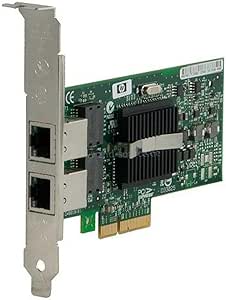
HP 412648-B21 NC360T PCI-Express Dual Port Gigabit Adapter
Dual Gigabit ports on a single PCIe card — cut CPU overhead and double your server's network throughput in one slot.
$32.00*
View on Amazon
✓ In Stock on Amazon.com
*Price sourced from Amazon.com. Last updated:Aug 28, 2026.Price and availability are subject to change — details.
Affiliate Disclosure: As an Amazon Associate, Studio Supplies earns from qualifying purchases made through links on this page, at no additional cost to you. This helps support our editorial team.
Notice a mistake? Let Us Know
Overview
Key Features
End-to-end Gigabit solution
Better network performance by alleviating congestion and removing bottlenecks
High-performance connectivity solution for your LAN
Significantly reduces CPU utilization and increases throughput
Allows Lower Power Consumption, Remote Wake And Remote Booting
Pci-E V1.0A Compliant
Senses and configures itself to the speed and duplex type of the attached device
Support For Acpi Wol (Wake On Lan)
Specifications
Interface
PCI Express v1.0a
Ports
2x Gigabit Ethernet (RJ-45)
Chipset
Intel 82571EB
Speed
10/100/1000 Mbps (auto-sensing)
Wake-on-LAN
ACPI WOL supported
Remote Boot
Supported
Model
HP NC360T (412648-B21)
Frequently Asked Questions
What chipset does the NC360T use, and why does it matter for driver stability?
The NC360T is built on the Intel 82571EB chipset — one of the most widely supported server NIC chipsets ever made. This means mature, stable drivers across Windows Server, Linux (e1000e module), and VMware ESXi, with no exotic firmware requirements. If driver reliability is your primary concern, Intel-based NICs at this tier are the benchmark.
Will this card work in a modern PCIe x4 or x8 slot if no x1 slot is available?
Yes — PCIe is backward and forward compatible in terms of slot size. The NC360T will operate in a PCIe x4, x8, or x16 slot at full PCIe Gen 1 bandwidth. The card only requires PCIe x4 electrical bandwidth to run both Gigabit ports simultaneously at line rate, so slot size is not a bottleneck here.
How much does the NC360T actually reduce CPU utilization compared to running two onboard NICs?
The NC360T offloads TCP/IP processing via hardware TCP Segmentation Offload (TSO) and Large Receive Offload (LRO). In high-throughput server scenarios, this can reduce NIC-related CPU utilization by 30–50% compared to software-processed network stacks — freeing cycles for application workloads.
Does this card support Wake-on-LAN in a PCIe slot without an auxiliary WOL connector?
Yes — ACPI Wake-on-LAN is supported via the PCIe bus without requiring a dedicated WOL header cable. The card uses the PCIe power rails to maintain WOL standby state. Ensure your system BIOS has PCIe WOL enabled for this to function correctly.
Is the NC360T compatible with link aggregation (LACP/802.3ad) for bonded throughput?
Yes — both ports support IEEE 802.3ad LACP link aggregation when connected to a managed switch that supports LACP. This allows you to bond both Gigabit ports for up to 2 Gbps aggregate throughput with failover capability, controlled at the OS or hypervisor level.
Related Products


