



HP
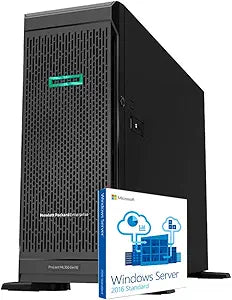
HP ASISVR121 Renewed ProLiant ML350 G10 Server 7.68TB SSD
68TB SSD
Dual Xeon Silver 4110 compute and 7.68TB all-SSD storage in a certified-renewed ML350 Gen10 tower delivers enterprise-class VM hosting at a fraction of new-build pricing.
View price on Amazon
Affiliate Disclosure: Studio Supplies may earn a commission from qualifying purchases made through links on this page, at no additional cost to you. This helps support our editorial team.
Notice a mistake? Let Us Know
Overview
Power Your Business with a Reliable and Efficient Server Solution
The HP ProLiant ML350 G10 Tower Server delivers robust performance and scalability for your business needs. Equipped with dual Intel Xeon Silver processors, ample memory, and ultra-fast SSD storage, this renewed server is designed for reliability and efficiency.
Specifications:
- Processors: Dual (2) Intel Xeon Silver 4110 8-Core 2.10GHz 8MB CPUs
- Memory: 64GB (4 x 16GB) DDR4 PC4-19200 2400MHz Registered Memory
- Storage: 7.68TB (4 x 1.92TB) 6Gb/s SATA III Solid State Drives
- Condition: Certified Refurbished
- Operating System: Windows Server 2016 Installed
- Features: Redundant Power Supplies
Key Features
HP ProLiant ML350 Gen10 Tower Server with Windows Server 2016 Installed
Dual (2) Intel Xeon Silver 4110 8-Core 2.10GHz 8MB CPUs
64GB (4 x 16GB) DDR4 PC4-19200 2400MHz Registered Memory
7.68TB (4 x 1.92TB) 6Gb/s SATA III Solid State Drives for Ultra Fast Enterprise Storage in RAID; Redundant Power Supplies
Pros & Cons
👍 Pros
- Dual Xeon Silver 4110 CPUs provide 16 cores / 32 threads — sufficient thread density for VM consolidation workloads where per-core clock speed matters less than parallel capacity.
- All-SATA-SSD storage array eliminates HDD mechanical failure risk and delivers low-latency I/O that spinning disks cannot match at any rotational speed.
- Redundant power supplies provide hardware-level PSU fault tolerance — single PSU failure does not interrupt server operation.
- Four open DIMM slots (64GB across 4 of 8 slots) leave a clear upgrade path to 128GB or higher without replacing existing modules.
- Tower chassis enables deployment in non-rack environments, reducing infrastructure overhead for smaller IT deployments.
👎 Cons
- 64GB DDR4 is a tight memory budget for dense VM hosting — a host running 15+ VMs will hit memory pressure before CPU or storage become the constraint.
- Four-drive RAID array offers less I/O parallelism than the eight-drive configuration in higher-spec variants — sequential throughput ceiling is proportionally lower.
- Windows Server 2016 pre-install, while still supported, is one generation behind and will reach end of mainstream support sooner than a 2019 or 2022 installation.
- SATA III interface caps storage performance well below what NVMe-based alternatives can achieve — not a fit for latency-sensitive NVMe-class workloads.
- Renewed units carry uncertainty around remaining drive wear life — SSD health audit on arrival is mandatory, not optional.
Frequently Asked Questions
How does the 64GB memory configuration compare to higher-spec ML350 Gen10 variants, and is it expandable?
64GB across four 16GB RDIMMs is a starting point, not a ceiling — the ML350 Gen10 supports significantly more RAM, and these four slots leave additional DIMM slots available for expansion. For light virtualization (10–15 VMs at 4GB each) or a dedicated database server, 64GB is functional. Heavy multi-tenant VM hosting or large in-memory database workloads will pressure this configuration faster than the 256GB variant.
What does the 7.68TB SSD RAID array actually deliver in real-world I/O performance?
Four 1.92TB SATA III drives in RAID-5 give you roughly 5.76TB usable with parity protection, or RAID-10 yields ~3.84TB with mirroring. Sequential read throughput across four SATA III SSDs in RAID can reach 1.5–2.5GB/s depending on the HP Smart Array controller configuration — fast enough that storage will not be the bottleneck for most SMB workloads.
Does Windows Server 2016 vs. 2019 on this unit matter for my deployment?
Windows Server 2016 is still in mainstream support through 2027 and receives security updates. The primary differences from 2019 are fewer container and hybrid cloud features — if your workload is traditional VM hosting or file/print services, 2016 is completely production-viable. Upgrading to 2019 or 2022 in place is supported if needed.
Will the dual Xeon Silver 4110 configuration handle SQL Server or Exchange workloads?
Yes, for mid-size deployments. SQL Server Standard on this hardware can comfortably handle databases in the hundreds of GB range with typical query loads. Exchange 2016/2019 for 50–200 mailboxes fits within the CPU and memory envelope. The all-SSD storage is particularly valuable here — transaction log writes and mailbox I/O benefit directly from the low-latency storage tier.
What should I inspect on a renewed unit before production deployment?
Prioritize: (1) SSD health via HP Smart Storage Administrator — check percentage life remaining on all four drives, (2) iLO system event log for hardware faults, (3) memory DIMM seating and ECC error counters. These three checks cover the failure modes most commonly associated with repurposed enterprise hardware.
Related Products


