



HP
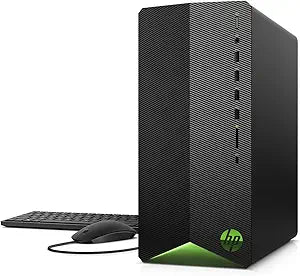
HP Core i5-10400F Pavilion TG01 Gaming PC RTX 3060
The RTX 3060's 12GB GDDR6 frame buffer paired with 64GB RAM gives this Pavilion TG01 headroom that most entry gaming towers can't match at this price.
Check availability
Affiliate Disclosure: Studio Supplies may earn a commission from qualifying purchases made through links on this page, at no additional cost to you. This helps support our editorial team.
Notice a mistake? Let Us Know
Overview
Specifications
Processor
Intel Core i5-10400F
Graphics Card
RTX 3060
Model Name
Pavilion TG01
Pros & Cons
👍 Pros
- The RTX 3060's 12GB GDDR6 VRAM on a 192-bit bus provides substantial texture memory headroom — larger than competing cards at this performance tier — supporting 1440p gaming and high-resolution asset workloads.
- 2TB PCIe SSD eliminates the SATA-speed penalty common in value gaming towers and provides room for a large game library without management friction.
- The i5-10400F's 4.3 GHz all-core boost sustains competitive frame rates in moderately threaded titles without thermal throttling under typical gaming loads.
- 64GB DDR4 at 2666 MHz provides extreme multitasking headroom for users running streaming software, VMs, or creative applications alongside gaming sessions.
- The compact 12.9 x 6.12 x 13.28-inch footprint fits a standard desktop under-desk configuration without the floor-space demand of mid-tower cases.
👎 Cons
- The i5-10400F is a 10th-gen CPU — two generations behind current Intel mainstream silicon — and lacks PCIe 4.0 support, which means the PCIe NVMe SSD cannot exceed Gen 3 bandwidth on this platform.
- 64GB DDR4 at 2666 MHz is overprovisioned for gaming and underclocked relative to DDR4-3200+ kits, which provide measurable performance gains with Comet Lake CPUs; the memory allocation is mismatched for this use case.
- Bluetooth 4.2 is dated relative to Bluetooth 5.0/5.2 now standard on comparable systems — relevant for users pairing wireless controllers, headsets, or peripherals with strict latency requirements.
- HP Pavilion TG01 chassis have limited upgrade paths for CPU (LGA1200 socket is a dead end with no future Intel platform support) and restricted airflow in the slim tower form factor.
- The 802.11ac (Wi-Fi 5) wireless module trails the Wi-Fi 6 standard now common on similarly priced competing systems, relevant in congested wireless environments.
Frequently Asked Questions
How does the i5-10400F bottleneck the RTX 3060 in practice?
The i5-10400F is a 6-core, 12-thread Comet Lake chip running up to 4.3 GHz. At 1080p, it can bottleneck the RTX 3060 in CPU-heavy titles (open-world games, simulation titles with dense AI), where frame rates occasionally dip below the GPU's capability. At 1440p, the GPU becomes the limiting factor more consistently, reducing the bottleneck effect. For esports titles and moderately threaded games, the pairing is well-matched.
Is 64GB of DDR4 RAM actually useful in a gaming build at this tier?
For gaming specifically, 64GB is well beyond what any current title requires — 16GB is sufficient for gaming, 32GB for streaming simultaneously. The excess RAM capacity is most useful if this machine doubles as a workstation for video editing, 3D rendering, or virtual machines. For pure gaming, that memory budget would have been better allocated to a faster GPU or CPU.
Does the RTX 3060 in this system support ray tracing and DLSS?
Yes. The RTX 3060 is an Ampere-architecture GPU with dedicated RT cores for ray tracing and Tensor cores for DLSS. DLSS 2.x support is broad — in DLSS-enabled titles at 1440p, the RTX 3060 can maintain 60+ fps with quality-mode upscaling even in demanding games, extending the GPU's effective performance range.
What storage upgrade options exist, and is the 2TB PCIe SSD the only drive bay?
HP Pavilion TG01 towers typically include at least one M.2 slot and one SATA bay, though HP's specific TG01 configuration can vary. The 2TB PCIe SSD is the primary boot and storage drive. Verify available internal expansion slots via HP's support documentation for this model before planning a storage upgrade.
What is the realistic 1080p gaming performance of the RTX 3060 in this config?
At 1080p High/Ultra settings, the RTX 3060 12GB delivers 60–100+ fps in most current AAA titles — typically 80–100 fps in games like Cyberpunk 2077 at High settings, and well over 100 fps in less demanding titles. The 12GB VRAM buffer is a meaningful advantage over the 8GB RTX 3060 Ti in workloads with high-resolution texture packs.
Related Products


