



HP
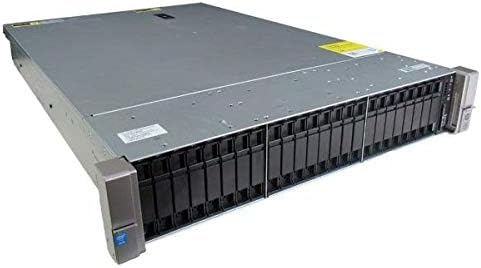
HP DL380 G9 E5-2680V3 128GB 11.52TB SSD 24-Bay Server Renewed
Twenty-four cores of Haswell-EP compute power paired with 11.52TB of all-SSD storage — a renewed rack server built for workloads that can't wait on spinning disks.
View price on Amazon
Affiliate Disclosure: Studio Supplies may earn a commission from qualifying purchases made through links on this page, at no additional cost to you. This helps support our editorial team.
Notice a mistake? Let Us Know
Overview
Reliable Performance for Demanding Workloads: HP DL380 G9 Server
The HP DL380 G9 24-Bay 2.5" Server is a robust and reliable solution designed to handle demanding workloads. Featuring dual Intel Xeon processors, ample memory, and high-capacity SSD storage, this server delivers exceptional performance for businesses of all sizes.
- Processors: 2x Intel Xeon E5-2680 V3 12-Core 2.5Ghz
- Memory: 128GB DDR4 REG RAM
- Storage: 11.52TB (24x 480GB SSD NEW)
- Controller: HPE Smart Array P440 12Gb/s
Key Features
HP DL380 G9 24-Bay 2.5 Server
2x Intel Xeon E5-2680 V3 12-Core 2.5Ghz
128GB DDR4 REG RAM
HPE Smart Array P440 12Gb/s
11.52TB (24x 480GB SSD NEW)
Pros & Cons
👍 Pros
- Twenty-four physical cores across two E5-2680 V3 processors enable dense VM hosting — dozens of concurrent virtual machines on a single chassis without resource contention at modest per-VM allocations.
- 11.52TB of all-SSD storage across 24 bays delivers consistent, low-latency I/O without the seek-time variance of spinning disk arrays — database query response times are substantially faster than equivalent HDD configurations.
- The HPE P440 12Gb/s controller supports hardware RAID with onboard processing, offloading parity calculations from the main CPUs and delivering predictable throughput under sustained write load.
- 128GB of DDR4 registered ECC RAM with 20 additional DIMM slots available allows memory expansion to 768GB — the platform scales with growing virtualization or in-memory database demands.
- New SSDs in a renewed chassis deliver full write endurance budgets without accumulated wear, reducing the storage-layer risk typical of fully refurbished server storage pools.
👎 Cons
- The E5-2680 V3 is a 2014-era Haswell-EP processor — single-threaded IPC performance is significantly lower than current-generation Intel Xeon or AMD EPYC alternatives at comparable core counts.
- No NVMe support in the 24-bay 2.5" SAS/SATA configuration — maximum sequential read throughput is limited by the SAS/SATA interface ceiling, not the SSDs themselves, leaving NVMe-class speeds unavailable without additional PCIe adaptation.
- DDR4-2133 memory speed is the maximum supported by this platform — current platforms run DDR5 at substantially higher bandwidth, which impacts memory-intensive analytical workloads and large in-memory databases.
- Power consumption at full load is significant — dual E5-2680 V3 CPUs with a full SSD complement draws several hundred watts continuously, with corresponding cooling and electricity costs in production deployment.
- As a renewed platform, hardware age means iLO firmware, BIOS updates, and HPE support contract availability are limited — organizations requiring vendor-backed support should factor in third-party maintenance costs.
Frequently Asked Questions
What is the combined core and thread count across both processors, and what workloads benefit most?
Two Intel Xeon E5-2680 V3 processors deliver 24 physical cores and 48 threads total. Each core runs at a base clock of 2.5GHz with Turbo Boost to 3.3GHz. This configuration benefits most from highly parallelized workloads — virtualization hosts running many VMs simultaneously, database servers handling concurrent queries, media transcoding pipelines, and scientific or analytical compute jobs. Single-threaded performance is less competitive against current-generation processors.
What does the HPE Smart Array P440 controller add compared to a basic SATA/SAS controller?
The P440 is a 12Gb/s SAS/SATA RAID controller with an onboard cache (cache module sold separately or may be included depending on configuration). It supports RAID 0, 1, 5, 6, 10, and 50/60 configurations across the 24 SSD bays. Beyond RAID, the P440 offloads parity calculations from the main CPUs, delivers consistent I/O throughput under heavy load, and provides drive health monitoring and predictive failure alerting through HP's iLO management interface.
Is 128GB of DDR4 RAM expandable, and what is the maximum memory this platform supports?
The E5-2680 V3 platform and DL380 G9 chassis support up to 768GB of DDR4 registered ECC RAM across 24 DIMM slots. The current 128GB configuration uses a fraction of available slots, leaving clear headroom for expansion. DDR4 REG ECC is required — consumer DDR4 is not compatible with this server platform.
Are the 480GB SSDs new units or reconditioned, and what impact does this have on expected lifespan?
The product listing specifies the 24x 480GB SSDs as new, which is a meaningful distinction in a renewed server. The chassis, processors, and RAM are renewed (inspected, tested, refurbished), but the storage layer is new — meaning you get a full TBW (terabytes written) endurance budget on each drive without accumulated write wear from prior deployment.
What does this server lack compared to a current-generation Dell or HP platform?
The E5-2680 V3 (Haswell-EP, 2014 architecture) predates PCIe 4.0, NVMe-native storage controllers, and DDR5 support. Compared to current Sapphire Rapids or Genoa platforms, single-core IPC is notably lower and memory bandwidth is limited to DDR4-2133. For workloads that are core-count and I/O bound rather than single-threaded IPC dependent, the performance gap is less significant than the price difference.
Related Products


