



HP
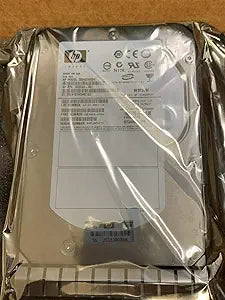
HP SAS DD400B8541 400-GB 10K 3.5 DP SAS 10-Pack
Ten 400GB 10K SAS drives in one pack — enterprise-grade IOPS and dual-path redundancy built for storage arrays that cannot afford downtime.
Check availability
Affiliate Disclosure: Studio Supplies may earn a commission from qualifying purchases made through links on this page, at no additional cost to you. This helps support our editorial team.
Notice a mistake? Let Us Know
Overview
Specifications
Capacity
400 GB per drive
Rotational Speed
10,000 RPM
Interface
Dual Port SAS (DP SAS)
Form Factor
3.5 inch LFF
Quantity
10 drives
Total Raw Capacity
4 TB (10 x 400 GB)
Brand
HP
Pros & Cons
👍 Pros
- 10K RPM rotational speed delivers average seek times of 3.5–4.5ms and ~130–170 random IOPS — meaningfully faster than 7.2K SAS alternatives in latency-sensitive workloads.
- Dual-Port SAS enables MPIO configurations, providing path-level redundancy without requiring drive replacement if a single HBA or SAS path fails.
- 3.5" LFF form factor is compatible with a broad base of existing enterprise server chassis and backplanes that cannot accept 2.5" SFF drives without adapters.
- 10-pack quantity supports immediate RAID array builds without ordering in multiple batches, reducing configuration time in deployment scenarios.
- 400GB capacity per drive is sufficient for OLTP database volumes, log storage, and virtual machine datastores in environments where capacity per drive is secondary to IOPS density.
👎 Cons
- 400GB capacity per drive is below the 1–4TB range now standard for enterprise nearline SAS HDDs; total raw array capacity of 4TB (10 drives) is limited relative to modern storage requirements.
- Spinning platter technology has intrinsically higher failure rates and longer rebuild times than SSD alternatives — RAID rebuilds on 10K SAS drives at 400GB can take hours, expanding the vulnerability window.
- 10K SAS drives consume more power per IOPS than SATA SSDs; in a dense array, power and cooling overhead is measurably higher than a comparable SSD deployment.
- These drives are HP-targeted; compatibility outside of HP ProLiant and qualified HP Smart Array controller configurations may require verification and is not guaranteed.
- No stated firmware version or drive model sub-revision is provided, which can complicate compatibility verification against specific HP server/controller qualification matrices.
Frequently Asked Questions
What does 10K RPM actually mean for this drive's performance profile versus 7.2K alternatives?
10,000 RPM reduces rotational latency to roughly 3ms versus 4.2ms on a 7,200 RPM drive. Combined with the 3.5" platter diameter, this translates to average seek times in the 3.5–4.5ms range and random IOPS figures typically in the 130–170 IOPS range — roughly 30–40% higher than 7.2K SAS equivalents. For transaction-heavy workloads like OLTP databases, this latency reduction is measurable.
What does "DP SAS" (Dual Port SAS) mean and why does it matter for server deployments?
Dual Port SAS means the drive exposes two independent SAS ports, each capable of connecting to a separate SAS controller or HBA. This enables multipath I/O (MPIO) configurations where both paths to the drive are active simultaneously — if one path or controller fails, I/O continues on the surviving path without downtime or data loss. In any redundancy-critical server environment, dual-port is the correct specification.
What server backplane and HBA do these drives require?
These 3.5" SAS drives require a SAS backplane with 3.5" LFF (Large Form Factor) bays and a SAS HBA or RAID controller with SAS support — not SATA-only controllers. Common compatible platforms include HP ProLiant DL/ML servers with HP Smart Array controllers and any system using LSI/Broadcom SAS HBAs. Verify your backplane supports SFF-8482 or SFF-8087/8088 SAS connectors.
How does 400GB SAS capacity compare to modern SSDs, and where does it still make sense?
400GB is modest by current storage standards, but these drives are optimized for IOPS density per rack unit rather than raw capacity. They remain relevant in legacy HP enterprise environments where the existing storage architecture, RAID configuration, and controller ecosystem are already in place and the cost of migrating to SSD is not justified by the workload profile.
Can these drives be used in a RAID array, and what RAID levels are appropriate?
Yes — dual-port SAS drives are designed for RAID deployment. With 10 drives in this pack, common configurations include RAID 10 (5 mirrored pairs, ~2TB usable with full redundancy), RAID 6 (8+2 parity, ~3.2TB usable with two-drive fault tolerance), or RAID 50/60 for larger arrays. RAID level selection should be driven by the application's IOPS, capacity, and redundancy requirements.
Related Products


