



HP
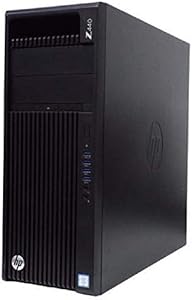
HP Z Series Z440 Workstation E5-1650 v4 128GB Renewed
500GB NVMeDisplayPort
The HP Z440's six-core Xeon E5-1650 v4 at 3.6GHz with 128GB ECC RAM delivers professional workstation compute at a renewed price that's hard to justify ignoring.
$479.00*
View on Amazon
✓ In Stock on Amazon.com
*Price sourced from Amazon.com. Last updated:Jun 30, 2026.Price and availability are subject to change.
Affiliate Disclosure: Studio Supplies may earn a commission from qualifying purchases made through links on this page, at no additional cost to you. This helps support our editorial team.
Notice a mistake? Let Us Know
Overview
Key Features
3.6Ghz Six Core E5-1650 v4 CPU
128GB of ECC DDR3 RAM
500GB NVMe M.2 SSD with PCIe Adapter Card Drive
Nvidia NVS 310 512MB Graphic Card - 2 DisplayPort - 2 Active Monitor Support
No Operating System Included
Specifications
Processor
Intel Xeon E5-1650 v4, 6-Core, 3.6GHz base / 4.0GHz Turbo
Memory
128GB ECC DDR4 RAM
Storage
500GB NVMe M.2 SSD via PCIe Adapter
Graphics
Nvidia NVS 310, 512MB, 2x DisplayPort
Display Support
2 Active Monitors
Operating System
None Included
Condition
Renewed
Model
HP Z Series Z440
Pros & Cons
👍 Pros
- The E5-1650 v4's 3.6GHz base clock with 4.0GHz Turbo delivers strong single-threaded performance that outpaces many higher-core-count Xeons in lightly threaded professional applications.
- 128GB of ECC DDR4 RAM supports large in-memory datasets, multi-VM development environments, and memory-intensive simulation workloads without paging to disk.
- 500GB NVMe SSD via PCIe 3.0 x4 provides sequential read throughput multiple times faster than SATA SSD — dramatically reducing load times for large project files and application launches.
- The Z440's tool-free chassis and hot-swap-friendly design simplify component upgrades, making RAM and storage expansions straightforward without specialist tools.
- ECC memory error correction is a non-negotiable feature for professional workflows where silent data corruption is unacceptable — it is not present on consumer-grade workstations at this price.
👎 Cons
- The Nvidia NVS 310 with 512MB VRAM is a display-output card, not a compute GPU — it will bottleneck any workflow requiring GPU acceleration (rendering, machine learning inference, video transcoding) and must be replaced for those use cases.
- No operating system is included, adding procurement and activation costs before the machine is production-ready.
- The E5-1650 v4 is a single-socket design — workloads that scale efficiently past twelve threads will hit a ceiling that a dual-socket platform (such as the Z640 or Z840) would not.
- PCIe 3.0 bandwidth caps NVMe throughput below what a native M.2 PCIe 4.0 slot on a current-generation workstation would deliver — sequential writes in particular may be lower than the drive's rated spec depending on the adapter.
- As a Broadwell-EP platform (2016 architecture), the Z440 does not support PCIe 4.0, Thunderbolt 3/4, or USB 3.2 Gen 2 natively — connectivity expansion requires add-in cards.
Frequently Asked Questions
What CPU is in this Z440, and what workloads does the E5-1650 v4 target?
The E5-1650 v4 is a six-core, twelve-thread Broadwell-EP Xeon running at 3.6GHz base with a 4.0GHz Turbo Boost ceiling and 15MB L3 cache. Its high base clock relative to other Xeon E5 v4 parts makes it well-suited for single-threaded-sensitive professional applications — CAD, 3D rendering tools, EDA software, and simulation workloads that don't scale linearly past six cores.
Is 128GB ECC DDR4 the maximum this platform supports?
The Z440 supports DDR4 ECC RDIMM across its eight DIMM slots (single CPU socket), with a platform maximum of 256GB. This unit ships with 128GB, leaving room to expand. Note that the E5-1650 v4 supports quad-channel DDR4-2400 — populating all four channels for maximum bandwidth requires matched DIMM sets of four.
What does the 500GB NVMe SSD via PCIe adapter mean for storage performance?
The NVMe drive is installed on a PCIe adapter card rather than a native M.2 slot, which is standard for Z440 builds of this era. PCIe 3.0 x4 bandwidth caps at approximately 3.5GB/s — a Gen 3 NVMe drive in this configuration will still deliver sequential reads of 1,500–3,500MB/s, which is five to fifteen times faster than the SATA SSD alternative.
What does the Nvidia NVS 310 support in terms of display output?
The NVS 310 provides two DisplayPort outputs supporting up to 2560x1600 per display, with a maximum of two simultaneous monitors. It is a low-profile compute card, not a gaming or rendering GPU — if you need GPU compute or high-end visualization, this card should be treated as a placeholder.
Does this workstation include an operating system?
No OS is included. The Z440 supports Windows 10 Pro, Windows 11 (with TPM 2.0 module installed), and major Linux distributions including Ubuntu and RHEL.
Related Products


