



HP
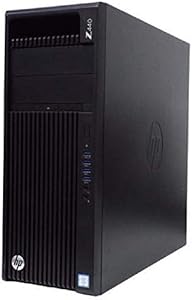
HP Z Series Z440 Workstation Xeon 256GB SSD Renewed
256GB SSD500GB NVMe
256GB of ECC-registered DDR3 and a 500GB NVMe SSD give this renewed Xeon workstation memory bandwidth that most desktops never see.
$648.00*
View on Amazon
✓ In Stock on Amazon.com
*Price sourced from Amazon.com. Last updated:Jun 30, 2026.Price and availability are subject to change.
Affiliate Disclosure: Studio Supplies may earn a commission from qualifying purchases made through links on this page, at no additional cost to you. This helps support our editorial team.
Notice a mistake? Let Us Know
Overview
Key Features
3.5Ghz Quad Core E5-1620 v3 CPU
256GB of ECC DDR3 RAM
500GB NVMe M.2 SSD with PCIe Adapter Card Drive
GeForce 210 1GB Graphic Card - 1 HDMI, 1 DVI, 1 VGA - 2 Active Monitor Support
No Operating System Included
Specifications
Processor
Intel Xeon E5-1620 v3, Quad-Core, 3.5GHz
Memory
256GB ECC DDR3 RAM
Storage
500GB NVMe M.2 SSD via PCIe Adapter Card
Graphics Card
GeForce 210, 1GB
Display Outputs
1x HDMI, 1x DVI, 1x VGA
Max Active Monitors
2
Operating System
None (not included)
Condition
Renewed
Pros & Cons
👍 Pros
- 256GB ECC DDR3 capacity supports in-memory processing of datasets that would force page-file thrashing on consumer platforms
- 500GB NVMe SSD delivers sequential read speeds well above the SATA SSDs common in systems from this era
- Xeon E5-1620 v3 at 3.5GHz base provides strong single-core throughput for lightly-threaded professional applications
- HP Z440 platform includes multiple PCIe slots for GPU and storage expansion beyond the included configuration
- Renewed pricing provides Xeon workstation infrastructure at a fraction of equivalent new hardware cost
👎 Cons
- Quad-core E5-1620 v3 with no hyperthreading is a hard ceiling for multi-threaded workloads — 4 logical cores in 2024 is a meaningful constraint
- DDR3 memory bus is two generations behind current DDR5 platforms — peak memory bandwidth is approximately 51 GB/s versus 96+ GB/s on modern DDR5 workstations
- GeForce 210 1GB is a legacy display card incapable of GPU-accelerated compute, modern game rendering, or hardware video encoding — replacement is expected for most professional workflows
- No operating system included — Windows 11 compatibility requires TPM 2.0, which this platform does not natively provide
- NVMe drive installs via PCIe adapter card, consuming an expansion slot that would otherwise be available for additional peripherals
Frequently Asked Questions
What does 256GB of ECC DDR3 RAM actually enable that a consumer desktop cannot?
ECC (Error-Correcting Code) RAM detects and corrects single-bit memory errors in real time — a requirement for workloads where data integrity is non-negotiable: finite element analysis, large dataset processing, virtual machine hosting, and scientific computation. 256GB of registered DDR3 also allows you to load extremely large datasets entirely in-memory, eliminating I/O bottlenecks that would otherwise force constant disk paging. Standard consumer desktops are limited to 128GB maximum on high-end platforms and lack ECC support entirely on mainstream chipsets.
What are the performance limitations of the Intel Xeon E5-1620 v3 in 2024 workloads?
The E5-1620 v3 is a quad-core Haswell-EP processor at 3.5GHz with no hyperthreading — it presents 4 logical cores to the OS. For lightly threaded single-core workloads, the 3.5GHz base clock remains competitive. For heavily multi-threaded workloads (video encoding, 3D rendering, parallel compilation), the 4-core ceiling is a hard bottleneck. Modern equivalents in the same workstation category offer 8–32 cores.
Does the included GeForce 210 support modern display configurations?
The GeForce 210 1GB supports a maximum of 2 active monitors via HDMI, DVI, or VGA outputs. It is a legacy display adapter — not suitable for GPU compute, gaming, or accelerated video workflows. For professional visualization, simulation, or GPGPU workloads, the PCIe slots on the Z440 support modern replacement cards including Quadro and Radeon Pro series.
What interface does the 500GB NVMe drive use, and is it a native M.2 slot or adapter?
The listing specifies a 500GB NVMe M.2 SSD installed via a PCIe adapter card — the Z440 predates native M.2 slots and the NVMe drive uses a PCIe x4 adapter to access the bus. Performance is functionally equivalent to a native M.2 NVMe slot for sequential reads and writes, though the adapter occupies a PCIe expansion slot.
Does this workstation ship with an operating system?
No. This is a renewed unit with no OS pre-installed. Windows 10 or 11 Pro, Windows Server editions, or Linux distributions must be sourced and installed separately. Windows 11 compatibility may require a TPM 2.0 module, which the base Z440 platform does not include natively.
Related Products


