
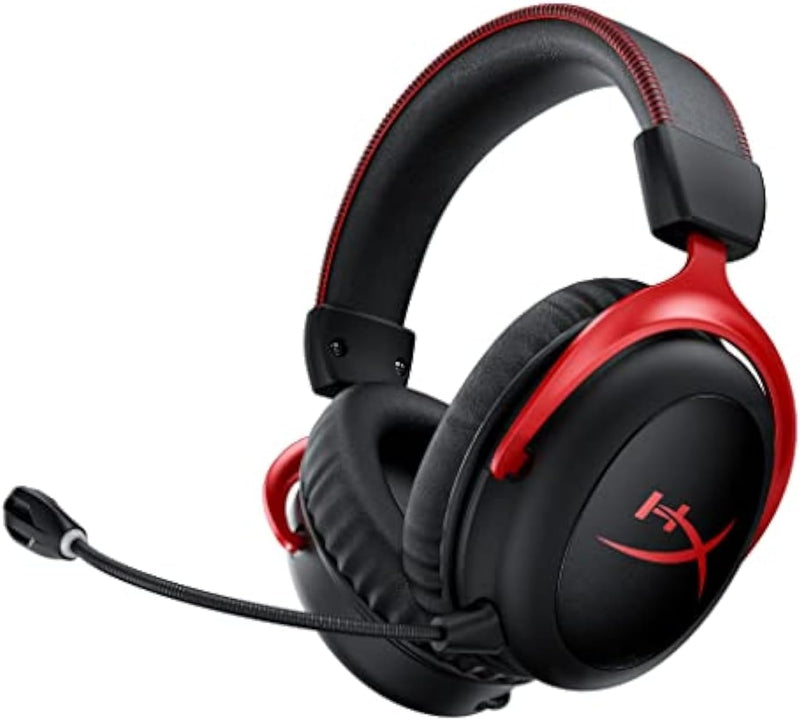


HyperX Cloud II Gaming Headset — Editorial Review & Use Cases
The HyperX Cloud II (HX-HSCP-RD Red, HX-HSCP-GM Gunmetal, HX-HSCP-SR Silver, plus the Cloud II Alloy Origins Core bundle SKU) is HyperX's flagship wired closed-back gaming headset — 53mm drivers, USB sound card with 7.1 virtual surround sound, memory foam earcups, detachable noise-cancelling microphone. Per HyperX's official Cloud II product page, the Cloud II has been the de-facto budget-to-mid-range gaming headset since 2015 — used by competitive esports teams (multiple Counter-Strike, Valorant, and Apex Legends pros), praised in PC gaming press for sound + comfort + microphone quality at sub-$100 price.
What the HyperX Cloud II Specifically Wins
- 53mm dynamic drivers — larger than typical 40mm gaming headsets. Better bass response for gunfire, explosions, footstep audio cues
- USB sound card with virtual 7.1 surround — connects via USB-A; the sound card delivers Windows / Mac surround processing. Crucial for FPS positional audio (CS2, Valorant, Apex)
- Memory foam earcups + headband — comfortable for 3-4 hour sessions. Closed-back design isolates from ambient noise (vs open-back HD 6XX)
- Detachable noise-cancelling boom microphone — clear voice chat for Discord / TeamSpeak / Mumble. Cardioid pickup pattern + electret condenser
- 3.5mm + USB connectivity — works with PC / Mac / PS5 / Switch / Xbox Series X|S (via 3.5mm controller jack) / mobile devices via 3.5mm
- Aluminum frame — more durable than all-plastic competitors. Survives bag transport + travel
- 2-year HyperX warranty — solid customer support track record
- Wide retailer availability — Amazon, Best Buy, Newegg, Microcenter, Target. Easy to buy and replace
- Used by competitive esports teams — Cloud II + Cloud II Wireless are common at LAN tournaments
- Inline volume + mic mute control on the USB sound card
Where the HyperX Cloud II Specifically Fits
- Competitive FPS gaming (CS2, Valorant, Apex Legends, Overwatch 2) — surround for footsteps + gunfire positional cues
- MOBA / RTS gaming (LoL, Dota 2, StarCraft) — clear voice chat for team coordination
- Twitch / YouTube streaming — built-in mic captures voice clearly without separate USB mic investment
- Discord / TeamSpeak voice chat for any game
- Casual gaming + everyday listening — closed-back isolates from ambient + adequate music quality
- PC + console multi-platform gamers — same headset across PS5 / Switch / Xbox / PC
- Console gaming with controller 3.5mm jack
- Music production scratch monitoring — closed-back fine for casual monitoring (not studio reference)
- Podcast recording on a budget — built-in mic + headphones combo
- Online classroom / Zoom / Microsoft Teams for clear voice + chat audio
- Cafe / library quiet gaming — closed-back isolation
- Office gaming break — closed-back doesn't leak music to coworkers
Honest Limits Buyers Should Know
- Wired only — no Bluetooth. For wireless, step up to HyperX Cloud II Wireless or Cloud Stinger 2 Wireless. Wired has lower latency for competitive gaming but limits mobility
- USB sound card is a separate piece — losing it = losing 7.1 surround. The Cloud II works as a basic 3.5mm headset without the sound card, but loses the virtual surround processing
- Closed-back design — limited soundstage vs open-back. Audiophile-detail listening + spatial separation benefits from open-back headphones (Sennheiser HD 6XX). Cloud II is closed-back for isolation but with narrower soundstage
- Microphone is good for gaming, not pro studio recording. Adequate for Discord / TeamSpeak voice; not for podcast recording or voiceover (use a dedicated USB mic like HyperX QuadCast or Shure MV7)
- Cable is non-detachable. Cable failure = replacing the whole headset. For detachable cable, look at HyperX Cloud Alpha S or competing brands
- Boom microphone position is fixed. No flexible 360-degree positioning (some boom mics rotate freely). Cloud II's boom mic is positioned to one side
- Wired tether limits mobility — cable can catch on chair arms / desk corners
- Memory foam earcups can get warm in long sessions. 4+ hour sessions in warm environments may cause ear sweat. Cooling-gel earcup alternatives (HyperX Cloud Alpha S, ASUS ROG Strix Pro) wick heat better
- Older design (2015 release). Newer wireless gaming headsets (SteelSeries Arctis Nova Pro Wireless, HyperX Cloud III Wireless) offer better feature sets — Cloud II is best in the "wired budget" tier, not premium
- Not suitable for audiophile-grade music listening. Gaming-tuned headphone, V-shape response. Audiophiles want flat reference (HD 6XX, Sennheiser HD 660 S2)
Where Buyers Should Look Elsewhere
- Wireless gaming headset → HyperX Cloud II Wireless, HyperX Cloud III Wireless, SteelSeries Arctis Nova Pro Wireless
- Premium wired gaming → SteelSeries Arctis 7P / 9X, HyperX Cloud Alpha S
- Audiophile / open-back listening → Sennheiser HD 6XX, Beyerdynamic DT 880 Pro, Sennheiser HD 660 S2
- Studio reference for production → Sennheiser HD 280 Pro, Audio-Technica ATH-M40x / M50x
- USB-only gaming headset → SteelSeries Arctis 7 (no 3.5mm)
- Higher-end gaming with ANC → Razer BlackShark V2 Pro, Astro A50
- Mobile gaming + voice chat → Backbone One headphone + phone mic system
- Console-specific premium → SteelSeries Arctis 7P (PS5/PS4 native), Astro A40 TR (Xbox)
- Pure budget gaming → Logitech G432, Razer Kraken Kitty Edition entry
Sources & Citations
- HyperX, "Cloud II Gaming Headset product page," hyperx.com (accessed 2026-05-19)
- RTINGS.com, "HyperX Cloud II review and gaming headset comparison," rtings.com (accessed 2026-05-19)
- PC Gamer, "Best gaming headset buying guide," pcgamer.com (accessed 2026-05-19)
- Tom's Hardware, "Gaming headset reviews and benchmarks," tomshardware.com (accessed 2026-05-19)
Last verified: 2026-05-19


