



Intel
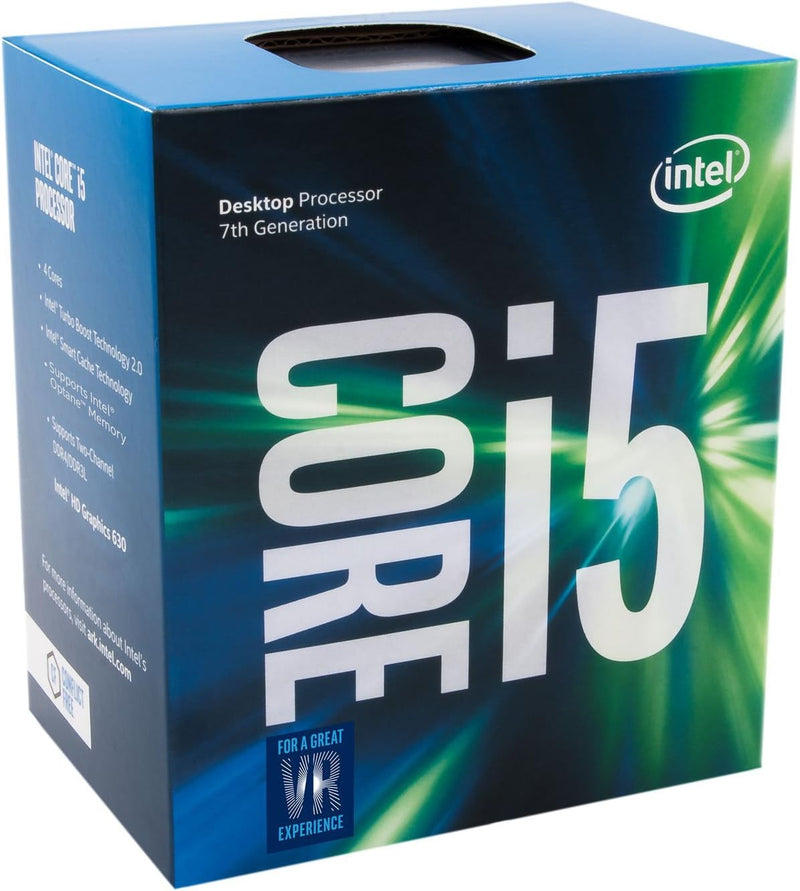
Intel BX80677I57500 Core i5-7500 Desktop Processor - LGA 1151
i5-7500
Four cores at 3.8 GHz Turbo on LGA 1151 — the Kaby Lake i5-7500 hits its performance ceiling efficiently for mainstream desktop builds.
$73.80*
View on Amazon
✓ In Stock on Amazon.com
*Price sourced from Amazon.com. Last updated:Oct 23, 2026.Price and availability are subject to change — details.
Affiliate Disclosure: As an Amazon Associate, Studio Supplies earns from qualifying purchases made through links on this page, at no additional cost to you. This helps support our editorial team.
Notice a mistake? Let Us Know
Overview
Key Features
Socket LGA 1151
Intel 200/1001 Series Chipset Compatibility (1. Excludes Intel Octane Technology support)
Intel HD Graphics 630
Intel Turbo Boost 2.0 Technology
Intel Hyper-Threading Technology1
Specifications
Socket
LGA 1151
Cores / Threads
4 / 4
Base Frequency
3.4 GHz
Max Turbo Frequency
3.8 GHz
TDP
65W
Integrated Graphics
Intel HD Graphics 630
Max Display Resolution
4096 x 2304 @ 60 Hz
Memory Support
DDR4-2133/2400, DDR3L-1333/1600
Max Memory
64 GB
Chipset Compatibility
Intel 200-series, select 100-series (BIOS update required)
Generation
7th Gen Intel Core (Kaby Lake)
Similar Products
Other products from the same family that visitors often consider:
 ✓ Available
Intel BX80662I36320 Core i3-6320 LGA 1151 Processor
$65.00
View on Amazon → ✓ Available
Intel BX8070110900 Core i9-10900 Desktop Processor (LGA 1200)
$465.00
View on Amazon → ✓ Available
Intel Core i5-7500 Kaby Lake 3.4 GHz Processor (Renewed)
$40.80
View on Amazon → ✓ Available
Intel Core i7-9700K Octa-Core 3.6 GHz LGA 1151 Processor
$237.91
View on Amazon → ✓ Available
Intel SR3QS Core i7-8700 Hexa-Core LGA 1151 Processor
$98.00
View on Amazon →Frequently Asked Questions
What motherboard chipsets are compatible with the Core i5-7500?
The i5-7500 uses the LGA 1151 socket and is compatible with Intel 200-series chipsets (Z270, H270, B250, H110) and select 100-series boards (Z170, H170, B150) with a BIOS update. Note that Intel explicitly excludes Optane Memory support on this SKU. Verify BIOS version on 100-series boards before installing.
Does the i5-7500 support Hyper-Threading, and does it matter for gaming?
The i5-7500 does NOT support Hyper-Threading — it presents 4 physical cores with no virtual thread doubling. For gaming in 2017-era titles, 4 threads was sufficient. However, modern games and creative tools increasingly leverage 8+ threads, meaning this CPU can become a bottleneck in thread-heavy workloads. For single-threaded gaming performance, the 3.8 GHz Turbo ceiling remains competitive on older titles.
What memory types and speeds does this processor support?
The i5-7500 officially supports DDR4-2133 and DDR4-2400, and DDR3L-1333 and DDR3L-1600 with a maximum of 64GB across two channels. Overclocked XMP memory profiles above 2400 MHz require a Z270 board — B250 and H-series boards lock memory at the rated JEDEC speeds.
What bottleneck does pairing this CPU with a modern GPU create?
In GPU-bound scenarios at high resolutions (1440p, 4K), the i5-7500 is generally not the limiting factor. The bottleneck appears in CPU-bound scenarios — dense open-world games, titles with heavy simulation, or streaming while gaming simultaneously — where 4 threads without Hyper-Threading constrains frame pacing and multitasking throughput compared to modern 6-core or 8-core alternatives.
Does the integrated Intel HD Graphics 630 support 4K output?
Yes. The HD Graphics 630 supports a maximum resolution of 4096 x 2304 at 60 Hz via DisplayPort. This is suitable for desktop productivity and media playback, but the integrated GPU lacks the shader throughput for modern 3D gaming at 4K — discrete GPU is required for that use case.
Related Products


