

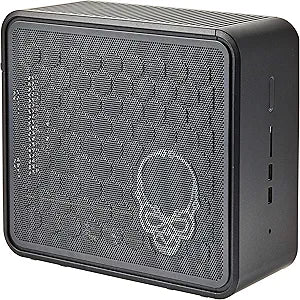


Intel
Intel BXNUC9i5QNX NUC Ghost Canyon Mini PC - i5-9300H
★★★★★
The Ghost Canyon NUC packs an i5-9300H and a discrete GPU into a form factor small enough to mount behind a monitor, without sacrificing the PCIe bandwidth that compact systems usually trade away.
Check availability
Affiliate Disclosure: Studio Supplies may earn a commission from qualifying purchases made through links on this page, at no additional cost to you. This helps support our editorial team.
Notice a mistake? Let Us Know
Overview
Specifications
Brand
Intel
Model
BXNUC9i5QNX (NUC 9 Ghost Canyon)
Processor
Intel Core i5-9300H (4-core, 8-thread, up to 4.1GHz)
Processor TDP
45W
Form Factor
Mini PC (NUC)
GPU Slot
PCIe 3.0 (proprietary NUC 9 half-length)
Included
Video Card
Memory Slots
2× SO-DIMM DDR4 (up to 64GB)
Storage Slots
2× M.2 2280 (NVMe/SATA)
Pros & Cons
👍 Pros
- 45W i5-9300H with 4.1GHz boost delivers quad-core performance comparable to desktop-class i5 parts in a chassis small enough to VESA-mount behind a display.
- Full PCIe 3.0 slot for discrete GPU — a capability absent from virtually all other NUC-class mini PCs — means this system doesn't force the CPU to handle graphics workloads.
- Modular Compute Element design allows the CPU/RAM/storage card to be swapped for a higher-spec NUC 9 element without replacing the entire chassis.
- Two M.2 slots support NVMe primary storage and a secondary drive simultaneously, avoiding the single-drive limitation of smaller NUC generations.
- Thunderbolt 3 connectivity (standard on the Ghost Canyon platform) provides 40Gbps I/O for external GPU enclosures, NVMe storage, or 5K display output.
👎 Cons
- GPU upgrades are constrained to half-length cards compatible with the proprietary NUC 9 slot — standard desktop cards do not physically fit, limiting upgrade paths compared to a full tower.
- The i5-9300H is a 9th-gen mobile part — single-thread performance trails current-gen Intel Core Ultra or AMD Ryzen 7000 mini PC options by a meaningful margin for CPU-bound tasks.
- The included GPU specification is not detailed in this listing, making it difficult to assess gaming or compute performance without further investigation.
- DDR4 SO-DIMM memory runs at lower bandwidth than desktop DIMM configurations, which can surface as a bottleneck in memory-bandwidth-sensitive workloads like large texture streaming or GPU-CPU transfer operations.
Frequently Asked Questions
What sets the Ghost Canyon NUC apart from standard NUC models architecturally?
Ghost Canyon uses Intel's Compute Element modular design — the CPU, RAM, and M.2 storage live on a removable card inside the chassis, separate from the baseboard. The baseboard provides a full-length PCIe 3.0 x16 slot for a discrete GPU via a proprietary NUC Compute Element Expansion card. This is fundamentally different from standard NUCs, which have no discrete GPU slot.
What is the i5-9300H's performance tier and what workloads does it suit?
The i5-9300H is a 45W quad-core, eight-thread Coffee Lake-H mobile processor with a 4.1GHz boost clock. It performs comparably to desktop i5-9400 parts in single-threaded workloads and handles light gaming, 4K video editing, and software development builds without thermal throttling under normal sustained loads.
What GPU is included, and can I upgrade it?
A video card is listed as included with this unit. The NUC 9 Extreme chassis accepts half-length, single-slot or double-slot GPU cards via the NUC Compute Element — standard desktop GPUs do not fit due to the proprietary slot and chassis dimensions. Upgradeable, but constrained to cards specifically designed or confirmed compatible with the Ghost Canyon form factor.
What RAM and storage does this unit support?
The Ghost Canyon Compute Element accepts two SO-DIMM slots (DDR4-2666, up to 64GB total) and two M.2 2280 slots supporting NVMe and SATA drives. Configuration specifics for this listing are not detailed beyond the processor and included GPU.
Is Ghost Canyon suited for a home theater or living room deployment?
Its compact size and HDMI/Thunderbolt 3 outputs make it physically practical for AV use, but the 45W H-series processor and discrete GPU generate meaningful heat and fan noise under load — it is not a passive-cooling silent PC. At idle or light loads, fan noise is manageable.
Related Products


