



Intel
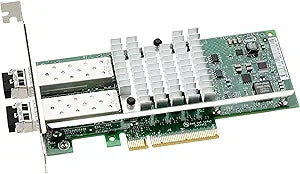
Intel E10G42BFSR Ethernet X520-SR2 Server Adapter
The Intel X520-SR2 drives dual 10GbE SFP+ ports off a single PCIe slot, resolving the 1GbE bandwidth ceiling for storage, virtualization, and high-throughput server workloads.
$44.99*$48.00Save 6%
View on Amazon
✓ In Stock on Amazon.com
*Price sourced from Amazon.com. Last updated:Aug 30, 2026.Price and availability are subject to change — details.
Affiliate Disclosure: As an Amazon Associate, Studio Supplies earns from qualifying purchases made through links on this page, at no additional cost to you. This helps support our editorial team.
Notice a mistake? Let Us Know
Overview
Key Features
Intel 82599 10 Gigabit Ethernet Controller - Industry-leading, energy-efficient design for next-generation 10 Gigabit performanceand multi-core processors
Low-profile - Enables higher bandwidth and throughput from standard and low-profile PCIe slots and servers
Load balancing on multiple CPUs - Increases performance on multi-processor systems by efficiently balancing network loads acrossCPU cores when used with Receive-Side Scaling (RSS) from Microsoft or Scalable I/O on Linux
Intel PROSet Utility for Windows Device Manager - Provides point-and-click management of individual adapters, advanced adapter features, connection teaming, and virtual local area network (VLAN) configuration
Support for most network operating systems (NOS) - Enables widespread deployment
Specifications
Model
X520-SR2 / E10G42BFSR
Controller
Intel 82599 10 Gigabit Ethernet
Ports
2x 10GbE SFP+
Interface
PCIe 2.0 x8
Optic Type
SFP+ (SR — 10GBASE-SR multimode fiber)
Form Factor
Standard + Low-Profile bracket included
SR-IOV Support
Yes
RSS Support
Yes (multi-core load balancing)
OS Support
Windows Server, Linux (ixgbe), VMware ESXi, FreeBSD, most enterprise NOS
Management
Intel PROSet Utility (Windows), native OS drivers (Linux/ESXi)
Frequently Asked Questions
What PCIe slot and version does the X520-SR2 require, and what bandwidth does it consume?
The X520-SR2 uses a PCIe x8 slot and is backward-compatible with PCIe x16 slots. It operates over PCIe 2.0, which provides approximately 4 GB/s of bidirectional bandwidth — sufficient for two simultaneous 10GbE ports running near-line rate (2 x 10 Gbps = ~2.5 GB/s aggregate). The card also fits in low-profile chassis via the included low-profile bracket.
What transceiver modules are compatible with the X520-SR2's SFP+ ports?
The X520-SR2's SFP+ ports accept short-range fiber optic modules — the "SR" designation indicates Single-mode or Multimode SR optics (specifically 850nm multimode for 10GBASE-SR). Intel-branded SFP+ modules are natively supported. Third-party SFP+ modules may require unlocking or firmware modification on some systems, as the 82599 controller performs vendor ID checks. Verify SFP+ compatibility with Intel's qualification list for third-party optics.
Does the X520-SR2 support SR-IOV for virtualization workloads?
Yes. The Intel 82599 controller supports SR-IOV (Single Root I/O Virtualization), which allows the physical NIC to present multiple virtual functions (VFs) to a hypervisor like VMware ESXi, Proxmox, or KVM. Each VM can access a dedicated VF with near-native performance, bypassing the hypervisor's virtual switch overhead — a significant throughput advantage for storage and network-intensive VMs.
What OS and driver support does the X520-SR2 have?
The Intel 82599 controller has mature driver support across Windows Server, Linux (ixgbe module), VMware ESXi, FreeBSD, and most enterprise NOS environments. Intel's PROSet utility provides Windows Device Manager-based configuration for teaming, VLANs, and advanced adapter features. Linux driver support through the ixgbe module is stable and actively maintained across current kernel versions.
Is this adapter suitable for a home lab or NAS build, or is it strictly enterprise hardware?
The X520-SR2 functions perfectly in home lab and NAS builds — Proxmox, TrueNAS, and unRAID all support the 82599 controller natively. The main practical consideration is the SFP+ interface: you'll need compatible SFP+ modules and either a 10GbE SFP+ switch or direct-attach copper (DAC) cables to connect to other devices. The enterprise-grade build quality is an advantage for 24/7 NAS operation; the SFP+ ecosystem cost is the barrier compared to RJ45-based 10GbE alternatives.
Related Products


