

Intel
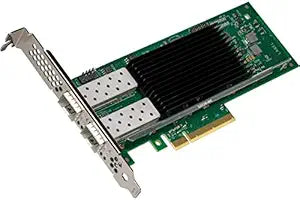
Intel E810-XXVDA2 Ethernet Network Adapter 25GbE SFP28
Dual 25GbE SFP28 ports with ADQ and RoCEv2 support eliminate network bottlenecks in cloud-scale and enterprise storage workloads.
$254.30*
View on Amazon
✓ In Stock on Amazon.com
*Price sourced from Amazon.com. Last updated:Oct 07, 2026.Price and availability are subject to change — details.
Affiliate Disclosure: As an Amazon Associate, Studio Supplies earns from qualifying purchases made through links on this page, at no additional cost to you. This helps support our editorial team.
Notice a mistake? Let Us Know
Overview
Key Features
This 25Gigabit Ethernet card will surely cater to the bandwidth requirements of the next-gen cloud and Web-scale environments
This dual port 25gigabit ethernet card lets you add two network ports using a single expansion slot to a client, server or workstation
Supports optical fiber cable to span longer distances and provides data transmission rates par excellence between servers and network components
Specifications
Type
Ethernet Network Adapter
Data Transfer Rate
25GbE
Port Type
SFP28
Port Count
Dual Port
Cable Type Supported
Optical Fiber
Brand
Intel
Frequently Asked Questions
What PCIe slot does the E810-XXVDA2 require, and what lane width does it use?
The E810-XXVDA2 uses a PCIe x8 slot. It physically occupies a single expansion slot while delivering two 25GbE ports — meaning you're getting 50Gbps of aggregate throughput from one slot, which is the core efficiency argument for this card in dense server builds.
What does Application Device Queues (ADQ) actually do for workload performance?
ADQ isolates application traffic into dedicated hardware queues, preventing high-priority workloads like NVMe-oF or latency-sensitive microservices from being queued behind bulk data transfers. In practice, this reduces tail latency — the worst-case response times that kill consistent application performance under load.
Does the E810-XXVDA2 support RDMA, and which implementations?
Yes — both iWARP and RoCEv2 are supported. iWARP routes RDMA over standard TCP, making it more firewall-friendly across routed networks. RoCEv2 operates over UDP and delivers lower CPU overhead in lossless Ethernet fabrics. Which you choose depends on your network topology and switch infrastructure.
Is the E810-XXVDA2 compatible with Linux and VMware environments?
Intel provides inbox drivers for Linux kernels 4.4 and later, and VMware ESXi is supported via Intel's native driver package. Dynamic Device Personalization (DDP) profiles also allow the card's packet processing pipeline to be reconfigured without hardware changes, which is particularly useful in virtualized and containerized environments.
What does IEEE 1588 PTP v2 support mean for this card's use cases?
PTP v2 (Precision Time Protocol) enables hardware-timestamped synchronization to sub-microsecond accuracy. This is essential in financial trading infrastructure, telecom timing chains, and any distributed application where coordinated timing across nodes matters. The E810 handles PTP in hardware rather than software, eliminating OS jitter from the timing path.
Related Products


