Intel

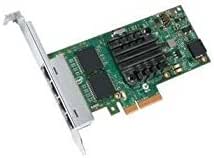
Intel I350T4V2BLK Ethernet Server Adapter I350-T4 Quad Port

Four independent GbE ports on a single PCIe card — the Intel I350-T4 eliminates network bottlenecks in multi-tenant, virtualized, and high-availability server builds.

$145.00*
In Stock on Amazon.com
View on Amazon

*Price sourced from Amazon.com. Last updated:Jul 14, 2026.Price and availability are subject to change.

Affiliate Disclosure: Studio Supplies may earn a commission from qualifying purchases made through links on this page, at no additional cost to you. This helps support our editorial team.

Notice a mistake? Let Us Know

Overview

The Intel Ethernet Server Adapter I350-T4 is a quad-port Gigabit Ethernet PCIe adapter built around Intel's I350 silicon, a controller that has become a data center reference design for good reason. Four independent GbE ports — each capable of 1 Gbps full-duplex — connect over a shared PCIe x4 bus. At GbE speeds, the x4 interface provides roughly 2 GB/s of bus bandwidth, enough headroom to run all four ports at line rate simultaneously without bus saturation. What differentiates this from a consumer adapter isn't raw port speed, but the feature stack underneath: hardware TCP/UDP/IP checksum offload reduces CPU cycles consumed by packet processing, Large Send Offload (LSO) reduces interrupt rates for bulk transfers, Receive Side Scaling (RSS) distributes incoming traffic across multiple CPU cores to avoid single-core bottlenecks, and SR-IOV enables hypervisors to assign physical port resources directly to virtual machines — a capability that measurably reduces vSwitch overhead in VMware ESXi and Microsoft Hyper-V environments.

The I350-T4 is built for environments where network reliability, OS driver longevity, and virtual infrastructure integration matter more than raw speed per port. Typical deployments include: multi-tenant virtualization hosts where each tenant VM benefits from dedicated NIC resources via SR-IOV; network-separated server builds where management, storage (iSCSI), and production traffic need physical isolation; and high-availability clusters where LACP bonding across multiple ports provides both throughput scaling and automatic failover. The hardware iSCSI initiator offload makes it a natural fit alongside SAN or NAS storage environments. It is not the right choice for builds where 10GbE or higher is required — the I350 platform is GbE-only and that ceiling is architectural. But for administrators building reliable, well-segmented server networking at 1 Gbps, Intel's I350 controller remains one of the most proven and broadly supported options available.

Specifications

Model
Intel I350-T4 (I350T4V2BLK)
Number of Ports
4 x RJ-45
Port Speed
10/100/1000 Mbps (GbE) per port
Bus Interface
PCIe x4
Virtualization
SR-IOV supported
Link Aggregation
IEEE 802.3ad LACP
Offload Features
TCP/UDP/IP Checksum, LSO, RSS
Boot Support
PXE network boot (all ports)
iSCSI
Hardware-accelerated iSCSI initiator
Brand
Intel

Pros & Cons

👍 Pros

  • Four independent GbE ports on a single card slot eliminates the need for multiple single-port NICs and conserves PCIe slots for other components.
  • SR-IOV support allows direct VM-to-NIC assignment in ESXi and Hyper-V, measurably reducing hypervisor CPU overhead compared to software-emulated vNICs.
  • Hardware TCP/UDP/IP checksum offload and LSO shift packet processing off the host CPU — critical in high-throughput environments where NIC CPU overhead is a real cost.
  • IEEE 802.3ad LACP bonding across all four ports enables up to 4 Gbps aggregate throughput with switch-side failover.
  • Intel's I350 controller has one of the longest-lived driver support records in the industry — firmware and driver updates have continued across more than a decade of OS generations.

👎 Cons

  • Maximum per-port speed is 1 GbE — for workloads that require 10 GbE or 25 GbE throughput per port, the I350-T4 is architecturally insufficient regardless of configuration.
  • The card's full feature set (SR-IOV, advanced QoS, VLAN offload) requires managed switch infrastructure and OS configuration; out-of-the-box deployment in flat networks uses none of its differentiated capabilities.
  • Quad-port physical footprint generates meaningful heat under sustained load — chassis airflow planning is necessary in dense 1U deployments.
  • No built-in 10GbE uplink port; teamed 4-port bonding still saturates at 4 Gbps aggregate, which modern NVMe storage or 10GbE-capable servers can exceed on a single storage path.
  • OEM and whitebox server compatibility requires verification — some BIOS implementations restrict third-party PCIe NICs or require manual driver injection during OS installation.

Frequently Asked Questions

The I350-T4 uses a PCIe x4 interface. It is backward compatible with x8 and x16 slots, and will operate in x1 slots at reduced bandwidth — though at GbE speeds, a x1 lane (500 MB/s) is not a practical bottleneck. It fits standard ATX workstations and most 1U/2U server chassis with a low-profile bracket option available.
Intel's I350 controller has broad driver support across Windows Server (2012 R2 through 2022), Linux (kernel drivers included mainline), VMware ESXi, and Hyper-V. SR-IOV (Single Root I/O Virtualization) support allows the card to present virtual functions to VMs directly, reducing hypervisor CPU overhead in virtualized environments.
Yes. All four ports support IEEE 802.3ad LACP link aggregation when connected to a compatible managed switch, providing up to 4 Gbps aggregate bandwidth with failover. OS-level teaming (via Windows NIC Teaming or Linux bonding) is also supported without managed switch requirements.
Both. The I350 includes hardware-accelerated iSCSI initiator offload, reducing CPU load during storage-over-IP operations. PXE boot is supported on all four ports, making it practical for diskless boot environments or large-scale OS deployment scenarios.
The I350-T4 is a server-class adapter built for sustained, multi-queue workloads. It includes TCP/UDP/IP checksum offload, Large Send Offload (LSO), Receive Side Scaling (RSS) across multiple CPU cores, and the SR-IOV support mentioned above. A consumer NIC at a similar price point typically lacks SR-IOV, multi-queue RSS, and the long-lifecycle driver support that server environments require.