

Intel
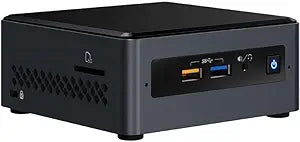
Intel NUC7CJYHN Barebone Mini PC - Celeron, Customizable
The NUC7CJYHN gives you a customizable Celeron-based mini PC footprint smaller than a paperback — bring your own RAM, storage, and OS to build exactly what the task requires.
$170.00*
Check availability
*Price sourced from Amazon.com. Last updated:Jul 18, 2026.Price and availability are subject to change.
Affiliate Disclosure: Studio Supplies may earn a commission from qualifying purchases made through links on this page, at no additional cost to you. This helps support our editorial team.
Notice a mistake? Let Us Know
Overview
Key Features
DDR4 SDRAM compatible slot - Install memory that synchronizes electrical and clock signals for an efficient data throughput
Gigabit Ethernet is very resourceful when a large number of file transfers are required, such as when performing backups over a network
Specifications
Model
NUC7CJYHN
Processor
Intel Celeron (7th Generation)
Memory Type
DDR4 SDRAM (SO-DIMM)
Network
Gigabit Ethernet (1000 Mbps)
Form Factor
Mini PC / NUC
RAM Included
None (user-supplied)
Storage Included
None (user-supplied)
OS Included
None (user-supplied)
Frequently Asked Questions
What RAM is compatible with the NUC7CJYHN, and how much can it support?
The NUC7CJYHN uses DDR4 SDRAM in SO-DIMM form factor. DDR4 synchronizes electrical and clock signals more efficiently than DDR3, reducing latency at the memory controller. Verify the specific maximum capacity and supported speeds against Intel's official NUC7CJYHN spec sheet before purchasing RAM, as barebone kits require user-supplied memory.
Does this unit come with storage or an operating system?
No — this is a barebone kit. It ships with the board and chassis only. You must supply your own M.2 or 2.5" storage (verify the supported form factors in Intel's spec sheet) and install your own operating system. This is intentional: it lets you spec storage capacity and OS to match your exact use case.
What does Gigabit Ethernet mean for this unit's practical network performance?
Gigabit Ethernet (1000 Mbps) allows the NUC7CJYHN to perform network-intensive tasks — large file transfers, NAS backups, or networked media serving — without the wired connection becoming the bottleneck. On a Gigabit switch, sustained transfers approach ~110 MB/s in real-world conditions.
Is the NUC7CJYHN suitable as a low-power always-on server or home automation hub?
The Celeron processor and compact chassis make it well-suited for always-on light-duty server tasks — file serving, home automation, thin client use, digital signage — where a full desktop's power draw and footprint are unnecessary. The Celeron's thermal envelope is low enough for fanless or near-silent operation in some configurations.
What operating systems are supported?
The NUC7CJYHN supports Windows 10/11 and major Linux distributions. Intel provides drivers for Windows; Linux support varies by distribution but mainstream distros (Ubuntu, Debian) generally work well with 7th-generation Intel hardware. ChromeOS Flex is also an option for thin-client deployments.
Related Products


