



Intel
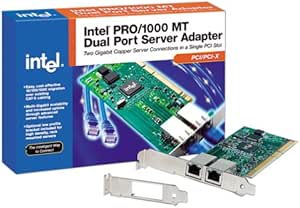
Intel PWLA8492MT PRO/1000 MT Dual Port Server Adapter
Dual 1GbE ports with PCI-X throughput and Intel's SingleDriver suite make the PRO/1000 MT the proven workhorse for Gigabit server NIC migrations.
$120.99*$129.95Save 6%
View on Amazon
✓ In Stock on Amazon.com
*Price sourced from Amazon.com. Last updated:Oct 07, 2026.Price and availability are subject to change — details.
Affiliate Disclosure: As an Amazon Associate, Studio Supplies earns from qualifying purchases made through links on this page, at no additional cost to you. This helps support our editorial team.
Notice a mistake? Let Us Know
Overview
Key Features
Permits easy (plug-and-play), cost-effective 10/100/1000 migration over standard Cat-5 cabling
Provides multi-Gigabit scalability and increased uptime through advanced server features
Intel SingleDriver technology provides a common Gigabit Ethernet driver suite
Full-duplex capable; features Intel PROSet II utility and auto-negotiation
Includes optional-use low-profile bracket for high-density, rack-mounted servers
Specifications
Brand
Intel
Model
PWLA8492MT
Host Interface
PCI-X
Number of Ports
2
Port Type
2 x RJ-45
Network Technology
10/100/1000Base-T
Duplex
Full-duplex capable
Card Height
Low-profile and full-height (bracket included for both)
Form Factor
Internal (PCI-X)
Management Utility
Intel PROSet II
Dimensions
4.7" H x 6.6" W x 2.5" D
Frequently Asked Questions
What host bus interface does this adapter use, and which server platforms is it compatible with?
The PRO/1000 MT Dual Port uses a PCI-X interface. PCI-X is the predecessor to PCIe — it is compatible with PCI-X slots (32-bit and 64-bit, 66/100/133MHz variants) and backward-compatible with standard 32-bit PCI slots at reduced speed. It is not compatible with PCIe slots. Verify your server's expansion slot inventory before purchasing — most servers built after 2006 use PCIe exclusively.
What is the maximum throughput per port, and can both ports operate simultaneously at full Gigabit speed?
Each port operates at up to 1Gbps full-duplex (1000Base-T). Both ports can operate simultaneously — PCI-X at 133MHz and 64-bit provides sufficient bus bandwidth (~8.5GB/s theoretical) to sustain dual 1Gbps full-duplex links without saturation at 10/100/1000 Ethernet speeds.
What does Intel SingleDriver technology mean for deployment?
Intel SingleDriver provides a unified driver suite across the PRO/1000 product family. In practical terms, a single driver package supports multiple card variants, simplifying OS deployment, driver update management, and image creation for environments running diverse PRO/1000 adapter types. This was a meaningful operational advantage in heterogeneous server fleets.
Does this card support jumbo frames and what link aggregation configurations are available?
The PRO/1000 MT supports jumbo frames (up to 9KB per frame) for reduced CPU overhead in high-throughput environments. IEEE 802.3ad link aggregation and AFT (Adapter Fault Tolerance) failover are supported via Intel's Advanced Network Services (ANS) through the PROSet II management utility.
Is this card still a viable choice for a new server deployment?
For legacy servers with PCI-X slots, yes — it remains a reliable, well-supported Gigabit adapter. For any server built after approximately 2006 with PCIe slots, this card is not compatible. New server NIC procurement should target PCIe-based Intel i350 or Intel X550 adapters for modern deployments.
Related Products


