

Intel
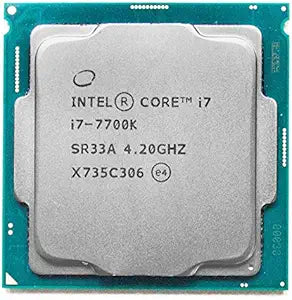
Intel SR33A Core i7-7700K 4.2 GHz CPU Processor
At 4.2 GHz base with an unlocked multiplier, the i7-7700K delivers generational single-thread performance that keeps Kaby Lake-era workstations competitive against newer mid-range builds.
$274.44*
View on Amazon
✓ In Stock on Amazon.com
*Price sourced from Amazon.com. Last updated:Oct 21, 2026.Price and availability are subject to change — details.
Affiliate Disclosure: As an Amazon Associate, Studio Supplies earns from qualifying purchases made through links on this page, at no additional cost to you. This helps support our editorial team.
Notice a mistake? Let Us Know
Overview
Key Features
CM8067702868535
Specifications
Brand
Intel
Model / Part Number
SR33A (Core i7-7700K)
Architecture
Kaby Lake
Cores / Threads
4 cores / 8 threads
Base Clock
4.2 GHz
Boost Clock
4.5 GHz (single-core)
Cache
8MB L3
TDP
91W
Socket
LGA 1151 (Z170/Z270 compatible)
Memory Support
DDR4 (official: DDR4-2400)
Multiplier
Unlocked
Stock Cooler Included
No
Similar Products
Other products from the same family that visitors often consider:
 ✓ Available
Intel Core i7-3632QM 2.2GHz Mobile CPU Processor
$172.02
View on Amazon → ✓ Available
Intel T2500 Core Duo 2GHz Mobile CPU Processor
$98.95
View on Amazon → ✓ Available
Intel CM8066201920404 Core i5-6500 3.2GHz CPU
$148.02
View on Amazon → ✓ Available
Intel i5-650 3.2GHz Socket 1156 CPU Processor
$108.70
View on Amazon → ✓ Available
Intel CM8064601464707 Core i5-4570 3.2 GHz Processor
$99.00
View on Amazon →Frequently Asked Questions
What socket does the i7-7700K use, and what motherboards are compatible?
The i7-7700K uses the LGA 1151 socket (300-series version — specifically Z170 and Z270 chipsets for overclocking support). It is not compatible with 8th/9th-gen Coffee Lake LGA 1151 motherboards despite the identical socket name — Intel changed the pin layout between generations. Verify your motherboard is a Z170 or Z270 chipset for overclock support, or B250/H270 for stock operation.
Is the i7-7700K still a viable CPU for modern gaming and productivity in 2024?
For 1080p and 1440p gaming, yes — the i7-7700K's four cores and eight threads at 4.2 GHz base (boosting to 4.5 GHz) remain competitive for gaming workloads where per-core frequency matters more than core count. For heavily multi-threaded productivity tasks (video encoding, 3D rendering, compilation), the 4-core design has been meaningfully surpassed by 6-core and 8-core successors. In a Z270 build with a current GPU, gaming performance holds up well.
What cooler is required, and does Intel include one in the box?
The i7-7700K ships without a stock cooler — it is a boxed OEM or tray unit in this listing (model SR33A is the tray/OEM part). A dedicated aftermarket cooler is required. The 91W TDP is manageable, but the i7-7700K is well-known for running warm under load and benefits significantly from a 120mm or 240mm AIO liquid cooler or a high-performance air tower cooler.
Does it support DDR4 RAM, and what speeds does it officially support?
Yes, the i7-7700K natively supports DDR4 RAM with official Intel XMP support up to DDR4-2400. With a Z270 motherboard and XMP-rated kits, users routinely run DDR4-3000 to DDR4-3200 stably. DDR3 is not supported — this platform is DDR4 exclusively.
What is the overclocking headroom on this chip?
The i7-7700K features an unlocked multiplier (the 'K' designation), making it straightforward to overclock on a Z170 or Z270 motherboard. Most retail samples reach 4.8–5.0 GHz on air cooling; with a capable AIO, some units push beyond 5 GHz. However, this CPU generation is notorious for heat concentration due to the thermal interface material (TIM) between the die and integrated heat spreader — delidding and replacing TIM with liquid metal was a common enthusiast modification to reduce temperatures significantly.
Related Products


