



Intel
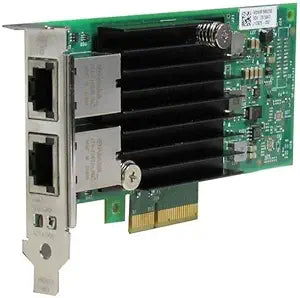
Intel X550T2 ETHERNET Network Adapter X550-T2
Dual 10GBase-T ports on a single PCIe 3.0 card give servers and workstations full 10Gb/s Ethernet over standard copper cabling without the cost of fiber infrastructure.
$131.71*$136.37Save 3%
View on Amazon
✓ In Stock on Amazon.com
*Price sourced from Amazon.com. Last updated:Oct 07, 2026.Price and availability are subject to change — details.
Affiliate Disclosure: As an Amazon Associate, Studio Supplies earns from qualifying purchases made through links on this page, at no additional cost to you. This helps support our editorial team.
Notice a mistake? Let Us Know
Overview
Key Features
Country of Origin: CHINA
Item Package weight : 0.02 grams
Specifications
Brand
Intel
Model
X550T2
Number of Ports
2 x 10GBase-T (RJ-45)
Host Interface
PCI Express 3.0 x16
Network Technology
10GBase-T
Supported Media
Twisted Pair (Cat 6A / Cat 7)
Country of Origin
China
Frequently Asked Questions
What cabling does 10GBase-T require, and how far can it run?
10GBase-T runs over Cat 6A or Cat 7 copper cabling at distances up to 100 meters — the same infrastructure used for standard Gigabit Ethernet. Cat 6 will work at shorter distances (up to ~55m depending on crosstalk conditions). This means you can upgrade to 10Gb/s without replacing your existing structured cabling in most enterprise and lab environments.
Does the X550-T2 require a full x16 PCIe slot, or will it work in shorter slots?
The adapter uses a PCIe 3.0 x16 host interface but is electronically compatible with x8 and x4 slots — the card will negotiate down to the available lanes. You will see a bandwidth ceiling in very high-throughput scenarios on a x4 slot, but for standard dual-10GbE traffic, a x8 slot is effectively unconstrained.
What operating systems and drivers does the X550-T2 support?
Intel provides drivers for Windows Server, Linux (inbox kernel drivers via ixgbe), and VMware ESXi. Linux support through the in-kernel ixgbe driver means zero third-party dependencies on most server distributions. Check Intel's current driver download page for the latest version supporting your specific OS release.
Does this adapter support SR-IOV for virtualized environments?
Yes, the X550 silicon supports SR-IOV (Single Root I/O Virtualization), which allows the physical ports to be partitioned into virtual functions assigned directly to VMs. This is relevant for hypervisor deployments where bypassing the software network stack reduces latency and CPU overhead.
Will this adapter work in a consumer desktop motherboard?
Yes, as long as the board has a PCIe 3.0 x16 (or x8/x4) slot and sufficient PCIe lane allocation. Note that your network switch also needs 10GBase-T ports — most consumer switches top out at 1GbE, so verify your switching infrastructure supports 10GbE before expecting the full throughput benefit.
Related Products


