



Lenovo
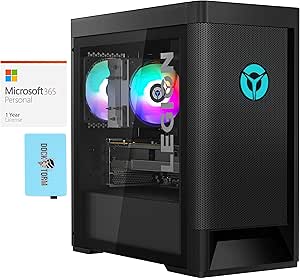
Lenovo 90RB001PUS-3693-226476 Legion Tower 5 Ryzen 7 16GB 7.6TB SSD Gaming PC
Ryzen 7 5700G16GB DDR46TB SSD400WBluetooth 5.2
An 8-core Ryzen 7 5700G, GTX 1660 Super, and 7.6TB SATA SSD combine in the Legion Tower 5 to deliver a capable mid-tier gaming desktop with substantial on-device storage capacity.
Check availability
Affiliate Disclosure: Studio Supplies may earn a commission from qualifying purchases made through links on this page, at no additional cost to you. This helps support our editorial team.
Notice a mistake? Let Us Know
Overview
Key Features
Wi-Fi 6 AX200 Wifi, Bluetooth 5.2, Ethernet LAN (RJ-45), No Webcam, USB Keyboard, .
AMD Ryzen 7 5700G Octa Core 4th Gen AMD Ryzen 7 5700G 3.8GHz Processor (upto 4.6 GHz, 16MB Cache, 8-Core , 16-Threads, ) ; GeForce GTX 1660 Super 6GB GDDR6 Dedicated Graphics, .
16GB DDR4 DIMM; 400W Power Supply, Air Cooling CPU Cooler; Raven Black Color, .
7.6TB SATA SSD; 4 USB 3.2 Gen1, 2 USB 2.0, 1 HDMI, 1 Display Port (DP), USB 3.2 Type-C Gen2, No Optical Drive, 1 x Headphone/Microphone Combo Jack., Windows 11 Pro-64.,
Includes Microsoft 365 Personal 1 Year Subscription for 1 User
Specifications
Processor
AMD Ryzen 7 5700G, 8-Core/16-Thread, 3.8 GHz base / 4.6 GHz boost, 16MB cache
RAM
16GB DDR4 DIMM
Storage
7.6TB SATA SSD
Graphics
NVIDIA GeForce GTX 1660 Super 6GB GDDR6
Operating System
Windows 11 Pro 64-bit
Wireless
Wi-Fi 6 (AX200), Bluetooth 5.2
Wired Networking
Ethernet LAN (RJ-45)
Ports
4x USB 3.2 Gen1, 2x USB 2.0, 1x HDMI, 1x DisplayPort, 1x USB 3.2 Type-C Gen2, 1x Headphone/Mic combo
Power Supply
400W
Cooling
Air cooling CPU cooler
Color
Raven Black
Dimensions
8.0 x 16.0 x 16.5 inches
Weight
30.86 lb
Included
Black USB keyboard, Microsoft 365 Personal 1-year subscription
Pros & Cons
👍 Pros
- The Ryzen 7 5700G's 8-core/16-thread architecture at up to 4.6 GHz boost provides strong multi-threaded throughput for gaming, streaming, and parallel background workloads simultaneously.
- GTX 1660 Super's 6GB GDDR6 VRAM is sufficient for 1080p gaming at high texture settings without VRAM overflow in the majority of current titles.
- 7.6TB of SSD storage provides capacity well beyond the typical 1–2TB baseline for gaming desktops, eliminating storage management overhead for large game libraries or video projects.
- Wi-Fi 6 (AX200) and Bluetooth 5.2 provide current-generation wireless standards, with Wi-Fi 6 supporting up to 2.4 Gbps on compatible routers.
- USB 3.2 Type-C Gen2 (10 Gbps) on the front or rear panel enables fast external storage and peripheral connectivity beyond legacy USB-A speeds.
👎 Cons
- The GTX 1660 Super lacks hardware ray tracing (RT cores) and DLSS (Tensor cores) — both features are increasingly standard in modern AAA titles and unavailable on this Turing-based GPU without an upgrade.
- The 400W power supply limits GPU upgrade headroom; moving to an RTX 3070-class or higher card requires a PSU replacement in addition to the GPU itself.
- SATA SSD versus PCIe NVMe is a measurable throughput difference (~550 MB/s versus 3,500+ MB/s sequential read) — for workloads with sustained large-file I/O, the SATA interface is the storage bottleneck here despite the capacity advantage.
- The tower's 30.86 lb weight and 8 x 16 x 16.5-inch footprint make it a bulky desktop form factor compared to compact alternatives — not a concern for stationary placement but notable for relocation.
- Air cooling on the CPU with a 65W TDP processor is adequate under normal use but leaves less thermal headroom for sustained Cinebench-class loads compared to a more capable aftermarket cooler.
Frequently Asked Questions
What is the performance trade-off between the GTX 1660 Super 6GB and current-generation GPUs?
The GTX 1660 Super delivers solid 1080p gaming performance in titles from 2020–2022, typically targeting 60–100 fps at high settings. It lacks hardware ray tracing capability and DLSS support (Turing architecture without RT or Tensor cores), so modern titles that leverage those features will either run without them or require settings reduction. At 1440p, frame rates will be meaningfully lower than at 1080p.
Does the Ryzen 7 5700G's integrated graphics create a conflict with the discrete GTX 1660 Super?
No. In a system with a discrete GPU, the motherboard will route display output through the dedicated card by default. The 5700G's integrated Radeon graphics are effectively disabled or held in reserve — they do not conflict with the GTX 1660 Super and can serve as a fallback if the discrete card is removed.
What does 7.6TB of SATA SSD storage mean in practical terms for a gaming system?
At SATA SSD speeds (~550 MB/s sequential read), 7.6TB provides ample space to maintain a large game library, video capture storage, or media archive without external drives. SATA SSDs at this capacity tier are slower than NVMe but significantly faster than HDDs. For game loading specifically, SATA SSD versus NVMe differences are less perceptible than the jump from HDD to SSD.
Is the 400W power supply sufficient for future GPU upgrades?
400W is adequate for the GTX 1660 Super (120W TDP) and Ryzen 7 5700G (65W TDP) with headroom to spare. However, a GPU upgrade to an RTX 3070 (220W) or RTX 4070 (200W) class card would bring the system close to or over the PSU's safe operating threshold. Any meaningful GPU upgrade should be accompanied by a PSU upgrade to 650W or higher.
What display outputs does this system support?
The GTX 1660 Super provides the primary display outputs — typically 3x DisplayPort and 1x HDMI on most board configurations. The listing confirms 1 HDMI and 1 DisplayPort on the rear panel I/O. Multi-monitor setups up to two displays are supported via the dedicated GPU outputs.
Related Products


