



Lenovo
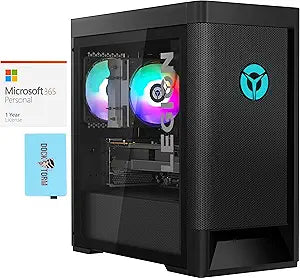
Lenovo 90RB001PUS-3693-232565 Legion Tower 5 Ryzen 7 Gaming PC
Ryzen 7 5700G128GB DDR43TB HDD400WBluetooth 5.2
128GB DDR4 and a 1TB NVMe SSD give the Legion Tower 5 enough headroom to handle heavy multitasking, streaming, and mid-tier 1080p gaming simultaneously.
View price on Amazon
Affiliate Disclosure: Studio Supplies may earn a commission from qualifying purchases made through links on this page, at no additional cost to you. This helps support our editorial team.
Notice a mistake? Let Us Know
Overview
Key Features
Wi-Fi 6 AX200 Wifi, Bluetooth 5.2, Ethernet LAN (RJ-45), No Webcam, USB Keyboard, .
AMD Ryzen 7 5700G Octa Core 4th Gen AMD Ryzen 7 5700G 3.8GHz Processor (upto 4.6 GHz, 16MB Cache, 8-Core , 16-Threads, ) ; GeForce GTX 1660 Super 6GB GDDR6 Dedicated Graphics, .
128GB DDR4 DIMM; 400W Power Supply, Air Cooling CPU Cooler; Raven Black Color, .
1TB PCIe NVMe SSD + 3TB HDD; 4 USB 3.2 Gen1, 2 USB 2.0, 1 HDMI, 1 Display Port (DP), USB 3.2 Type-C Gen2, No Optical Drive, 1 x Headphone/Microphone Combo Jack., Windows 11 Pro-64.,
Includes Microsoft 365 Personal 1 Year Subscription for 1 User
Specifications
Model
Legion Tower 5
Processor
AMD Ryzen 7 5700G Octa Core 4th Gen
Processor Speed
3.8GHz (upto 4.6 GHz)
Processor Cache
16MB
Processor Cores
8-Core, 16-Threads
Graphics
GeForce GTX 1660 Super 6GB GDDR6 Dedicated Graphics
RAM
128GB DDR4 DIMM
Storage
1TB PCIe NVMe SSD + 3TB HDD
Operating System
Windows 11 Pro-64
Wireless Connectivity
Wi-Fi 6 AX200 Wifi, Bluetooth 5.2
Wired Connectivity
Ethernet LAN (RJ-45)
Ports
4 USB 3.2 Gen1, 2 USB 2.0, 1 HDMI, 1 Display Port (DP), USB 3.2 Type-C Gen2, 1 x Headphone/Microphone Combo Jack
Optical Drive
No Optical Drive
Webcam
No Webcam
Power Supply
400W
Cooling
Air Cooling CPU Cooler
Color
Raven Black
Included Peripherals
USB Keyboard
Included Software
Microsoft 365 Personal 1 Year Subscription for 1 User
Pros & Cons
👍 Pros
- 128GB DDR4 DIMM configuration provides exceptional multitasking headroom and supports virtualization workloads beyond typical gaming use cases.
- 1TB PCIe NVMe SSD delivers sequential read speeds approximately 6× faster than SATA, dramatically reducing game load times and application launches.
- 3TB HDD included alongside the NVMe SSD provides 4TB total storage — no immediate need for additional drives.
- Wi-Fi 6 AX200 supports 802.11ax with theoretical throughput up to 2.4 Gbps, and Bluetooth 5.2 covers current peripheral standards.
- USB 3.2 Type-C Gen2 at 10 Gbps supports high-bandwidth external storage and peripherals alongside the legacy USB-A port array.
👎 Cons
- GTX 1660 Super lacks RT (ray-tracing) cores and Tensor cores — DLSS and hardware ray tracing are not available on this GPU.
- 400W PSU limits GPU upgrade paths; moving to an RTX 3070 or higher would require a PSU replacement alongside the GPU swap.
- The 5700G's integrated graphics and the discrete GTX 1660 Super both reside on an AM4 platform approaching end-of-life — future CPU upgrade ceiling is limited.
- 128GB RAM, while impressive on paper, yields no practical gaming performance gain over 32GB — buyers paying a premium for the memory capacity should have a non-gaming workload in mind.
- No webcam included; video conferencing requires an external camera purchase.
Frequently Asked Questions
Is the GTX 1660 Super still a viable GPU for modern gaming at this spec level?
At 1080p, the GTX 1660 Super 6GB GDDR6 handles most titles at medium-to-high settings with playable framerates. It is a mid-tier Turing-architecture card — not a ray-tracing solution (no RT cores), but capable for esports titles, older AAA games, and 1080p gameplay at reduced settings in current releases. At 1440p or above, it becomes a bottleneck.
Why does this configuration ship with 128GB DDR4? Is that actually useful?
128GB is an unusually high memory configuration for a gaming desktop — standard gaming builds run 16–32GB. This configuration is effectively overbuilt for gaming but is well-suited for virtualization, large dataset workloads, or running multiple VMs concurrently. For pure gaming, the extra RAM provides no measurable frame rate benefit beyond approximately 32GB.
Does the 400W PSU have enough headroom for this hardware configuration?
The Ryzen 7 5700G has a 65W TDP and the GTX 1660 Super draws approximately 125W under load — a combined peak of roughly 200-225W for the primary components. The 400W PSU provides adequate headroom for this specific hardware pairing, but leaves limited room for future GPU upgrades to higher-TDP cards without a PSU swap.
What storage performance can I expect from the 1TB PCIe NVMe SSD?
PCIe NVMe SSDs at this tier typically deliver sequential reads of 3,000–3,500 MB/s — roughly 6× faster than a SATA SSD and vastly faster than the included 3TB HDD. Boot times, application launches, and game load times will be driven by the NVMe drive, while the HDD provides bulk storage for media and archives.
Is the USB 3.2 Type-C Gen2 port on the front panel or rear?
The product specifications list one USB 3.2 Type-C Gen2 port; exact placement (front or rear) is not confirmed in the available documentation. This port supports up to 10 Gbps data transfer, making it suitable for fast external NVMe enclosures or high-bandwidth peripherals.
Related Products


