



Lenovo
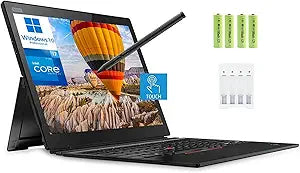
Lenovo ThinkPad X1 Tablet Gen 3 2-in-1 Laptop
★★★★★
8GB RAM
The ThinkPad X1 Tablet Gen 3 pairs a 13-inch touch IPS display with detachable keyboard flexibility — a full Windows Pro productivity platform in a compact, pen-capable form factor.
Check availability
Affiliate Disclosure: Studio Supplies may earn a commission from qualifying purchases made through links on this page, at no additional cost to you. This helps support our editorial team.
Notice a mistake? Let Us Know
Overview
Key Features
Stunning 2K IPS Display – Dive into vibrant visuals on an 11.5” 2K screen with TÜV-certified eye care, reducing strain during long viewing sessions.
Powerful MediaTek Helio G99 Performance – Smooth 90Hz refresh rate and fast loading times for gaming and multitasking, backed by 8GB RAM + 512GB storage (expandable via included 256GB microSD card).
Immersive JBL Octa-Speaker Sound – Enjoy booming Dolby Atmos audio with 8 JBL speakers, perfect for movies, music, and gaming. Plus, use Bluetooth speaker mode to turn any spot into a party zone!
Smart Standby & Long-Term Support – Use as a digital photo frame/clock when idle and enjoy 4 years of security updates for lasting performance.
Versatile Viewing with 175° Adjustable Kickstand – Watch, work, or play comfortably at any angle with the sturdy built-in stand, perfect for hands-free entertainment on the go.
Specifications
Processor
Intel Core i7-8650U (4-core, up to 4.2 GHz, 15W TDP)
Memory
8GB RAM
Storage
1TB PCIe SSD
Display
13-inch IPS Touchscreen, 400 nits
Operating System
Windows 10 Pro
Security
Fingerprint Reader (Windows Hello), discrete TPM (dTPM)
Connectivity
Wi-Fi, Bluetooth
Included Accessories
Detachable Keyboard, ThinkPad Pen Pro
Form Factor
2-in-1 Detachable
Pros & Cons
👍 Pros
- The Intel i7-8650U with 8GB RAM handles productivity multitasking — document editing, browser-heavy research sessions, and video conferencing — at a sustained performance level that consumer-grade ARM tablets cannot match.
- 1TB PCIe SSD delivers sequential read speeds that eliminate storage bottlenecks for professionals accessing large documents, VM images, or media files while mobile
- Detachable keyboard design provides genuine laptop-to-tablet mode flexibility without the awkward weight imbalance common to most convertible hinge designs
- 1TB PCIe SSD storage at this capacity is generous for a detachable 2-in-1, allowing full project libraries, offline content, and OS installations without cloud dependency during travel.
- The 13-inch IPS touchscreen at 400 nits delivers sufficient brightness for office and indoor use, while the touch layer with included Pen Pro stylus enables annotation workflows that laptop-only form factors cannot replicate.
- ThinkPad Pen Pro is included — active digitizer pressure-sensitive stylus input for annotation and note-taking without a separate accessory purchase
- dTPM and fingerprint reader support BitLocker encryption and Windows Hello biometric login natively, meeting enterprise security compliance requirements out of the box
- Discrete TPM hardware combined with a fingerprint reader provides a dual-layer security architecture appropriate for enterprise deployments — meaningfully more robust than software-based security on consumer convertibles.
- The detachable keyboard design means the tablet can be used as a standalone presentation or annotation device in meetings, then reconfigured as a full laptop for desk-based work without carrying additional accessories.
- Windows 10 Pro with Hyper-V enables native VM support for developers and IT administrators without additional virtualization licensing
👎 Cons
- 8GB RAM is soldered and non-upgradeable on this platform — for users who later need to run VMs, heavy browser tab counts, or memory-intensive applications, this becomes a hard ceiling with no path to expansion.
- Intel i7-8650U is 8th-generation — current-gen Intel Core Ultra and 12th/13th-gen platforms offer meaningfully better performance-per-watt and AI-accelerated workload capability
- 8GB RAM is non-upgradeable in the X1 Tablet form factor — users running multiple VMs or memory-intensive analytical tools will encounter a hard ceiling
- The 15W Intel U-series processor is thermally constrained in the tablet chassis, which means sustained all-core performance under extended loads (video encoding, large compilation tasks) will throttle more aggressively than the same chip in a full laptop body.
- Windows 10 Pro out-of-box means an upgrade path to Windows 11 may require Lenovo firmware updates and compatibility verification — not all ThinkPad X1 Tablet Gen 3 configurations pass Windows 11's TPM 2.0 and Secure Boot requirements without BIOS changes.
- The 13-inch IPS display at 400 nits is capable for indoor work but limits readability in bright outdoor environments compared to higher-brightness or OLED panels
- Windows 10 Pro is the installed OS — Windows 11 Pro upgrade compatibility should be verified before deploying in organizations standardizing on Windows 11
- As a Gen 3 model based on 8th-gen Intel, this system is now several processor generations behind current platforms — battery efficiency, AI workload support, and USB4/Thunderbolt 4 capabilities lag meaningfully behind current-gen alternatives.
- The ThinkPad Pen Pro uses a AAAA battery rather than wireless charging, which means carrying a spare battery for extended stylus use — a friction point that modern pen-input devices have largely eliminated.
- In standalone tablet mode without the keyboard, the weight distribution favors the display end, making extended one-handed reading sessions less comfortable than on lighter ARM-based tablets
Frequently Asked Questions
What processor is in the ThinkPad X1 Tablet Gen 3, and what is its thermal envelope in tablet mode without the keyboard attached?
The Intel Core i7-8650U is a 15W TDP processor. In tablet mode without the keyboard base, the ThinkPad X1 Tablet Gen 3 relies solely on the tablet chassis for cooling — Lenovo manages this through firmware-based power limits that may reduce sustained clock speeds under extended heavy workloads compared to full laptop mode.
Can the ThinkPad X1 Tablet Gen 3 run full Windows desktop applications?
Yes — it runs Windows 10 Pro on Intel x86 architecture, which means full compatibility with any Windows application including Microsoft Office, Adobe Creative Suite, development tools, and enterprise software. No compatibility compromises versus a traditional laptop.
Does the 1TB PCIe SSD improve performance meaningfully over SATA M.2 options?
Significantly — PCIe NVMe sequential read speeds typically exceed 2,000 MB/s versus SATA's ~550 MB/s ceiling. For large file operations, application launches, and VM storage access, the difference is perceptible in daily professional use.
Does the 1TB PCIe SSD use the M.2 2280 form factor, and is it user-replaceable?
The ThinkPad X1 Tablet Gen 3 uses a M.2 SSD, but the tablet-thin chassis design restricts access significantly — this is not a straightforward user-serviceable component the way a traditional ThinkPad is. SSD replacement is technically possible but requires disassembly beyond what most users should attempt without service documentation.
What display outputs are available for connecting an external monitor when the keyboard is detached?
The ThinkPad X1 Tablet Gen 3 provides USB-C / Thunderbolt 3 connectivity for external display output. A USB-C to DisplayPort or Thunderbolt dock will drive an external monitor. There is no full-size HDMI port on the tablet unit itself.
How does the ThinkPad Pen Pro integrate with the display?
The ThinkPad Pen Pro uses active digitizer technology with pressure sensitivity, enabling precise stylus input for annotation, digital signing, and note-taking directly on the 13-inch IPS touchscreen without requiring a third-party stylus.
Does detaching the keyboard affect performance or wireless connectivity?
No — the keyboard is an input peripheral connected via pogo pins. Detaching it has no effect on processing speed, storage performance, or wireless connectivity. The tablet operates fully in standalone mode.
Is the included ThinkPad Pen Pro an active EMR stylus, and does it require a battery or charging?
The ThinkPad Pen Pro is an active digitizer stylus compatible with the tablet's Wacom AES digitizer layer. It requires a AAAA battery rather than wireless charging — a distinction worth knowing so you have a spare battery available during extended use sessions.
Does the fingerprint reader work with Windows Hello for passwordless login, and is dTPM hardware-based?
Yes — the fingerprint reader supports Windows Hello biometric authentication for passwordless sign-in. The dTPM (discrete Trusted Platform Module) is a hardware chip rather than a firmware implementation, providing stronger cryptographic key isolation — this is a meaningful distinction for enterprise deployments handling sensitive data.
Is this unit suitable for enterprise deployment with MDM and BitLocker?
Yes — the integrated fingerprint reader, dTPM, and Windows 10 Pro support Windows Hello biometric login, BitLocker drive encryption, and enterprise MDM enrollment, meeting standard corporate security policy requirements.
Related Products


