

Lenovo
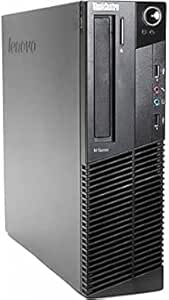
Lenovo Lenovo M91P SFF i5 Desktop Refurbished
A professionally refurbished Sandy Bridge quad-core paired with a 360GB SSD and HDMI output delivers a capable, compact business desktop for a fraction of new hardware cost.
$219.99*
View on Amazon
✓ In Stock on Amazon.com
*Price sourced from Amazon.com. Last updated:Jun 07, 2026.Price and availability are subject to change.
Affiliate Disclosure: Studio Supplies may earn a commission from qualifying purchases made through links on this page, at no additional cost to you. This helps support our editorial team.
Notice a mistake? Let Us Know
Overview
Specifications
Model
M91P SFF
Processor
Intel Core i5
Pros & Cons
👍 Pros
- Intel i5-2400's 4 cores at 3.1GHz base / 3.4GHz Turbo remain sufficient for productivity, web, and video conferencing workloads that represent the majority of business desktop use cases
- Intel i5-2400 quad-core at 3.1GHz with 3.4GHz Turbo handles the full office productivity and web-based application stack without throttling
- 360GB SATA SSD storage eliminates the HDD seek-time bottleneck that defined the original M91P's performance ceiling, delivering sub-15-second OS boot times
- 360GB SSD delivers random read/write performance that is orders of magnitude faster than the mechanical HDDs these units originally shipped with, making boot and application launch times modern-competitive
- 12GB DDR3 provides comfortable headroom for Office 365, browser-based applications, and multi-tab workflows without the memory pressure that 4GB or 8GB refurbished configs experience
- 12GB DDR3 RAM is generous for Sandy Bridge-class productivity use and comfortably supports 15-20 browser tabs plus Office applications running simultaneously
- SFF form factor occupies minimal desk footprint — physically smaller than a full-tower while delivering equivalent productivity-tier compute performance
- Bluetooth 4.0 and HDMI/DP/VGA multi-output connectivity cover a broad range of peripheral and monitor pairing scenarios without additional hardware
- Windows 10 Pro 64-bit provides domain join capability, BitLocker, and Remote Desktop — essential for business and SMB deployment scenarios
- Multi-output display connectivity (HDMI, DisplayPort, VGA) covers the full range of monitor vintages without requiring adapters
👎 Cons
- Sandy Bridge i5-2400 is a 14-year-old CPU architecture — driver support for future Windows versions (Windows 11 upgrade path is blocked by TPM 2.0 and CPU generation requirements) is a long-term risk for business deployments
- Intel HD 2000/2500 integrated graphics cannot drive displays above 1920x1200 or handle GPU-accelerated creative workloads — no discrete GPU slot is accessible in SFF configuration
- Sandy Bridge platform has no USB 3.0 native support on the motherboard — USB connectivity is limited to USB 2.0 unless an add-in card occupies a PCIe slot
- 12GB in a 3-DIMM configuration runs in mixed-channel mode, reducing memory bandwidth by approximately 20–30% versus a dual-channel 2-DIMM configuration — measurable in memory-bandwidth-sensitive applications
- 360GB SSD capacity is marginal for workstations accumulating software, OS updates, user profiles, and working files over multi-year deployment cycles
- 12GB in a non-symmetric triple-channel arrangement means memory does not run in fully optimized dual-channel mode, reducing memory bandwidth below theoretical DDR3 peak
- No NVMe M.2 slot limits future storage upgrades to SATA III maximum throughput — a hard architectural ceiling compared to any modern platform
- Refurbished unit condition, drive health, and remaining SSD write endurance are not independently verifiable without direct inspection — reputable seller selection and warranty terms are critical
- Wi-Fi adapter specification is unconfirmed as OEM or aftermarket, and adapter quality in refurbished builds varies significantly — a wired Ethernet connection is the reliable baseline for this unit
- W10P64 (Windows 10 Pro) will reach end-of-support in October 2025, requiring the buyer to plan a Windows 11 compatibility check or OS transition
Frequently Asked Questions
What generation and architecture is the Intel Core i5-2400, and what does that mean for current workloads?
The i5-2400 is a Sandy Bridge (2nd-gen Core) quad-core processor clocked at 3.1GHz base with a 3.4GHz Turbo Boost. Sandy Bridge's IPC is meaningfully stronger than the first-gen Nehalem architecture it replaced. For current-generation web browsing, Office 365, video conferencing, and document workflows, the i5-2400's 4 cores and 3.1–3.4GHz clock range remain capable — the bottleneck will be RAM and storage before it's the CPU.
What generation is the Intel i5-2400, and what workloads does it handle competently in 2024?
The i5-2400 is a Sandy Bridge (2nd-gen) quad-core running at 3.1GHz base with 3.4GHz Turbo. It handles office productivity, web browsing, video conferencing, email, and light data processing without bottleneck. Sustained video encoding, large virtual machines, or modern gaming are outside its performance envelope.
Is the 360GB SSD a SATA or NVMe drive?
The M91P SFF platform is limited to SATA III (6 Gbps) storage interfaces — there is no M.2 NVMe slot on Sandy Bridge-era ThinkCentre motherboards. A SATA SSD in this machine delivers sequential reads up to ~550MB/s, which is transformatively faster than the HDDs these machines originally shipped with and removes storage as the primary bottleneck.
Does the ThinkCentre M91P SFF support PCIe GPU upgrades for additional display outputs?
The M91P SFF includes a PCIe x16 slot, but the small form factor chassis has a half-height expansion card limitation. Full-height discrete GPUs will not physically fit. Half-height/low-profile PCIe cards (such as entry-level half-height models from AMD or NVIDIA) are compatible and supported by the 240W SFF power supply.
What does "360G SSD" indicate about the refurbished unit's storage, and is it a known OEM drive?
The 360GB capacity suggests a QLC or TLC drive installed by the refurbisher as part of the refurbishment process — not a standard Lenovo OEM configuration (typical OEM configurations used HDDs). 360GB is a non-standard capacity, meaning it may be a 360GB-class consumer SSD. Performance and longevity characteristics vary by the specific drive installed; the refurbisher should be able to identify the drive model on request.
Does the 12GB of RAM in this configuration represent the maximum the platform supports?
The ThinkCentre M91P supports up to 16GB DDR3 across four DIMM slots. The 12GB configuration uses a non-symmetric arrangement (likely 4GB + 4GB + 4GB). Upgrading to 16GB is possible by adding a fourth 4GB DDR3 stick, though the practical performance gain at this tier is marginal for productivity workloads.
What does the HDMI output enable versus the DisplayPort connection?
Both HDMI and DisplayPort on this machine output at up to 1920x1200 resolution via the Intel HD 2000/2500 integrated graphics. HDMI is the more common consumer display input; DisplayPort connects directly to business monitors without an adapter. VGA is also present for legacy monitor compatibility.
What does the Wi-Fi adapter in this refurbished M91P support, and is it an OEM or aftermarket addition?
The original M91P SFF did not ship with Wi-Fi as standard — wireless is typically added as a PCIe or USB adapter in the refurbishment process. 802.11 protocol generation (ac/n) and antenna configuration depend on the specific adapter installed. For reliable throughput, confirming the adapter spec with the seller is advisable before purchase.
Is 12GB of DDR3 RAM a standard or custom configuration for this platform?
12GB is a non-standard but valid Sandy Bridge configuration using three 4GB DDR3 DIMMs in a mixed-channel arrangement. The M91P SFF has 4 DIMM slots and supports up to 32GB DDR3. A 3-DIMM configuration does not run in full dual-channel mode, which slightly reduces memory bandwidth compared to a 2x4GB or 2x8GB dual-channel setup — not a significant real-world constraint for typical office workloads.
Is Bluetooth 4.0 useful on a desktop from this era?
BT 4.0 on a refurbished unit enables wireless keyboard, mouse, and headset pairing without USB dongle occupancy — a practical benefit in a small-form-factor machine with limited USB ports. BT 4.0 is backward-compatible with BT 3.0 and 2.1 peripherals.
Related Products


