



Lenovo
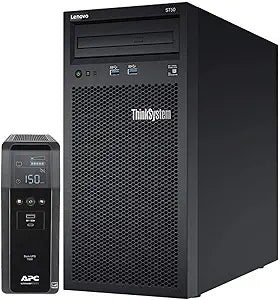
Lenovo ST504 ThinkSystem Tower Server 12TB HDD Xeon Bundle
★★★★★
A Xeon E-2124G tower server with 64GB ECC RAM, 12TB SATA storage, and APC sine-wave UPS protection — complete SMB infrastructure in a single box.
View price on Amazon
Affiliate Disclosure: Studio Supplies may earn a commission from qualifying purchases made through links on this page, at no additional cost to you. This helps support our editorial team.
Notice a mistake? Let Us Know
Overview
Reliable Server Solution: Lenovo ThinkSystem ST50 Tower Server Bundle
The Lenovo ThinkSystem ST50 Tower Server Bundle provides a comprehensive server solution for small businesses and remote offices. Featuring an Intel Xeon processor, ample memory, and large storage capacity, this server delivers reliable performance and data protection.
Specifications:
- Brand: Lenovo
- Model: ST50
- Form Factor: Mini Tower
- Processor: Intel Xeon E-2124G Quad-Core 3.4GHz (up to 4.5GHz Turbo)
- Memory: 64GB DDR4 PC4-21300 2666MHz Unbuffered Memory
- Storage: 12TB (3 x 4TB) 6Gb/s SATA Hard Drives
- RAID: JBOD
- Connectivity: Serial; DisplayPort; USB 3.1 Gen 1; USB 2.0; 1 x 1GbE ports
- Power: Single Power Supply
- Included: APC Sine Wave UPS Battery Backup & Surge Protector, 1500VA
Key Features
Lenovo ThinkSystem ST50 Tower Server Bundle with APC UPS Battery Backup for Small Business and Remote Offices
Processor
Intel Xeon E-2124G Quad-Core 3.4GHz 8MB CPU, Up To 4.5GHz Turbo; Memory: 64GB DDR4 PC4-21300 2666MHz Unbuffered Memory
Storage
12TB (3 x 4TB) 6Gb/s SATA Hard Drives for High Capacity Storage; JBOD RAID
APC Sine Wave UPS Battery Backup & Surge Protector, 1500VA, APC Back-UPS Pro (BR1500MS)
Serial; DisplayPort; USB 3.1 Gen 1; USB 2.0; 1 x 1GbE ports standard; Hard drives and memory upgrades included separately NOT installed, installation required.
Pros & Cons
👍 Pros
- Intel Xeon E-2124G with ECC memory support provides error-correcting RAM at 64GB capacity — a meaningful reliability advantage over workstation-grade processors in 24/7 server roles.
- Intel Xeon E-2124G supports ECC memory — the single most important reliability differentiator between server and consumer-grade platforms for always-on workloads
- 64GB DDR4-2666 unbuffered provides generous headroom for hypervisors like Proxmox or Hyper-V running multiple concurrent VMs
- 12TB raw storage (3 × 4TB SATA) gives a small business substantial capacity headroom for file serving, backup targets, or media storage without immediate expansion.
- APC BR1500MS pure sine wave output is the correct UPS pairing for active PFC server power supplies, protecting against power events that stepped-wave UPS units cannot safely handle.
- 12TB raw capacity across three independent 6Gb/s SATA drives gives flexible storage partitioning across different workload types
- APC BR1500MS pure sine wave output is specifically appropriate for server power supply requirements, not just a generic UPS add-on
- 4.5GHz turbo frequency on the E-2124G benefits single-threaded workloads — file serving, database queries, and small-business ERP applications that rarely saturate all four cores simultaneously.
- Compact mini-tower form factor fits under a desk or in a small server closet without requiring rack infrastructure.
- Mini-tower form factor fits in a closet, under a desk, or on a shelf without requiring a rack enclosure or dedicated server room
👎 Cons
- JBOD storage configuration ships with zero redundancy — a single drive failure results in data loss on that volume, requiring immediate manual RAID configuration before production deployment.
- JBOD configuration provides zero drive redundancy — a failed drive means data loss on that volume without pre-configured OS-level RAID
- Single 1GbE network port is a real throughput ceiling for multi-user file serving or high-bandwidth virtualization scenarios
- E-2124G is a quad-core processor without hyperthreading, limiting parallel thread throughput for multi-user or multi-VM scenarios compared to octa-core Xeon E-2200 series options.
- Single 1GbE network port is a bandwidth constraint for environments with multiple concurrent large file transfers or iSCSI workloads.
- Memory and storage arrive uninstalled, requiring hands-on hardware configuration before the server can boot — not suitable for non-technical deployment
- Single non-redundant power supply means a PSU failure takes the system fully offline with no failover path
- Memory is maxed at 64GB at the platform ceiling — no upgrade path exists if RAM requirements grow beyond this threshold.
- Hard drives and memory ship uninstalled, requiring technical assembly before the server can be brought online.
- No out-of-band management port (IPMI/iLO equivalent) in this configuration limits remote administration when the OS is unresponsive
Frequently Asked Questions
Does this bundle arrive fully assembled and ready to power on?
No. Per the product listing, the hard drives and memory are included but ship separately and require installation. Plan for hands-on assembly time before the server is operational — this is not a plug-and-play appliance.
Are the drives and memory pre-installed, or do I need to install them myself?
Per the product listing, drives and memory are included but NOT pre-installed — you'll need to seat the DIMMs and mount the drives before first boot. This is straightforward for anyone comfortable with server hardware but not a plug-and-play out-of-the-box experience.
What RAID level does the 12TB storage support, and is there any built-in redundancy?
The drives ship in JBOD — each 4TB drive appears as a separate independent volume with no redundancy. A single drive failure loses data on that volume. If you need RAID 5 or RAID 1, you'll need to configure it through your OS software RAID layer or add a hardware RAID controller.
What does JBOD RAID mean for data protection on this configuration?
JBOD (Just a Bunch of Disks) means the three 4TB drives appear as independent volumes — no redundancy, no parity. If one drive fails, data on that drive is lost. For production use, you should configure RAID 1 or RAID 5 via the server's RAID controller if supported, or implement software RAID to add fault tolerance.
Why is a sine wave UPS specifically important for this server?
The APC BR1500MS provides pure sine wave output, which is critical for modern server power supplies that use active PFC (power factor correction). Simulated or stepped sine wave UPS units can cause instability or damage to active PFC power supplies — the ST50's power supply benefits from the clean waveform the BR1500MS provides.
Why does the Xeon E-2124G matter over a desktop Core processor for server use?
ECC memory support. The E-2124G accepts ECC RAM, which silently detects and corrects single-bit memory errors — critical for preventing silent data corruption in databases, NAS volumes, and always-on services. Consumer Core processors don't support ECC at all, regardless of clock speed.
What does the APC BR1500MS add to this bundle, and why does the output waveform matter?
The BR1500MS delivers 1500VA of pure sine wave battery backup. Pure sine wave output is specifically required by many server-grade power supplies — stepped approximation waveforms from cheaper UPS units can cause compatibility issues or damage to sensitive PSUs. The 1500VA capacity provides meaningful runtime for a controlled shutdown.
Is the Intel Xeon E-2124G sufficient for virtualization workloads?
The E-2124G is a quad-core processor without hyperthreading, giving you 4 physical cores at up to 4.5GHz. It supports VT-x and VT-d, making it capable of running Hyper-V or VMware ESXi for lightweight virtualization. For running 2–4 VMs in a small-business environment it is adequate; for dense multi-VM hosting it will become the bottleneck before the 64GB RAM does.
Can memory be expanded beyond 64GB on the ThinkSystem ST50?
The ST50 platform supports up to 64GB of unbuffered DDR4 ECC RAM across its DIMM slots. This bundle already ships at the platform maximum, so memory expansion is not possible — a consideration if your workload is expected to grow significantly.
Is one 1GbE port sufficient for this server's use cases?
For a domain controller, print server, or light file server with under 20 concurrent users, yes — 1GbE handles those workloads adequately. For NAS-heavy multi-user workloads or virtualization hosts with significant VM network traffic, a second NIC or 10GbE expansion card would remove the port as a bottleneck.
Related Products


