



Lenovo
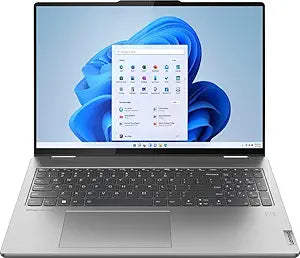
Lenovo Yoga 7 16" WUXGA Touch Laptop Ryzen 5 7535U
★★★★★
FHD1080p1920 x 1200Ryzen 5 7535UUSB-C
A 360-degree convertible chassis houses a 6-core Ryzen 5 7535U and LPDDR5 memory on a 16:10 touch display built for all-day versatility.
View price on Amazon
Affiliate Disclosure: Studio Supplies may earn a commission from qualifying purchases made through links on this page, at no additional cost to you. This helps support our editorial team.
Notice a mistake? Let Us Know
Overview
Key Features
✔【Original Seal】 is opened for upgrade ONLY. If the computer has modifications, then the manufacturer box is opened for it to be tested and inspected and to install the upgrades to achieve the specifications as advertised
✔【Memory & Storage】8GB LPDDR5 RAM and 512GB Solid State Drive (SSD) storage
✔【Processor】AMD Ryzen 5 7535U Processor, 2.9 gigahertz, 6-core
✔【360° flip-and-fold design】Offers four versatile modes — laptop, tablet, tent and stand.
✔【Screen】 16" 60Hz Display, The 60Hz ultra bright 300 nits display features a 16:10 1920 x 1200 resolution that gives you more space for toolbars and tabs.
✔【Graphics】 AMD Radeon 660M graphics
✔【Webcam】 Built-in FHD webcam with dual array microphone, 1080p Front Facing Camera Video Resolution
✔【Ports】 1 x HDMI Outputs,2 x USB-A 3.2, 2 x USB-C 3.2, Headphone Jack
✔【Operating System】 Windows 11
Specifications
Display Size
16 inches
Display Resolution
WUXGA 1920 x 1200
Display Refresh Rate
60Hz
Display Brightness
300 nits
Aspect Ratio
16:10
Processor
AMD Ryzen 5 7535U Processor
Processor Cores
6-core
Processor Base Clock Speed
2.9 gigahertz
RAM
8GB LPDDR5 RAM
Storage
512GB Solid State Drive (SSD)
Graphics
AMD Radeon 660M graphics
Webcam
Built-in FHD webcam with dual array microphone
Front Facing Camera Video Resolution
1080p
HDMI Outputs
1
USB-A 3.2 Ports
2
USB-C 3.2 Ports
2
Operating System
Windows 11
Pros & Cons
👍 Pros
- Ryzen 5 7535U's 6-core Zen 3+ architecture provides strong single-threaded boost performance (up to ~4.55GHz) that keeps Office, browser, and video editing workflows responsive under the 15W TDP envelope
- AMD Ryzen 5 7535U delivers 6-core / 12-thread compute performance at 2.9GHz base with boost headroom, outpacing Intel Core i5-1235U in multi-threaded workloads
- LPDDR5 memory architecture provides higher bandwidth than LPDDR4X at lower power draw, benefiting both Radeon 660M GPU frame rates and battery longevity
- 16:10 WUXGA (1920x1200) panel adds 11% more vertical screen real estate versus 16:9 at the same width — directly useful for document editing, coding, and web browsing where vertical content density matters
- LPDDR5 memory delivers approximately 50% higher bandwidth than LPDDR4X at equivalent capacity, reducing memory bottlenecks on AMD Radeon 660M integrated graphics
- 16:10 aspect ratio on the 1920x1200 WUXGA panel adds 11% more vertical screen real estate versus standard 16:9 laptops — measurably more document and spreadsheet content visible
- 512GB NVMe SSD storage delivers OS boot times under 15 seconds and application launch speeds that a SATA or eMMC drive cannot match
- Wi-Fi 6E (802.11ax) tri-band support enables 6GHz band operation for lower-latency connections on compatible routers, avoiding the congestion of 2.4GHz and 5GHz bands in dense environments
- Dual USB-C 3.2 Gen 2 ports with DP Alt Mode enable flexible external display connectivity and simultaneous charging from either side of the machine
- WiFi 6E tri-band wireless future-proofs the network adapter for 6GHz band access as router infrastructure catches up
👎 Cons
- 8GB LPDDR5 is soldered and non-upgradeable — a hard ceiling that limits the machine's longevity for users whose workloads grow to require 16GB for stable multi-application performance
- 8GB RAM is soldered and non-upgradeable — a hard ceiling that will limit Chrome-heavy workflows with 20+ tabs and professional creative applications simultaneously
- 300-nit display brightness is below the 400-nit threshold recommended for comfortable outdoor or high-ambient-light use
- 60Hz display refresh rate is a fixed limitation that cannot be changed — while appropriate for the iGPU's output capability, it is below the 90–120Hz that competing convertibles now offer at similar price points
- AMD Radeon 660M integrated graphics handles 1080p video decode and light creative work but is not capable of sustained GPU-accelerated creative workloads (video rendering, large Photoshop canvases) that a discrete GPU would enable
- 60Hz panel refresh rate is the weakest display spec relative to competitors in this price range who ship 90Hz or 120Hz panels
- AMD Radeon 660M integrated graphics shares system RAM, reducing effective available memory for compute tasks when GPU is under load
- 512GB SSD provides limited headroom for users maintaining large media libraries or multiple development environments — an upgrade at purchase time is worth evaluating
- The product listing notes the original seal may be opened for upgrade inspection, which introduces uncertainty about refurbishment history that new-condition buyers should factor into their purchasing decision
- The unit is noted as opened and inspected for upgrade installation, which introduces variability in seal integrity that some buyers may find objectionable
Frequently Asked Questions
What are the real-world performance implications of the Ryzen 5 7535U's 2.9GHz base clock?
The Ryzen 5 7535U is a 6-core, 12-thread processor with a 2.9GHz base and a boost clock that reaches approximately 4.55GHz under thermal headroom. In the Yoga 7 16's chassis, sustained multi-threaded loads will boost beyond 3.5GHz comfortably. Single-threaded tasks like browser tabs, Office documents, and video playback stay in the 3.5–4.5GHz range, where the Zen 3+ architecture delivers strong per-clock throughput.
What does LPDDR5 RAM mean in practice compared to LPDDR4X in older Yoga models?
LPDDR5 delivers roughly 50% higher memory bandwidth than LPDDR4X at lower operating voltages. For this Yoga 7, that translates to faster texture handling in AMD Radeon 660M integrated graphics workloads, snappier app switching, and marginally better battery efficiency under sustained multitasking.
Can the AMD Radeon 660M handle light video editing or casual gaming?
The Radeon 660M is AMD's integrated RDNA 2 GPU with 6 compute units. It handles 1080p video export in apps like DaVinci Resolve at reduced settings and runs esports-tier games (League of Legends, Minecraft, Rocket League) at medium settings around 60fps. Demanding AAA titles at native WUXGA resolution will push it beyond its limits.
Is the 8GB LPDDR5 RAM soldered, and can it be upgraded?
Based on product specifications, the 8GB LPDDR5 is soldered and not user-upgradeable. 8GB is adequate for standard productivity and light creative workloads, but memory pressure becomes visible when running multiple browser-heavy applications alongside creative software. Buyers with heavier workloads should assess whether a higher-capacity SKU is available at purchase time.
Does the 16" 60Hz display support adaptive sync, and is 60Hz a limitation for the Radeon 660M's output?
The display is a fixed 60Hz panel — no adaptive sync (FreeSync/VRR) is listed. The AMD Radeon 660M is an integrated GPU that targets productivity and light gaming rather than high-frame-rate output, so 60Hz aligns with its realistic performance envelope. For media consumption and productivity use, 60Hz has no perceptible disadvantage.
Does the 60Hz display create a noticeable limitation compared to higher-refresh competitors?
For productivity, web browsing, and media consumption, 60Hz is imperceptible. For touch-based use in tablet mode, it feels smooth. The limitation surfaces only in gaming scenarios where 90Hz or 120Hz panels provide a competitive or comfort advantage — not a concern for the target use case of this machine.
How does the 360-degree hinge affect keyboard rigidity in laptop mode over time?
The hinge mechanism on the C330 and similar Yoga-class convertibles is tested to tens of thousands of open/close cycles. In laptop mode the keyboard deck remains stable. In tent and stand modes, the keyboard disables automatically — a firmware-level feature Lenovo has maintained reliably across Yoga generations.
Does the USB-C ports support Thunderbolt 4, and can they output video?
The Yoga 7 16 uses AMD Ryzen, which does not support Intel Thunderbolt 4. The two USB-C 3.2 Gen 2 ports (10Gbps) support DisplayPort Alt Mode for external display output and power delivery, but not Thunderbolt's 40Gbps bandwidth or daisy-chaining. For typical monitor connections and peripheral use, USB-C 3.2 with DP Alt Mode is fully functional.
How practical is the 360° hinge for tablet mode on a 16" screen?
At 16", tablet mode is physically functional but less ergonomically practical than on 11–13" convertibles — the unit is larger and heavier than typical tablets. Tent and stand modes are where the 360° hinge delivers the most day-to-day value on a 16" form factor: tent mode for media, stand mode for presentations or touch interaction at a fixed angle.
Is WiFi 6E meaningful on this laptop for everyday use?
WiFi 6E (802.11ax) adds access to the 6GHz band, reducing congestion in dense wireless environments. For users on a WiFi 6E router, it delivers lower latency and more consistent throughput. On a standard WiFi 5 router, the radio negotiates down gracefully — you won't lose functionality, just the 6GHz band benefit.
Related Products


