Microsoft

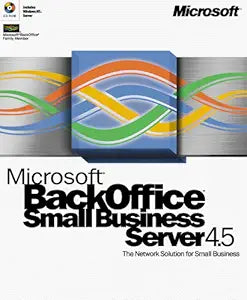
Microsoft 723-00339 Backoffice SBS 4.5 (5-client) Server

5.0 (1 reviews)

An integrated five-client server bundle that delivered domain management, email, and shared printing to small businesses in a single install.

Check availability
Affiliate Disclosure: Studio Supplies may earn a commission from qualifying purchases made through links on this page, at no additional cost to you. This helps support our editorial team.

Notice a mistake? Let Us Know

Overview

Microsoft BackOffice Small Business Server 4.5 was a late-1990s integrated server suite designed to bring enterprise-class network infrastructure within reach of businesses with 50 or fewer workstations — and this 5-client edition targeted the smallest end of that market. The bundle unified Windows NT Server 4.0, Exchange Server 5.5 for email, SQL Server 7.0 for database workloads, IIS for intranet hosting, and Proxy Server 2.0 for shared internet access into a single installation package. In its era, that consolidation represented a meaningful reduction in licensing complexity and administrative overhead for small businesses that lacked dedicated IT staff.

From a technical standpoint, this is exclusively a legacy or archival product in 2024. Every component application within SBS 4.5 reached end-of-support status between 2002 and 2004, meaning no security updates have been issued for over two decades. The 32-bit NT 4.0 foundation is incompatible with modern server hardware without significant virtualization workarounds, and the 5-client CAL limit is a hard ceiling baked into the license. This product is of interest to IT historians, legacy lab enthusiasts, and vintage software collectors — it has no recommended path to production use on any live network.

Specifications

Product Name
Backoffice SBS 4.5 Server
Client Licenses
5-client

Pros & Cons

👍 Pros

  • The all-in-one bundle approach — email, domain services, database, proxy, and shared printing in a single install — reduced the complexity and cost of standing up a small business network in its era significantly.
  • A 5-client license provided a low-cost entry point for very small businesses that only needed a handful of connected workstations, avoiding the cost of full open-license server editions.
  • SQL Server 7.0 inclusion gave small businesses access to a relational database engine without a separate licensing purchase — a genuine cost advantage for line-of-business applications of the period.
  • The integrated management console simplified server administration for non-specialist IT staff, centralizing tasks that would otherwise require navigating multiple separate administrative interfaces.

👎 Cons

  • All component software in this bundle — Windows NT 4.0, Exchange 5.5, SQL Server 7.0 — reached end-of-life status over 20 years ago and receives no security patches; deployment on a live network is not advisable.
  • The 5-client CAL ceiling is a hard architectural limit, making this version unsuitable for any organization with more than five workstations regardless of server hardware.
  • SBS 4.5 is strictly 32-bit and incompatible with modern hardware without a legacy virtualization environment; getting it running today requires significant technical effort.
  • Physical media from this era degrades over time — optical discs may have become unreadable, and finding replacement installation media for a 1999-era product is increasingly difficult.

Frequently Asked Questions

This edition is licensed for 5 client workstations. Microsoft BackOffice SBS 4.5 enforced client access license (CAL) limits at the server level — exceeding 5 connected clients requires upgrading to a higher-CAL edition or a different server platform entirely.
SBS 4.5 bundled Windows NT Server 4.0, Exchange Server 5.5, IIS, Proxy Server 2.0, SQL Server 7.0, and shared fax/modem services into a single integrated package. It was designed so a small business could run all core server functions on one physical machine.
No — Microsoft ended all support for BackOffice SBS 4.5 and its component applications (Windows NT 4.0, Exchange 5.5) well over a decade ago. Running this in a production environment presents significant security risks due to unpatched vulnerabilities. It is suitable only for legacy lab or archival purposes.
SBS 4.5 was designed for the hardware standards of the late 1990s. It required a Pentium-class x86 processor, minimum 128MB RAM (with more recommended for multi-user use), and supported a maximum of 50 workstations — though this 5-client edition imposed a lower limit at the license layer.
No — BackOffice SBS 4.5 is built on Windows NT 4.0, a 32-bit operating system. It is incompatible with modern 64-bit hardware in standard configurations and cannot be installed on current server operating systems. Running it requires period-appropriate hardware or a compatible virtualization environment.